|
|
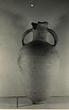
| Lower half only preserved. Bottom rounded; body ribbed.
Orange clay with black particles. Previously North Basement-Jar Fragments, Block XIIIA. Well, containers 7 and 8 (plus fragments from containers ... 2 April 1937 |
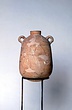
| Foot and fragments of body missing; restored in plaster. Body and neck ribbed; handle ridge below lip; rising ridged handles.
Clay a rather gritty orange-brown.
Type noted as S. Phoenician (Akko-Tyre ... 2 April 1937 |
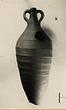
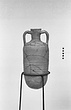
| Body with fragments missing, preserved up to shoulder. Bottom pointed; elongated ovoid body, lower part plain. Horizontal grooves on upper part of body.
On shoulder, part of red dipinto preserved:
Brownish-red ... 2 April 1937 |
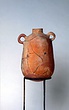
| Fragment of mouth missing; otherwise intact, save minor fractures. Low curving foot; egg-shaped body tapering towards bottom; neck bulges slightly; thickened projecting lip; band handles, from neck to ... May 1938 |
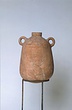
| Lip, one handle and foot missing; filling hole broken in shoulder. Partly restored in plaster, lacking foot. Fusiform, wheel-ridged jar; two handles.
Reddish-brown micaceous clay.
A coating of mastic ... 1937 |
| Numerous fragments of body missing; restored in plaster.
Bottom rounded with projecting knob; rather full pear-shaped body with point of greatest diameter quite low; shoulder slopes to short neck; rolled ... May 1938 |
| Mouth, one handle and stubs of other, and one side of body down to curve for bottom, preserved.
Shape, decoration and fabric as P 11556 (Φ 489). Well, most fragments from containers 11, 12, 13 (but some ... 2 April 1937 |
| Lip chipped; small hole in shoulder; otherwise intact. Body tapers to very small ribbed foot; narrow neck and mouth, thickened at the lip. Groove on neck at shoulder attachment.
Coarse brown clay. Well ... 2 April 1937 |
| Fragment broken all around; also a small hole [Max. Dim. 0.15]; probably from the shoulder of a large closed pot. Ribbed.
Incised: Κ Α Λ
Unglazed.
ADDENDA Many more pieces added; restored in plaster ... 2 April 1937 |
| Fragments of body missing; restored in plaster. Rounded bottom; more or less cylindrical body with irregular horizontal ribbing; rolled lip; roughly ridged handles from below lip.
On shoulder, three red ... May 1938 |
| Part of one handle and fragments of body missing; restored in plaster. Broad round bottom; low straight neck; two vertical ring handles. Ribbing on body, most prominent above and below.
Decoration in ... 2 April 1937 |
It may perhaps be assumed that in the 5th c. the Romans cleaned the well to 25.30m., thus removing 2nd c. and subsequent fill, and then began to reuse the shaft. Coins
20 May 1938 #6
21 May 1938 #1
25 ... POU 1st c. and 5th-6th c. A.D. |
| Robinson, H. S ... American School of Classical Studies at Athens ... A group of closed deposits, ranging in date from the 1st century B.C. to the early 7th century A.D., provide evidence for the relative and absolute chronology of pottery used during many centuries of Roman ... 1959 |
|
|