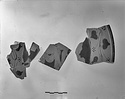
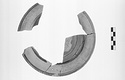
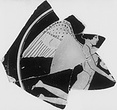
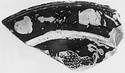
|
|
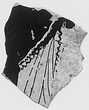
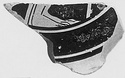
| From a plate with low ring foot; resting surface reserved. In preserved part of interior medallion, a draped woman right, her long tresses undulating down her back. Time of Sotades? Surface. Leica ... 28 February 1935 |
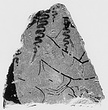
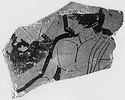
| The heavy fabric and low plain foot ring suggest a plate rather than a stemless cup. Reserved line, with pink wash, at junction of foot and body. Fragment depicts youth seated, right (Dionysos?), missing ... 1933 |
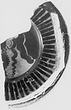
| Single fragment preserves about one-third of the base to near center of floor. Disk foot, slightly concave beneath; outer edge rounded. The center of the floor is depressed. In the raised area around the ... August 1961 |
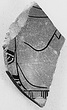
| Fragment from the floor of a stemless cup; low flat base, reserved beneath. Part of a nude figure seated on a couch and reclining against cushions. Published as plate fragment (PK). Found going through ... 1949 |
| From a plate(?) on a low ring foot. Inside, pair of feet right, with the end of a staff in front of them. Outside and inside, upturned wall, above foot, unglazed and finished with a fine polished surface; ... 1936 |
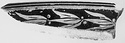
| Small rim fragment. Around the floor a band of myrtle in red figure. Rest of surface covered with rich black glaze, worn. Catalogued August 1967. Disturbed context. 1874 Leica ... 1931 |
| Small fragment from the rim of a very large plate. Low upcurved wall, finished with a thickened rim flat on top and double-grooved, the ridges between the grooves reserved and washed with pink. On the ... 30 April-10 May 1939 |
| The fragment is from near the edge of the lid; the vertical flange which fitted into the box, and the projecting horizontal flange, have broken away but can be traced. The surface of the fragment is very ... 10 March 1932 |
| Three fragments, one from the center, the other from further out, with parts of rim and floor from a large plate. Ring foot; broad rim convex on top, with groove on outer edge; flat floor.
Preserved on ... 10 March 1937 |
| Six fragments join to form about half the rim; a seventh fragment, from the rim, does not join. Flat bottom, reserved, with a band of glaze around its outer edge this band separated from the glazed undersurface ... August-September 1932 |
| Mended from two pieces; from the floor of a plate. Nude youth, apparently winged, standing right, his arms outstretched. No relief contour.
Additional fragments give left side of the medallion with Eros's ... 30 April 1947 |
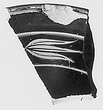
| Fragment from rim and floor; nothing of foot preserved. Rim rounded on top, with two grooves at the edge. Beneath, the rim set off by a groove; the wall below marked by pairs of grooves and ridges.
Above, ... May-June 1949 |
Well in the industrial area west of the Areopagus.
A flask-shaped cistern in House H with a dumped fill of the late fifth century brought from elsewhere and evidently deposited sometime in the 3rd c. B.C ... Ca. 420-400 B.C. |
An unfinished well in the northwest room of the Poros Building, west of the Areopagus. Dumped filling. Chips from marble-working, variety of plain and figured wares ... Ca. 400-385 B.C. |
Well at 69/ΟΒ (Late 5th c.)
Lower fill dated to 420-400 B.C. in Agora XXX.
There were no use filling and the well was apparently not a success as a water-supply: there was no concentration of water-jars ... 420-400 B.C. |
| Pit (6x10) in the valley between the Areopagus and the Hill of the Nymphs. Large cutting in bedrock with 540 ostraka, mainly of the late eighties of the 5th. c. B. C. Much pottery, principally of the early ... Ca. 500-450 B.C. |
| A cave-in not long after the digging of this shaft destroyed its possible usefulness as a well and thereafter it was used as a dump. Two principle periods of such use were noted, and within these several ... Ca. 575-480 B.C. |
| Moore, M. B ... American School of Classical Studies at Athens ... This volume presents the inventoried red-figure and white-ground pottery found in the Agora Excavations between 1931 and 1967. Although many of these vases have already been published in various reports ... 1997 |
|
|