|
|
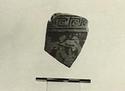
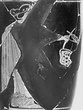
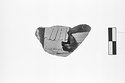
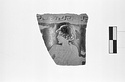
| Fragment from upper wall. Head of a youth, looking left, below a maeander border. He appears to wear a cap. No relief contour.
Glaze fired red. Cut along east wall of East Building ca. 13.50m. to 17.50m ... 23 June 1967 |
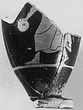
| Half of lower body, foot missing.
Woman running toward laver. No relief contour. North of Stoa, red earth filling. Box 296. Leica ... 1939 |
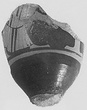
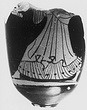
| Neck, mouth and most of handle missing; foot chipped.
Boy in himation running right, looking back left. Above scene, single maeander; below, reserved line. On reserved shoulder, four linked palmettes ... 10 November 1955 |
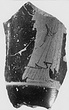
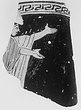
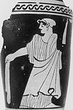
| Fragment from red figured lekythos, preserving lower part of standing draped figure, right. 92-93/*
B 20 Early cutting beneath Great drain, green sand. 3511 Leica ... 8 June 1946 |
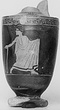
| Preserved to shoulder with many pieces missing. Black figure palmettes on shoulder; maeander at top of body just below. On the front of the body a standing draped female figure right, holding out a lyre; ... 24 April-13 June 1947 |
| Preserved to half way up the body; most of the foot chipped away. Lower part of draped figure striding left with phiale in his hand. Ostrakon fill. 7550 Leica ... 24 April-13 June 1947 |
| Foot and upper half of body missing; small lekythos. Woman preserved to waist, running left, holding in the right hand oblong banded object. She wears chiton and himation. Reserved ground line.
No relief ... 28 May 1951 |
| Fragment from side of a lekythos. Band of simple maeander at top. Part of a draped woman, wearing chiton and himation and facing right with outstretched hands, from each of which hangs a wreath, painted ... 16-19 March 1935 |
| Preserved is lower part of draped female figure facing left. In front of her is the upper part of a large basket; behind her, the leg of a chair or bench. Inner markings in relief line: the vertical folds ... March 1934 |
| A single fragment preserves part of side of a lekythos near the top. A youth, cloak thrown over his shoulder, advances right, looking behind him. Above, a maeander pattern. Surface fill. Fauvel Collection ... 5 March 1935 |
| A single fragment preserves most of the body; neck and handle, with nearly all of shoulder and part of wall at back, missing. Traces of rays on reserved shoulder; on wall, upper border of S-pattern between ... 27 May 1939 |
| Handle and neck missing. On front, draped youth right, leaning on his staff. To each side of him a stele, on which is written in black letters running vertically, ΚΑΛΟΣ. Shoulder reserved with two rows ... 16 April 1935 |
| Shoulder and foot missing. Body glazed black. On reserved ground line: an owl, right, head front. In front, olive branch. No contours. The spots on the bird's wing run to brown. Double row of diagonal ... 12 April 1935 |
Deposit of fine table ware and lekythoi, both black-figured and red; the plain wares closely resemble those from the well H 6:5 ... 470-450 B.C. |
Dumped debris filling east of East Building, badly shattered. There is a small amount of disturbance from the filling immediately above, but the bulk of the pottery is consistent, and very close to that ... Ca. 470-460 B.C. |
Pottery Deposit at 57/ΙΔ (also 57/ΙΣΤ and 63-66/Κ-ΚΕ). Contents of pit range from Mycenaean to Turkish; apparently the dump of a modern antiquities dealer ... Modern Context |
Carefully cut in bedrock with firm footholds on either side. The use filling is represented by a few fragments of water jars (uninventoried), indicating a short period of use. The dumped filling, below ... Ca. 470-425 B.C. |
"Fauvel Collection"
Collector's dump? Debris in the cellar of a modern house, probably once that of F.S. Fauvel.
The collection included vases of all periods, from Geometric to Turkish; a number of the ... Modern Context |
Dumped filling in a well on the west slope of the Areopagus (apparently separate, no mends between them, but differing little in date) the bottom filling apparently thrown in towards the beginning of the ... Ca. 425-400 B.C. and earlier |
Well at 45/Θ (Skytha Well) near the north side of the market square. No period of use was distinguished, since it was impossible to clear the well to the bottom. The considerable quantity of dumped filling ... Ca. 460-440 B.C. |
|
|