|
|
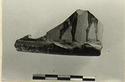
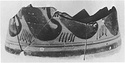
Fragment of floor and side of a small flat-bottomed pot with projecting lower edge, levelled below, rounded above. Wall slopes sharply inward. A large hole, pierced before firing, passes through the wall ... (1955) |
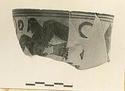
Two non joining fragments of a tall, concave-sided pyxis. Purple and glaze bands above and below; around the body a procession of lions and ostriches to right. Added purple; no incision; large dots in ... 21 June 1939 |
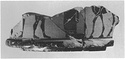
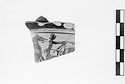
| Fragment from base and lower wall. Low base and side wall, slightly inclined inward. Around the lower wall a frieze of which there remain parts of a mounted horseman, in front of him and facing him one ... 16 March 1938 |
Four joining fragments preserve part of plain rim and vertical wall; strengthened with plaster.
Three bands of glaze below rim. Siren, left, and part of panther right. Incised rosettes. Band of glaze ... 16 July 1952 |
a) The pyxis resembles a kalathos: flat bottom, concave sides; small ribbon handles at lip. Unglazed beneath. Inside, glazed and reserved bands alternating. Two broad red horizontal bands on outside; other ... 5 February 1935 |
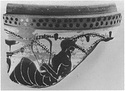
| Rim and wall fragment. Inset flange, painted red. Border of dots above scene.
Draped, wreathed, bearded figure, reclining left, holding a lyre; looking right. At left edge of fragment, part of the drapery ... May-June 1954 |
| Fragment from upper wall with part of sharply triangular lip and start of vertical flange. A fine ridge at junction of lip and wall. In center, a charioteer, bearded, to right, his outstretched hands hold ... 19-27 May 1937 |
| [Originally identified as a lid.]
The upper part fragmentary. Top surface unglazed; on the wall, a broad and two narrow bands; then a zone of swans, reversed, with groups of strokes between.
Inside unglazed ... 5 May 1950 |
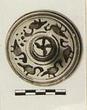
| The top has no knob, but a heavy overhanging rim, and is unevenly flat. Straight, very thin sides. In black: on top, in concentric bands from center out: a circle, row of dots, circle, dots, large irregular ... March 1934 |
Rodney S. Young ... Grave 1 in notebook. Slightly disturbed by the digging of Pit A.
A large oil jar/amphora lay on its side with a flat stone stopping its mouth. The three small vases offered at the burial were found, together ... Ca. 600 B.C. |
Well at 115/ΜΘ.
Careful stone curbing around the upper walls, the presence of footholds in the sides, an adequate water supply and the fragments of a terracotta well-head in the filling indicate that the ... 600-550 B.C. |
| Lid intact save for chip at edge. Straight wall and very slightly convex top, projecting a little beyond the wall and grooved near the edge. On top, a bird with spread wings, no incision; black glaze on ... 25 April 1940 |
| Grave XXVI in notebook = RSY Grave 12 ... Ca. 525-500 B.C. or sightly later |
Well East of Stoa Room 6 (well with Siana Cup); scanty dumped filling.
No water. Well never used. Estimated Grid ... 600-550 B.C. |
Well I: archaic. On the northwest slope of the Acropolis below the Klepsydra. Diameter ca. 1.10m. Water level ca. -9.50m. Substantial use filling in the lower 0.75m. In the upper debris filling both the ... End of 6th c. B.C. - Early Byzantine |
Pottery Deposit at 57/ΙΔ (also 57/ΙΣΤ and 63-66/Κ-ΚΕ). Contents of pit range from Mycenaean to Turkish; apparently the dump of a modern antiquities dealer ... Modern Context |
| Well below Stoa Gutter opposite Pier 1.
Heavy dumped filling remarkable among Agora well-deposits both for the high quality and the good conditions of pottery of all sorts.
It represents the stock of a ... Ca. 520-490 B.C. |
| Moore, M. B. Philippides, M. Z. P ... American School of Classical Studies at Athens ... This volume is the first of the Athenian Agora reports to deal specifically with figured wares; it is concerned with the black-figured pottery found in the excavations in the Athenian Agora between 1931 ... 1986 |
|
|