|
|
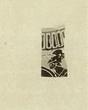
| Below tongue pattern, upper part of armed warrior, left. Inside glazed with irregular reserved band center.
Glaze streaky brown. Green earth. Leica ... 24 March 1932 |
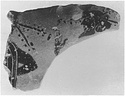
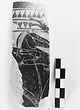
| Wall fragment from a large open pot; column krater?
Part of charioteer, mounting chariot, to right; rail, wheel, pole and tail of one horse remain. Uncertain objects at left.
A little of the white of ... 17 April 1951 |
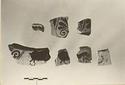
| Six non-joining rim and handle-plate fragments.
On rim, pigs and lions; on handle-plates, palmettes. On vertical face of rim, two series of ivy leaves divided by a line.
Pinkish-buff clay; glaze unevenly ... 1 May 1953 |
| Fragment from shoulder of a small open vase, black glazed inside to near top of fragment. On the right, the head of a bearded man to left, his right hand raised in front of him; on the left, the arm and ... 14 March 1938 |
| From a badly burned column krater. Along one edge, bordering a panel, vertical ivy pattern. The edge of the scene of the panel is too fragmentary to be adequately explained; there are traces of added red ... 26 February 1935 |
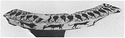
| Three shoulder fragments and one from farther down, much mended. Decoration in a panel, bordered at sides by dots between vertical bands; above, tongue pattern.
Fragments from left: a) Woman in chiton ... 23 March 1935 |
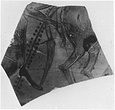
| From a large open pot, glazed inside. The back end of a horse, right, followed by a maenad dancing; one leg of a nude male figure seated on the rump of the horse is preserved. Tendril in field. Return ... 6 May 1935 |
| About a quarter of the circumference of the rim preserved. A bit of the horizontal part of the handle preserved at one end. Mended from three pieces. On the flat top of the rim, a chain of lotus buds, ... August-September 1932 |
| Glazed inside. Along the right edge of the panel, ivy. Two horses facing right, heads and chests preserved. Red for manes, white for teeth and dots on harness.
Pink clay, orange surface. 6th. and 5th ... 22 February 1935 |
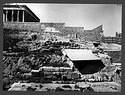
Well by Stoa Pier 8.
Mouth of well discovered in 1950 (p. 2287).
Dumped filling in the 4th c. B.C. but the bulk of the material of the 5th c. B.C. Fill contained much wood, bones, Mycenaean, Geometric, ... 5th c. B.C. |
Green Earth at 03-04-05/ΚΑ-ΚΔ, to at least -3.50m. near the southwest corner of the market square. Terracotta figurines; lamps; fragmentary pottery ... Ca. 500-475 B.C. and later |
| Well A, early 5th c. B.C. Near the Agora Boundary Stone, northwest corner of Middle Stoa; diameter at top 0.92m, widening to 1.15m and more below. Shaft neatly faced with stones to a depth of 0.70m below ... Ca. 520-480 B.C. |
Fillings in and to the north of Building A/Poros Building/Greek Building ("Strategeion"), the accumulation mostly a late archaic dump, but not deposited till near the middle of the century. Most of the ... First half of 5th c. to ca. 460-450 B.C. |
| A cave-in not long after the digging of this shaft destroyed its possible usefulness as a well and thereafter it was used as a dump. Two principle periods of such use were noted, and within these several ... Ca. 575-480 B.C. |
| Moore, M. B. Philippides, M. Z. P ... American School of Classical Studies at Athens ... This volume is the first of the Athenian Agora reports to deal specifically with figured wares; it is concerned with the black-figured pottery found in the excavations in the Athenian Agora between 1931 ... 1986 |
|
|