|
|
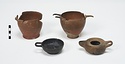
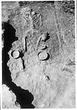
Grave (?) under wall 4. Infant burial(?); a kados, P 16747, lying sideways with a tall cylindrical stand, P 16748, set over it as a cover; the upper parts of the pots cut away ... Late 6th. c. B.C. |
Pits in area 96-100/ΝΕ-ΝΘ (lower east slopes of Hill of the Nymphs, near extreme west edge of excavated area).
Shallow pit in bedrock against N. face of wall. dMax. depth 0.20m.d.
Many fills in areas ... Ca. 325-300 B.C. |
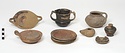
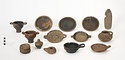
| A compact group of four complete vases and a lamp, found on a house floor; possibly the remains of a sacrificial pyre but without evidence of burning or the characteristic votive vases.
Layer II, "nest ... 425-400 B.C. |
Pits in area 96-100/ΝΕ-ΝΘ (lower east slopes of Hill of the Nymphs, near extreme west edge of excavated area).
Scanty debris filling in a pit. Many fills in areas A 19 and A 20 similar in character to ... 325-300 B.C. |
Small deposit including red figured fragments ... Second and third quarters of 4th c. B.C. |
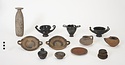
Scanty debris filling in a pit. The wishbone-handled bowl (P 16753) is of the middle of the third quarter of the 5th. c. century, as are also two red figured fragments, P 25820 and P 25821; the deposit ... Ca. 450-400 B.C. |
| Grave XXVI in notebook = RSY Grave 12 ... Ca. 525-500 B.C. or sightly later |
| Burned deposit: Middle Terrace, south of Archaic cemetery.
RSY: Pyre 10.
Pottery, burnt bone, charred logs, and heavy burning, recovered by tunneling under the cement floor of a Late Hellenistic workshop, ... Ca. 325-300 B.C. |
Fills from construction and reconstruction of a house. "Brown House" = House A (RSY Hesp. 20) (and pit under Layer 4) in the industrial area west of the Areopagus.
Under the original floor of this house ... Second half of the 5th. c. B.C. |
| (RSY=Pyre 2). Pyre in the industrial area west of the Areopagus, in House B. In northern corner of room. No pit discerned. A deposit of small stones (a marker/) lay 0.30m above the level of the pyre, ... Third quarter of the 4th. century. |
| Pyre in House C, Room 8 (RSY=Pyre 6).
Near east corner of room 8. Artifacts, burnt bone, burnt sticks, and large cinders in a shallow pit dug into surface of layer 3, and covered by layer 2. Some cinders ... 350-325 B.C.-end of 4th c. B.C. |
Green Earth at 03-04-05/ΚΑ-ΚΔ, to at least -3.50m. near the southwest corner of the market square. Terracotta figurines; lamps; fragmentary pottery ... Ca. 500-475 B.C. and later |
Well. Construction, use and dumped fillings of the Hellenistic period. Tile-lined well with a packing of jars behind the tiles; the well cut through (Fill 4) the passage of a cistern (B 21:25). At 9.00m ... Hellenistic |
Early cutting beside Great Drain: 103-111/Λ-ΛΓ (= "Deep cutting" Pit at 107/ΛΑ).
Abandonment filling in channel for early drain; the fragment of a red figured bell krater, P 17000, probably to be dated ... Ca. 425-395 B.C. |
Filling in a cistern chamber in the area west of the Areopagus. Main dumped fill of 2nd. c. B.C., with small amount of later material in uppermost 1.00m. A connecting passage contained some material of ... 2nd. c. B.C. |
Fillings to either side of the Great Drain, in the southern part of the area west of the Areopagus; various levels, late 6th. and early 5th c. B.C. to Sullan destruction. Coins:
26 July 1946 #1-#2
30 July ... Late 6th. c. B.C.-1st. c. A.D. |
7th c. well below east part of Odeion Cavea Trench K). Use filling negligible; dumped filling of the second half of the 7th c. B.C.
Brann Well H. Diameter 1.10m. Cut into bedrock. During excavation seepage ... 650-600 B.C. |
Accumulated fillings in a system of underground drains at west end of section ΔΔ with northward continuation into and across Section Υ.
The filling in the "underground passages" in section ΔΔ appears to ... 3rd c. B.C.
2nd c A.D. |
| Thamneus' Cellar, a storage cellar on the north slope of the Areopagus. Lower filling of mid-6th c. B.C., upper filling of last quarter of 6th c. B.C ... 6th c. B.C. |
|
|