|
|
Foundry pit and shop.
Now Deposit E 2:3. Asterisk: F 2:1* |
| a) Preserves part of upper wall with a trace of the concave curve of the neck. The head of a man wearing a broad dark purple fillet with hanging ends. He has a full beard and in front of his head appear ... Late 5th c. B.C. |
Preserved, about one-fifth of the upper body, with one handle. Shallow bottom, probably on flaring short stand, and high flaring, slightly concave side wall. Inside, black glaze with six pairs of added ... 16 March-3 April 1935 |
Rectangular pit over bedrock in north part of E. Building. Broken jars and household basins with a few black glazed and black-figured fragments (uninventoried). The figured pieces indicate the lower limit ... Late 6th-ca. 480 B.C. |
| Lower part preserved. Low ring foot. Decoration on front only: egg and dart ground line, on which preserved, left, a rectangular object; right, a wool basket.
Four joining pieces added from tins give both ... 21 March-16 April 1935 |
Disturbed burial set into a cutting in hardpan. No lot ... 2nd half of 5th c. B.C. |
The almost complete red figure hydria set into this cutting suggests the possibility of a 5th c. burial put into a much earlier grave cutting; however, the remainder of the filling appears thoroughly disturbed ... 450-425 B.C- Late Roman disturbance |
| From a closed pot (squat small amphora?).
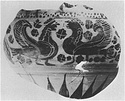
Below, rays. Frieze of animals: preserved, two sirens facing; in field, incised rosettes. Above, double line of dots separating it from next frieze. Added purple ... 27 March 1935 |
| Lid glazed black inside with red bands. Outside, part of three bands: above, palmette band; middle, tongue pattern alternating red and black; outer band, part of Herakles wrestling with Triton (both right) ... 19 March 1935 |
| Crevice in Rock (Grave?) at 70/ΝΣΤ (below modern surface accumulation).
Identified as a sacrificial pyre, with characteristic banded plates and saucers, by SIR ... 4th c. B.C./300-250 B.C. |
Cutting in stereo. Early 4th c. fill with some Hellenistic-Early Roman disturbance ... Ca. 400-375 B.C. |
Scanty dumped filling in an abandoned well cutting ... Ca. 425-420 B.C. |
Pit on north slope of Kolonos Agoraios. Traces of burning in the dirt fill; mixed in with this many fragments of fine pottery ... Ca. 450-420 B.C. |
N-S Cut on 20m. line (area of Road, area of Stoa, area N of Stoa)
various levels and dates over the three areas.
Investigations to the northwest of the market square in the area of the road that bordered ... Protogeometric to Late Roman |
| Base intact; lip, neck, shoulder and handles largely complete; lower body fragmentary. Restored in plaster. Shape: late variety of amphora, type B.
A) Charioteer in long chiton driving a team of four horses, ... Ca. 440-430 B.C. |
Small compact deposit. Cutting. High proportion of good black glaze; 21 loom weights (19 pyramidal, 2 lentoid); a very large red-figured skyphos somewhat recalls the style of earlier work of the Dinos ... Ca. 430-420 B.C. |
Lower levels of cistern to N. of House of Greek Mosaic.
Connected by tunnel to another chamber that was apparently cleared by Wilhelm Dorpefeld in the 19th c. Roman fill in mouth. Coins:
6 July 1964 # ... Ca. 325-290 B.C. |
North and South Rectangular Stereo-cut Rubbish Pits. These two adjacent rock-cut pits, of uncertain original purpose, were filled with deposits of rubbish evidently contemporary and probably dumped simultaneously, ... Second half of 5th c. B.C. |
Located in the NE corner of the early peribolos. Probably originally 1.00-1.50m. deeper, the bedrock above having been cut back in late times. Scanty pottery remains; some evidence for a period of use ... Ca. 600-570 B.C. |
Well A (depth 10.20m, diameter 1.04m, water level 4m) outside the SW corner of the market square, to the east of the north-south road.
At the bottom of the well were scanty remains probably from a period ... Ca. 425-375 B.C. |
| Grave V, under room 18 in House 3, plus burned deposit at 94/IΘ. Identified as sacrificial pyre by SIR on Agoraios Kolonos:
In southeast corner of house 3. 35 artifacts, bone and charred material in pit, ... Ca. 300-275 B.C. |
See cistern system wells F 11:2 and F 12:3, part of Tholos water system. Estimated Grid ... Ca. 350-294 B.C. |
Possibly a short period of use but chiefly a debris filling including a number of fragments from disturbed early burials. Two pot fragments, believed to be from lower body of P 18525, added from Well 3 ... Ca. 575-550 B.C. |
Exploration of area of small early house walls on the NW slopes of Areopagus. Considerable deposits of late 6th-early 5th c. B.C., but some later (all periods) and some early levels, disturbed.
Objects ... Late 6th-Early 5th c. B.C. |
N-S Cut on 50m. line (area of Road, area of Stoa, area N of Stoa) various levels and dates over the three areas.
Investigations to the northwest of the market square in the area of the road running out ... Prehistoric to Roman |
Fillings below the courtyard floor of the Poros Enclosure west of the Areopagus. The lowest layer, over bedrock, is of the archaic period and may have accumulated on the spot before the start of building ... First half of 5th c. B.C. |
Evidence of stratification into five layers, although joins between the layers. Layer VI added when the construction of the Roman building above required it. No subdivisions assigned.
Flask-shaped cistern ... Early 3rd-late 2nd c. B.C. |
Associated with the Tholos.
Originally a well but after it had been in use for a short time the shaft was partially filled in and the upper part widened to form a large cistern.
The pottery falls into ... 335-250 B.C. |
A well (diameter 1.10m) at the east edge of the valley road leading from the SW corner of the Agora, about 90m SW of the Tholos. The mouth of the well was subsequently covered by the east wall of the Great ... Ca. 500-480 B.C. |
"Foundry Pit": N-S Cut on 50m. line (area of Stoa, Layer VII, with slag). A foundry pit in the courtyard of a small metalworking establishment outside the Agora to the northwest.
Both the courtyard and ... Ca. 375-350 B.C. |
Near the SW corner of the market square beneath the north part of the Heliaia (?).
No clear distinction in the filling, either of date or of character, could be observed but the presence of a number of ... Ca. 625-570 B.C. |
Unfinished well cut in bedrock to the southwest of the Tholos; dumped filling containing much material of the 7th c. B.C. but extending into the 6th ... 7th-ca. 570 B.C. |
Tiled well near the SW corner of the market square between the Southwest Fountain House and the Great Drain, three fills noted: lower fill of earth and stones with a few fragments only of coarse pottery ... 4th-2nd c. B.C.
100-70 B.C. |
Well near southwest corner of market square; successive use fillings, and dumped filling.
Lower use filling, second half of 4th century B.C.
Main use filling, second quarter of 2nd century B.C. to shortly ... 10 April-31 May 1935 |
Well associated with the Tholos, with scanty use fill but primarily dumped filling. Coins:
5 April 1934 #1-#4
10 April 1934 #1-#2
11 April 1934 #1
12 April 1934 #1
18 April 1934 #1-#2
19 April 1934 #1-#5 ... Ca. 350-294 B.C. |
Fillings in and to the north of Building A/Poros Building/Greek Building ("Strategeion"), the accumulation mostly a late archaic dump, but not deposited till near the middle of the century. Most of the ... First half of 5th c. to ca. 460-450 B.C. |
| Sparkes, B. A. Tallcott, L ... American School of Classical Studies at Athens ... This massive (two-part) volume focuses on pottery produced between 600 and 300 B.C. with Sparkes discussing the black glaze and Talcott the domestic (household and kitchen) wares of the period. Over 2,040 ... 1970 |
|
|