|
|
| Sacrificial pyre, disturbed; a small pyxis (P 14864) is close to that from B 18:4. First half of 4th. c. B.C., perhaps first quarter.
West of House C. Pottery and cinders in pit in stratum. The pyre was ... First half 4th. c. B.C. |
Pits in area 96-100/ΝΕ-ΝΘ (lower east slopes of Hill of the Nymphs, near extreme west edge of excavated area).
Shallow pit in bedrock against N. face of wall. dMax. depth 0.20m.d.
Many fills in areas ... Ca. 325-300 B.C. |
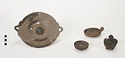
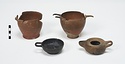
| A compact group of four complete vases and a lamp, found on a house floor; possibly the remains of a sacrificial pyre but without evidence of burning or the characteristic votive vases.
Layer II, "nest ... 425-400 B.C. |
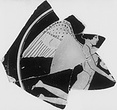
| Mended from two pieces; from the floor of a plate. Nude youth, apparently winged, standing right, his arms outstretched. No relief contour.
Additional fragments give left side of the medallion with Eros's ... 30 April 1947 |
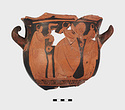
| Many joining fragments give much of the reverse; one rim fragment does not join. Three cloaked figures, those at left and right facing the center, that at center facing right. A stele between the central ... 27 April 1940 |
Pits in area 96-100/ΝΕ-ΝΘ (lower east slopes of Hill of the Nymphs, near extreme west edge of excavated area).
Scanty debris filling in a pit. Many fills in areas A 19 and A 20 similar in character to ... 325-300 B.C. |
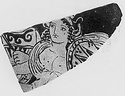
| From the wall of a small closed pot with thin glaze wash on the lower part inside; probably an oinochoe. Upper part of a youthful figure, wearing an elaborate helmet with turned back cheek pieces, a flying ... 29 April 1947 |
Scanty debris filling in a pit. The wishbone-handled bowl (P 16753) is of the middle of the third quarter of the 5th. c. century, as are also two red figured fragments, P 25820 and P 25821; the deposit ... Ca. 450-400 B.C. |
|
|