|
|
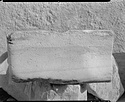
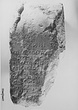
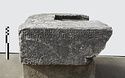
| Inscribed base.
A rectangular base, fully preserved, with a cutting in the top surface, presumably the bedding for a Herm.
The front inscribed surface, which was used as a bench, badly worn.
Records victory ... 4th. century B.C. |
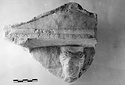
| Inscribed fragment of Herm.
Part of front and apparently a little of right surface preserved, though this latter carelessly worked.
Near the right edge two wavy tresses.
Below, left, inscribed.
Honorary ... 1931 |
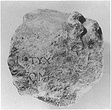
| Inscribed fragments of base. From a circular monument.
Fragment ΟΑ 260 a), inscribed face only preserved.
Above the smooth dressed inscribed band, the stone is pick-dressed. Below, the face makes an oblique ... a) (ΟΑ 260) 20 April 1938
b) (ΖΖ 42) 5 April 1939 |
| Inscribed Herm.
Only the right shoulder and chest remain. The original thickness is preserved.
The sides are carefully dressed, with trace of mortise for arms. The end of a lock of hair remains on the ... 210 A.D. |
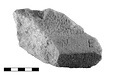
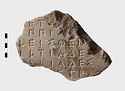
| Inscribed fragment.
Inscribed face and original top preserved.
Copy of Marathon Epigram I.
Four lines of the inscription preserved.
Pentelic marble. Αντίγραφο επιγράμματος 4ου π.Χ. αιώνα. Η επιγραφή απλώνεται ... Ca. late 4th. century B.C. |
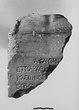
| Fragment from an inscribed Herm.
Broken at top, right side, back and bottom.
Part of the chest, and a strand of hair left preserved.
Part of eleven lines of the inscription preserved.
Pentelic marble ... Ca. 166/7 A.D. |
| Inscribed fragment.
Only the upper left hand part remains.
A stele with gabled top, the mid-part of its front deeply cut back to hold the relief; a figure of the Mother seated on her throne, facing front ... 4th. century B.C. |
| Inscribed fragment.
Inscribed face, left side and back preserved.
Nineteen lines of the inscription preserved; stoichedon.
Space between lines, five including: ca. 0.052m.
Space between letters, five including: ... Before 321/0 B.C. |
| Inscribed base.
Left side hacked off and reworked, and face much chipped.
A rectangular cutting, rough picked, inside top, its dimensions ca. 0.27X 0.222 X 0.065m. deep.
Front and right faces smoothly ... 2 June 1938 |
| Inscribed fragment.
Inscribed face only preserved.
Archon list (?).
Six lines of the inscription preserved; stoichedon.
Pentelic marble. Τμήμα μαρμάρινης στήλης με κατάλογο Αθηναίων Αρχόντων των ετών: ... 5th. century B.C. |
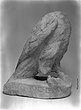
| Inscribed fragment.
Head missing, and part of right leg; minor fractures.
The eagle is standing, his left foot advanced. Feathers carved in shallow but naturalistic style. In bottom surface of plinth, ... (ΙΙ 430) 9 May 1938
(ΘΘ 296) 21 May 1938 |
| Inscribed fragment of statue base.
Base for a bronze statue of a standing figure with right foot advanced.
Broken below at left. Much of back missing, but joining fragments give some of back surface. Most ... 13 May 1952 |
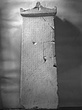
| Inscribed stele.
Pedimental stele mended from seven pieces. Small fragments missing.
Back rough. Setting for socket visible at bottom.
Wreath below the inscription.
Honorary decree of Aiantis, in praise ... 326 B.C. |
| Inscribed grave stele.
A great stele, broken off at the top. Back and sides finished smooth. Two fine drafted lines run vertically down each side of the front face, near the edge, to 0.082m. from the bottom, ... 6th. century B.C. |
| Inscribed base.
Broken off at right. All faces preserved smoothly dressed. A large rectangular cutting in the top, rough picked inside.
Archaistic dedication in elegiacs to Deo by her attendant, Lysistrata ... Ca. 455 B.C. |
| Inscribed statue base.
About the three exposed sides a band was left undressed around the bottom, and this projects ca. 0.025m. beyond the finished face above. This upper face would seem originally to ... Ca. 485 B.C. |
| Harrison, E. B ... American School of Classical Studies at Athens ... Over 170 catalogued pieces of sculpture from the Athenian Agora are divided into four sections: the genuinely Archaic in date and form, the “archaistic” imitating Archaic originals (late 5th century to ... 1965 |
|
|