|
|
Pre-Stoa Pit beneath floor of Shop I ... 2nd c. B.C. |
Pit in bedrock under W drain of Square Peristyle ... Late 6th-early 5th century |
The Tortoise's Grave.
Small deposit in the lower part of a wine-jar (P 21715) set down into the filling of a pit of the archaic period (O 7:9).
Contains tortoise shell ... 425-400 B.C. |
Mycenaean Grave inside NW corner of N extension of Stoa.
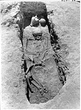
It was set deeply down, ca. 1.50m below the surface. Excavation revealed a single skeleton, extended, with head to east, and legs bent up at the ... Myc. III B |
Well in Stoa Terrace opposite Shop 5.; small amount of pottery. Estimated Grid ... 6th c. B.C. |
| Eugene Vanderpool ... "Submycenaean" grave into Mycenaean gully.
Rectangular trench cut partly in bedrock, partly through Mycenaean domestic filling. No pottery catalogued ... Late Helladic IIIC-Early Protogeometric |
Pocket in Bedrock, martyr south of 29/ΜΕ (formerly O 8:6) ... 500-480 B.C. |
| Mycenaean Chamber Tomb by Stoa Pier 12 (Burial 10).
The entire north side of the chamber had been cut away by Stoa Pier 12 and most of the depth by leveling operations in connection with Square Building, ... Early Myc. IIIA |
Shallow rectangular pit in bedrock at 44/Η. It contained a very small quantity of pottery, mostly coarse but including a few black glazed pieces, one stamped. Agora XII, p. 396.
No container, pottery ... 450-400 B.C. |
Dromos of a Mycenaean Tomb at N end of Stoa Terrace (Burial 3). No remains. Perhaps to be associated with dromos of a Mycenaean chamber tomb (?) observed in this area (XIV, p. 2707).
Tomb found when workmen ... Myc. III A |
| Mycenaean Chamber Tomb SE of Stoa Pier 12 (Burial 8).
Roughly rectangular, measuring 1.70m by 1.40m, and was cut down to within 0.65m. by the construction of the Square Building. A rectangular cutting ... Early Myc. IIIA |
Tiled well in Stoa Terrace opposite Shop 2 Estimated Grid ... Byzantine |
Mycenaean Grave below Stoa stylobate opposite pier 21, about 0.75m below the bottom of the Stoa conglomerate foundations. Although only the south side and the west end could be certainly fixed, the dimensions ... Myc. III A-early IIIB |
| Shallow pit below layer I in Stoa Shop VI (Pyre)
Diameter 0.90; D. 0.15m Under shop VI of the Stoa of Attalos Pottery, ash, burning and packing of small stones in pit in stratum. The pyre was covered by ... Ca. 350 or 325 B.C. ? |
| Eugene Vanderpool ... Mycenaean Grave under Stoa Terrace, at original north end of Stoa; and PG vases on patches of stones over this burial, and to NE (formerly P 8:7). Cf. Q 8:13. No remains. In some records as Grave XLV ... 1 December 1953 |
Well in front of Shop 15: Turkish (in line of Valerian Wall) Opened the well again in 1951, without realizing that it was finished. Found nothing in it. (p. 1468) ... 15th-16th c. A.D. |
Filling around rubble wall (35/ΚΕ). It contained a mass of pottery, most of it uninventoried ... Ca. 425-400 B.C. |
Mycenaean Grave W. of Circular Building. Measuring 1.40m by 0.55m and it was covered with a few rough stone covering slabs, under which lay the skeleton of an adult with the head to the north and the knees ... Myc. III A2-B |
Deposit associated with early walls West of the Stoa of Attalos ... Late 5th c. B.C. (?)- early 4th c. B.C. |
Mycenaean burial, disturbed (Piers 12-13 east). Plan unclear.
Bones discarded.
It was found in the trench for the east stylobate of the Square Building. It was so badly disturbed by the Classical builders ... Myc. IIIA:2 |
Mycenaean Grave, disturbed, in scarp E of Stoa, a little to the south of the group of tombs clustered around Pier 12. No remains (perhaps a child's grave whose bones had completely disintegrated).
Small ... Myc. IIIA:2-B |
Child's Chamber Tomb opposite piers 16-17.
Miniature chamber tomb complete with a dromos and a door closed with stones, but with a chamber measuring only 0.50m by 0.70m and just large enough to contain ... Myc. III B |
Byzantine Well in Stoa Shop 15 Estimated Grid ... Byzantine |
Byzantine Well at 22/ΜΕ ... 24 February 1936
16 June 1951 |
Mycenaean Tomb under Valerian wall (Burial 12).
It was impossible to fix the limits of the tomb in any direction, since at the north and south it was cut by the wall, an operations could not be extended ... Myc. III B |
Pit in Bedrock South of Large Monument Base, just West of the Stoa of Attalos ... First half of 6th c. B.C. |
Irregular Pit in Bedrock, ca. 35/ΙΕ Coins:
28 May 1951 #4 ... 600-550 B.C. |
Narrow trench in bedrock. Cf. Section Σ, p. 4358 (nb. XXII) same trench, same filling.
EV notes that the cutting probably.. to the "narrow cutting in bedrock". The filling seemed to be ca. 425-420 B.C ... Third Quarter to Last Quarter of 5th c. B.C. |
In "Ballot Box" ... Late 4th-early 3rd century |
Fifth century Pit E of Stoa Room 11 with coarse pottery and a few black-glazed, some with stamping and red-figured pieces ... Ca. 450-425 B.C. |
Geometric Well East of Stoa Room 4. Diameter 1.10m; narrows at bottom. Rough-cut, with irregular footholds north-south and east-west sides. Little water; no use fill Estimated Grid ... 725-700 B.C. |
Well at 24/ΝΒ-ΝΓ ... 18-19 April 1938 |
| Eugene Vanderpool Homer A. Thompson ... Mycenaean Grave to W. of "Court Room" below Stoa Terrace with "Ballot Box" (Grave XXIX).
Unusual type, conforming neither to our pit nor to our cist graves, and consisted of two parts. The outer part was ... Mycenaean III A-B |
A fair-sized pit in bedrock in Stoa Terrace opposite Pier 18, which contained a good deal of pottery mostly coarse. A little additional material as late as second quarter 4th. c. B.C ... Ca. 425-400 B.C. |
| Eugene Vanderpool ... Grave (E.L. Smithson: Grave XXXVIII: PG)
Shallow oval cutting in natural bedrock lintel of Mycenaean chamber tomb O 7:5, containing a large two-handled cooking pot. Within, the unburned bones of a foetal ... Developed-Later Protogeometric |
Small Pit or Well at 25/ΚΑ with a small quantity of fine and coarse household pottery, much of it whole, or nearly so ... Ca. 450-425 B.C. |
| Homer A. Thompson ... PG grave north of Stoa Pier 19 (Grave 6). In some records as Grave XLIII.
Unlined rectangular pit cut into a shallow depression in bedrock that was formed by the collapse of the roof of Mycenaean Chamber ... Developed Protogeometric |
| Mycenaean Grave to W of Pier 12 (Burial 11).
The northern part of the tomb had been cut away by the foundation trench for the south stylobate of the Square Building that preceded the Stoa, and the dromos, ... Myc. IIB-IIIA:1 |
| Mycenaean Burial.
The cutting was roughly rectangular (1.60 by 0.50m) and was once covered with rough stone slabs, two of which were found over the body. The skeleton, presumably that of a man, lay in ... Myc. III A-B |
Hollow with silt over niche of Mycenaean Tomb (O 7:5) ... 7th-early 6th century, some 5th century intrusions. |
|
|