|
|
RSY Grave 49. Outside Archaic Cemetery ... 550-525 B.C. |
Nb page 5044: Great shapeless pit with a well (62/Ξ) at its bottom which we were unable to dig because it was too dangerous. Fill in the pit was of sand and white ash. The finds and pottery 4th. and perhaps ... Late 4th.-early 3rd. c. |
Small pit in bedrock; nothing later than 3rd qtr. 4th. c. B.C ... 3rd quarter 4th c. B.C. |
Tiled well (diam. 0.78m); height of tiles 0.61m. Water level -5m. Well found at bottom of Byzantine pit, uppermost tiles cut down. Coins:
7 July 1947 #1-#2 ... Post-Herulian |
Diameter 0.80m. Water level -2m. Tiled well; height of tiles 0.67m. well in court (Room 3) of House N.
Late Hellenistic destruction fill (Pergamene etc) to -7m;
Sand without a well deposit (lamp Type ... 1st c. B.C. to 1st c. A.D. |
Tiled well (diameter 0.78, water level -3.50m) at 65/Κ (64/Κ) with poros wellhead. Built as early as 2nd c. Post-Herulian filling.
Tiled well, tiles 0.60m high ... 4th-5th c. A.D. |
Ca. 73-81/Drain. Fillings associated with the construction of the Great Drain South, especially the fill thrown in behind the east wall of the drain at the time of its building.
Cf. A 20-21:1 and B 19:7 ... Ca. 425-400 B.C. |
Pit in House N, Room 2 (RSY, House C). Filling thrown in behind the west wall of the Great Drain South at the time of the building of the drain and the extension of House C.
Cf. Hesperia 20 (1951), pp ... Ca. 430-410 B.C. |
Well (diameter shaft 0.95m) with POU and dumped fillings, separated by about 2.00m. of plain mud apparently fallen from the collapsed sides of the well. The fillings are, however, closely contemporary ... Ca. 425-400 B.C. |
| A well on the lower slope of the Hill of the Nymphs, (diam. 1.20m -water level -7m), to 7.90m. The scanty use filling at the bottom contained water jars and pitchers as well as the inventoried objects; ... Second quarter of 6th. c. B.C. |
House R, fill under drain tiles and fillings associated with house K in industrial area, including what was C 19:15, plus C 19:16 and
C 19:17.
a) House built as dwelling in second half of 5th.c.
b) Used ... Ca. 5th and 4th c. B.C. |
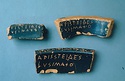
| Pit (6x10) in the valley between the Areopagus and the Hill of the Nymphs. Large cutting in bedrock with 540 ostraka, mainly of the late eighties of the 5th. c. B. C. Much pottery, principally of the early ... Ca. 500-450 B.C. |
|
|