|
|
| Intact but somewhat chipped.
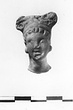
Head of a girl with hair done in a bow on top of head.
Prominent round earrings.
Traces of red on hair.
Pale yellow clay. From dump from South Stoa II. Context of 1st.-2nd ... 3 August 1960 |
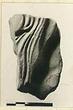
| Fragment of a sizable mould, preserving part of a body and some flowing drapery.
Broken all around. Embedded in floor of South Stoa II. Leica ... 4 January 1956 |
| Part of one edge preserved.
Uncertain representation: extended arm with drapery behind (?).
Clay buff with coarse pink particles.
ADDENDA: Animal combat. Surface. Leica ... 7 April 1938 |
| Rectangular marble brick.
Chip missing from one side.
Badly stained by fire or acid. Late fill. Leica ... 9 March 1954 |
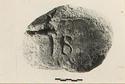
| A rough field stone with letters incised on it.
Destruction of Byzantine Wall K. Leica ... 27 May 1959 |
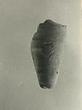
| Toe preserved.
Brownish-buff clay; streaks of matt red-brown paint.
Monogram stamp near bottom. Dark Age to early Byzantine fill. ΚΡΗ (Κ,Ρ,Η monogram) 4664 Leica ... 19 March 1954 |
Material from trenches:
a) 1.00-7.00m. from East End of Stoa.
b) 18.40-21.40m. from East End of Stoa ... 1st c. A.D. |
| Well at 99/ΜΕ.
Just outside of SE corner of Fountain House. This well was used in at least two periods; the marble well curb of the second period, certainly Byzantine, was found in place. The fill was ... 5 May 1952
5-14 July 1952 |
Kiln (pit) at 110/ΛΘ.
Debris in a metal working pit in the area of the Mint. Lot Τ 26e and T 27 ... 1st century A.D. |
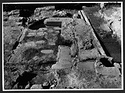
| East end of the Fountain House, showing the well (Deposit P 16:1) before the removal of the stones and tiles ... north 2825 Horizontal (normal) ... 20 May 1952 |
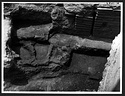
| Late Roman bronze workers' kiln (Deposit P 16:3) on line with the north wall of the Mint. Cf. nb. pp. 5230ff ... 5236 Horizontal (normal) ... 26 May 1954 |
| Ate Roman bronze workers' kiln (Deposit P 16:3) on line of the north wall of the Mint. Cf. nb. pp. 5230ff ... Horizontal (normal) ... 26 May 1954 |
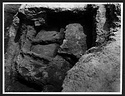
| Bronze-casting pit and furnace against S apse of Church (106/ΛΕ). Late Roman sherds of the 4th and the 6th c. A.D. were found with fragments of moulds from bronze casting. The west end was destroyed by ... 5th-6th c. A.D. |
Well at ΜΣΤ,ΜΗ/112. Collapsing bedrock prevented us from reaching bottom. Not A. Walker but same scenario ... 7th-Mid 6th c. B.C. |
Just east of Building II near its south end. The tiles were in place.
Upper filling (to 3.00m.) of Hellenistic-Byzantine dump all discarded.
POU fill a gradual accumulation of typical Justinianian ware ... 6th c. A.D. POU-7th c. A.D. |
| Hydraulic Unknown Concrete Rubble, Marble Poor, foundations only ... 2nd A.D. |
| Hydraulic Unknown Limestone Poor, foundations only ... Late 6th B.C. |
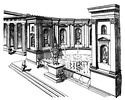
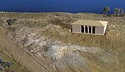
| Temple, Religious Unknown Marble Fair, foundations and fragments of superstructure ... Late 1st A.D. |
| Rough-picked top preserved; otherwise broken all around. A cyma reversa molding and part of plain fascia below. Clear outline of painted Lesbian leaf ornament on molding.
From epistyle crown of the Temple ... 30 May 1952 |
| Broken at both ends and at back; finished lower edge. Chipped.
Part of a large muzzle and eye (?).
Good roof tile fabric with smooth buff slip.
ADDENDA A spout of an eaves tile? Published as an archetype ... 1933 |
|
|