|
|
| Roman Republic, M. Antonius ... Mint = moving with M. Antonius. Δηνάριο: Μάρκος Αντώνιος 31 π.Χ. Coin no. 2. Stony green fill, core of burned Building; to below level of blocks of inner foundation. Ship r., with scepter tied with fillet ... 32-31 B.C. |
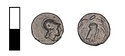
| Athens ... Χάλκινο Αθηνών 3ου αιώνα π.Χ. Coin no. 3. Soft fill and below. Head of Athena r., wearing Corinthian helmet. [Θ]-Α
Owl standing r., facing. All in wheat wreath. 85-15-18, 91-1-3, C 94 ... 284-270's B.C. |
"Fauvel Collection"
Collector's dump? Debris in the cellar of a modern house, probably once that of F.S. Fauvel.
The collection included vases of all periods, from Geometric to Turkish; a number of the ... Modern Context |
| N.A. Doenges Evelyn Lord Smithson ... "Near or in Grave" (width 0.50m)
Grave to the east of the southeast corner of the great court of the Gymnasium. Shallow and superimposed on Well N 11:5. It is a simple cist oriented north and south, with ... 750-725 B.C. |
Well at 74/ΜΒ ... Early Byzantine |
Well at 69/ΚΗ (diameter 1m).
The well forms the south apse of the apsidal cutting south of the late Roman entrance porch ... Late 8th c. B.C. |
Well (diameter 1.10m).
Neatly cut. Footholds on east and west at intervals of ca. 0.50m. Plentiful water ... Late 8th - Early 7th c. B.C. |
Well at 69/ΛΕ (diameter 0.95m).
Narrows at bottom. Footholds on east and west. Uniform fill. Bones found in the well make it likely that it had cut through a grave, as it was itself overlain by one ... Late 8th c. B.C. |
Well at 71/ΛΒ (diameter ca. 1.10m) near the east wall of the entrance porch.
Narrows toward bottom, collapsed at top. Six footholds preserved at south, three at north, spaced at ca. 0.50m. Uniform fill ... Late 8th in early 4th c. B.C. |
Byzantine Well at 66/ΛΑ.
Semi-curbed well at the west wall of the Byzantine room.
From the mouth of the well, a few brown glazed sherds ... Byzantine |
| Mycenaean grave. It consisted of a shallow rectangular cutting in bedrock about 1.40m by 0.70m, but it was probably somewhat bigger, since the east side and a large part of the north side had been cut ... Myc. IIIA:1-2 |
Well at 70/Κ ... Middle Geometric |
Well at 15/ΜΓ (Well E: PG, ELS). Supplementary filling around its top Small partly glazed one handler
Fragment of black figured kylix
Small protogemetric cup
Fragment of skyphos
Rim fragment of Large Open ... Protogeometric-6th - 5th c. B.C. |
Debris of Odeon-purse? A. Walker coin deposit. |
Filling between tongue walls to north of main apse in Late Roman complex, equals "Coroplasts' Dump" overlying Odeion south side.
Containers Ο 17-Ο 20 are from "debris of burnt building" [i.e. Odeion ... 267-ca. 350 A.D. |
Unstratified pit below east part of Odeion Cavea (Trench K).
Brann Well or Pit O. Estimated Grid ... To ca. 725 B.C. |
Well at SE corner of Court of Late Roman Building (Trench C). Estimated Grid ... 12th c. A.D. |
7th c. well below east part of Odeion Cavea Trench K). Use filling negligible; dumped filling of the second half of the 7th c. B.C.
Brann Well H. Diameter 1.10m. Cut into bedrock. During excavation seepage ... 650-600 B.C. |
| Mycenaean Grave.
One of the first Mycenaean burials found in the Agora. It consisted of a regular cist, carefully cut with vertical sides and a flat bottom, measuring 1.90m by 0.55m. There were apparently ... LH III (c. 1200) |
Grave of 38 year-old female, head NW, legs drawn up. Apparently unlined cist in bedrock or hard-packed dug-bedrock, its outlines no longer distinguishable from surrounding fill. Above skeleton, a number ... Mycenaean? |
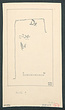
| Mycenaean grave in section O at 70/ΙΘ ... Marian R. Holland ... Dirty Cartridge Paper Drafting Ink ... 1952 |
| Geometric grave in section O at 69/ΛΕ ... Marian R. Holland ... Dirty Cartridge Paper Drafting Ink ... 1952 |
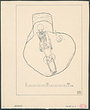
| Drawing of a Mycenaean cist grave. Deposit M 21:1. Cf. Agora XIII, pl. 82 under Grave XXXVII (PD 428bis) ... PD 428 ... 1935 |
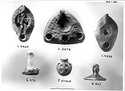
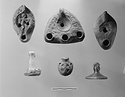
| Selection of three lamps (L 5469, L 5479, L 5453), a glass candlestick (G 576), an ampulla (P 27463) and a glass goblet fragment (G 567) illustrating the deposit over the floor of the rooms ... no deposit number (SD) ... September 1969 |
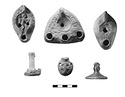
| Selection of three lamps (L 5469, L 5479, L 5453), a glass candlestick (G 576), an ampulla (P 27463) and a glass goblet fragment (G 567) illustrating the deposit over the floor of the rooms ... Cleaned version of 1997.10.0034, cf. 2012.58.0014. Horizontal (normal) ... September 1969 |
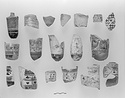
| White ground lekythoi from Fauvel collection. Tin Ο 157 ... AMS Horizontal (normal) |
| Selection of three lamps (L 5469, L 5479, L 5453), a glass candlestick (G 576), an ampulla (P 27463) and a glass goblet fragment (G 567) illustrating the deposit over the floor of the rooms ... no deposit number (SD) Horizontal (normal) ... September 1969 |
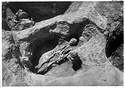
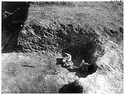
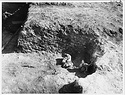
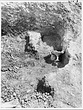
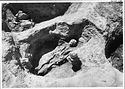
| Child's pit grave, completely excavated. At left, the large cutting which destroyed the east part of the grave. Deposit N 12:1 ... AMS south 709 Horizontal (normal) ... 27 May 1952 |
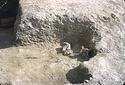
| Child's pit grave, partly excavated. Deposit N 12:1 ... AMS south 708 Horizontal (normal) ... 27 May 1952 |
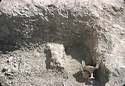
| Cist grave as cleared. Deposit N 11:1 ... AMS northwest 716 Horizontal (normal) ... 2 Jun 1952 |
| Mycenaean grave to east of Odeion (partly cleared). Deposit N 12:1 ... Cf. LIV-8 ... 1952 |
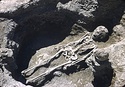
| Mycenaean grave to east of Odeion (fully cleared). Deposit N 12:1 ... Cf. LIV-2 ... 1952 |
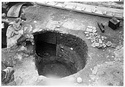
| Skeleton in mouth of well in the Gymnasium porch. Deposit N 11:1 ... Cf. LIV-13 ... 1952 |
| Cist grave as cleared. Deposit N 11:1 ... northwest 716 Horizontal (normal) ... 2 Jun 1952 |
| Cist grave disturbed by the construction of a Roman wall. Deposit M 12:1 ... south Horizontal (normal) ... 19 Feb 1935 |
| Cist grave. Deposit M 12:1 ... south ... 19 Feb 1935 |
| Child's pit grave, completely excavated. At left, the large cutting which destroyed the east part of the grave. Deposit N 12:1 ... south 709 ... 27 May 1952 |
| Child's pit grave, partly excavated. Deposit N 12:1 ... south 708 ... 27 May 1952 |
|
|