|
|
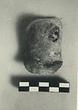
| Small ball; when rubbed against another surface it leaves a white mark; perhaps used for chalking (?).
Gritty substance, apparently a soft stone. Seventh century well below east part of Odeion Cavea (from ... July 1946 |
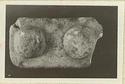
| Mastoid weight.
One corner broken off.
Pentelic marble. Leica ... 29 March 1934 |
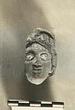
| Broken at top and bottom and at right side of head.
A high headdress on the elaborately waved hair.
Traces of red paint on the face, and white in the eyes.
Pinkish buff clay. Leica ... 18 May 1935 |
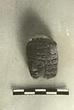
| Broken away all around.
Signed.
For the same signature see T 603 and probably also T 471.
ADDENDA: Incised in wet clay the letters: P O
Φ
Late Roman.
Destruction fill of late Roman Building. Leica ... 9 April 1935 |
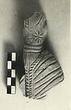
| Broken all around.
Gouged folds; and gouged decoration, hatching and startss on the drapery.
Red clay; buff surface.
Late Roman. Destruction fill of the late Roman Building. Leica ... 10 April 1935 |
| Nude body of child and draped adult arm supporting it.
Broken away on all sides.
Traces of white paint.
Red clay. Destruction fill of late Roman Building. Leica ... 12 April 1935 |
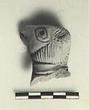
| First interpretation: head of figurine.
The figure wears a high ornamental headdress. Pierced eyes. The curiously distored mouth suggests a mask of some sort.
Buff clay, thin purple red wash. Red earth ... 9 April 1935 |
| The left side of a dog 's head.
Broken away below.
Micaceous red clay, buff surface.
Cf. T 1422. Compact brown earth over burnt layer. Leica ... 16 April 1935 |
| Neck, left shoulder, and breast of woman preserved.
Woman wears a thin chiton, belted in just below the breasts, and over this a cloak which slips off the left shoulder, but comes close up to the neck ... 19 April 1935 |
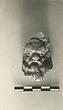
| Head with beard and moustache; the eyes pierced.
Red paint.
Yellow-red clay.
From a plastic lamp (?) Late Roman fill. Leica, LXIX-16 ... 25 April 1935 |
| At the top of the headdress there was a pierced projection forward.
The face and the top of the pointed headdress are painted white; the lower part of the headdress red.
Red clay.
From a plastic lamp, ... 2 May 1935 |
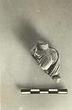
| First interpretation: fragment of the head of an animal or bird.
The details done in color. White for flesh. Black for eye and eyebrow, and for borders of "collar", yellow for collar proper. Red above ... 24 April 1935 |
| The nose and moustache preserved, broken all around.
Clay painted red.
Orange red clay. Late Roman. Leica ... 17 May 1935 |
| First interpretation: female figurine.
Face and neck painted red, hair and headdress buff colored; traces of yellow paint (?)
Orange red clay.
See T 525. Leica ... 17 May 1935 |
| Three legs, front of face and tail missing. Bottom of preserved leg shows he was free standing, i.e. not from pyxis lid.
Glaze bands down neck, sides and legs; bars across chest and back.
Pottery clay; ... 8 June 1946 |
| Head and all four legs missing.
Similar in size, fabric and decoration to T 2312; they were a pair.
Restored in plaster. Not found to check, believed lost, 5-6-58. Pit below east part of Odeion Cavea ... 8 June 1946 |
| One front leg, part of neck and of body only preserved.
Traces of red glaze bands across back.
Fine pinkish buff clay. Pit below east part of Odeion Cavea. 378 Leica ... 8 June 1946 |
| Part of the edge of a round convex shield with flat edge or rim.
On body, well in from rim, traces of a red band over the white.
Micaceous pink clay, covered outside with white. Seventh century well below ... July 1946 |
| Rectangular plaque with suspension holes by each upper corner. The back striated or grooved, as if the impression of the object on which the plaque was laid while still soft.
Front and sides covered with ... July 1946 |
| Part of the seat and the stumps of two of the legs, probably a front and a back one. Attachments underneath for two more legs (?) or for supporting stretchers.
Bands of dull black glaze.
Pinkish-buff clay ... July 1946 |
|
|