|
|
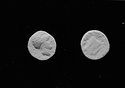
| Demetrios Poliorketes, Kings of Macedonia ... No details. Coin no. 2
Casts Head of Demetrios r., wearing Corinthian helmet with horn. B A above
Prow r. 85-25-28, 91-3-5 ... 300-295 B.C. |
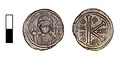
| Antioch ... Justinian I ... Coin no. 3. Modern bothros. DINVSTINI-NVS PP AVG
Bust of Emperor facing, in helmet with plume and diadem with trefoil ornament in front, and cuirass; in r. hand he holds globus cr.; on l. shoulder, shield ... 539/540 A.D. |
Pottery Deposit at 57/ΙΔ (also 57/ΙΣΤ and 63-66/Κ-ΚΕ). Contents of pit range from Mycenaean to Turkish; apparently the dump of a modern antiquities dealer ... Modern Context |
North of east branch of Great Drain. Coins:
21 June 1973 #1 ... 4th c. A.D. |
Coins:
15 March 1934 #6 ... 6th-7th c. A.D. |
Exploration in the peristyle of the Heliaea (1960); evidence for rebuilding in the third quarter of the 4th c. B.C. with some disturbance as late as 1st-2nd c. A.D. Date of reconstruction ca. 325 B.C ... Ca. 350- 325 B.C. |
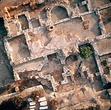
| Administrative Unknown Concrete Rubble, Limestone, Marble Good, foundations and walls up to one meter high ... 5th A.D. |
| Concrete Ring Around Tholos; Southwest Part ... Β-15 2819, 2820 ... Aug 24 1961 |
| Marble Fragments: List of Names ... Κ-19 3770, 3771 I 7014 I 6819 ... 15-16 September 1966 |
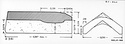
| One end is preserved, though slightly battered. At the other end the tile has been rudely cut off, probably somewhere near the middle. The underside is rough-picked, with a sort of swelling near the original ... 18 April 1934 |
| Black Glaze Column Krater Fragment. Pit. Panathenaic Amphora Fragment ... Ψ-7 1238, 1239 P 26072 P 26073 O 18:5 P 26072 P 26073 ... July 1957 |
| Marble Fragment. House 641/4. Monument Fragments ... Ψ-1 38, 39 I 5122 I 5123 I 1230 I 5122 I 5123 I 1230 ... 22 November 1937 |
| Monument Fragments. House 641/17. Marble Fragments: Bouleutic List. House 641/18 ... Ψ-1 48, 49 I 1230 Ψ 32 I 5105 Ψ 8 I 1230 I 5105 ... 25 November 1937 |
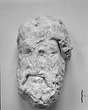
| Bearded head, front only preserved. Nose missing; hair on proper right side badly worn; beard chipped, especially below.
Mustache indicated in part by parallel lines running down beside and below edges ... Roman period. |
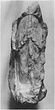
| Broken top and bottom.
Head missing.
Bottom of square beard and locks of hair on shoulders preserved.
Pentelic marble. 33-N written in the upper right corner of the card. Pre-war marble pile. Leica, ... 14 February 1952 |
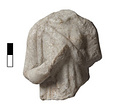
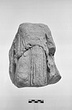
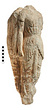
| Torso preserved, from neck to below the waist; lower left arm broken off, the right elbow chipped, also some object held at the breast by the right hand.
Standing, archaistic kore, wearing thin chiton ... 24 February 1953 |
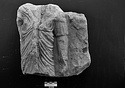
| One out of the three draped figures mostly preserved and fragment of column. Plinth on which figures stood broken all around; dressed on bottom. Head, shoulder, right breast, upper arms, broken off; feet ... 1st c. A.D. (?). |
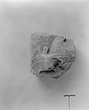
| Top edge and back preserved. Roughly picked.
Hermes in petasos looking left. Head and shoulders preserved, wearing chiton. Features completely gone.
Archaistic.
From same monument as S 245 (Θ 47)(which ... May 1953 |
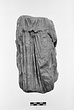
| Back and right edge preserved. Roughly picked.
Draped standing female figure, Isis article. Preserved, shoulders to thighs; right arm missing.
Pentelic marble. Pre-war marble pile from south side of section ... Early Antonine period. |
| Head and lower legs broken off.
Three female figures back to back with arms and skirts touching at sides. Feet together, both arms lowered. Peplos girded at waist worn over chiton with buttoned sleeves ... 1st c. A.D. |
| Broken off above feet. Edges of base chipped.
On a reel-shaped base three identical female figures back to back. Archaistic drapery.
Coarse, heavy work.
Pentelic marble. From circled marbles. Leica, LXXVII-60 ... 1st - 2nd c. A.D. |
| Double handle.
Red clay, greenish-buff slip.
Rectangular stamp, a palmette or thunderbolt, on the handle.
Cf. SS 610. Corpus number 730. From dump. thunderbolt 1040 Leica ... 12 May 1934 |
| Orange micaceous clay; brownish thick slip.
Device. Dim: W 0.041*
Rdg: the H as pres looks like a hook of a laddle(VG)* Finished Disturbed fill. [Θασί]ων
device
[Ναυσι]κύ | δης? Leica ... 29 March 1934 |
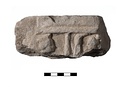
| Of the relief only the upper part of the sistrum is preserved, considerably battered. The top of the block, fairly smooth-picked, is preserved with a dowel cutting, partly broken off, at the right. Just ... 5 May 1934 |
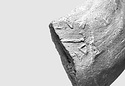
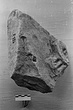
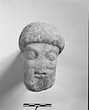
| A small bearded head in archaic style. Nose broken, the break worn smooth; beard somewhat damaged. Detail in general rubbed rather smooth.
Hair worn in curls across forehead, otherwise apparently left ... Late Archaic period. |
| A vertical break down right side of face. Features damaged. Back surface of relief perhaps preserved.
A male head full front in high relief, probably from grave monument.
Pentelic marble. Marble dump ... 28 April 1936 |
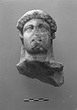
| Head and very upper part of pillar preserved, including part of the rectangular cutting for left arm stub. Nose, mouth and chin damaged. Beardless, rather full face. Double row of curls across forehead, ... Roman period. |
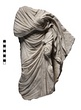
| Head, right arm, lower left arm, and legs below knees missing. Upper body battered.
The figure wears a Doric chitin with kelps. She is standing, the weight is on the left leg, the right knee bent. Traces ... 28 January 1936 |
| Preserved from waist to above ankles. The figure wears a Doric chitin with long overfilled; standing with the weight on the right leg, the left leg bent.
Broken at sides; back rough-picked.
Pentelic marble ... 28 January 1936 |
| Head and feet missing; part of the relief background preserved at the left of the figure. Back rough-picked, sides broken.
The figure is wrapped in a Hymettian, its folds held at the breast by the right ... 28 January 1936 |
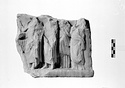
| Back, right side, and bottom preserved, elsewhere broken. The four figures, heads all missing, face half left. The first wears an himation; his right leg is bent, his right, bare arm is raised, with the ... 27 March 1934 |
| The upper part of a small relief, broken away below. Part of the left edge preserved, close to right edge also.
The heads of two women are facing. The one at the left wears a polos and holds a staff in ... 24 March 1936 |
| Most of one figure preserved and part of a second; the heads broken off; the surfaces considerably battered.
From a group of three like female figures, standing back to back, wearing elaborate archaizing ... Early 1st c. A.D. (?). |
| The upper part of a plastic lamp with perforated top, modelled in the shape of a sandalled right foot. Traces of handle behind.
Glaze red to brown, worn on outside.
Pinkish-buff clay.
ADDENDA RVN: Pobably ... 28 February 1953 |
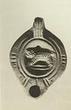
| On the rim, panels and dotted circles. On the discus, a bear to left.
Solid grooved handle.
On the reverse, within two concentric grooves, the signature "A".
Light red clay, buff surface.
Type XXVIII ... 9 March 1934 |
| Preserved is only ca. one-half the base of a small steep-sided Samian A cup. Low, rather narrow foot ring, rounded in section. In center, inside, part of a pattern made of deep parallel grooves.
Pinkish, ... 12 March 1934 |
| Neck, ring handle, and a bit of one side missing. Low solid foot, slightly concave. On top in clay-colored paint, a wreath with white dots; above it, also in clay-colored paint, two pairs of very crudely ... 14 March 1934 |
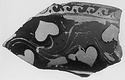
| Fragment of rim and foot of a very heavy large plate or dish. Groove where center and rim meet is reserved. On rim an ivy pattern: leaves reserved, stems in clay-colored paint, berries in white. On band ... 14 March 1934 |
| Fragment of wall and base of a flat-bottomed Samian A bowl. Fairly fine pinkish- brown clay, very micaceous; conspicuous wheel marks on outside and bottom. Inside and out a thick fairly lustrous glaze ... 14 March 1934 |
| Fragment from wall and rim of a bowl like P 4527 (Λ 482).
Outside; on wall is scratched: Ν
Pinkish-orange micaceous clay, good orange glaze inside and out. Near well. Late Roman context. Leica, 96-9-32 ... 24 March 1934 |
|
|
.jpg.icon.jpg)
.jpg.icon.jpg)
.jpg.icon.jpg)
.jpg.icon.jpg)
.jpg.icon.jpg)