|
|
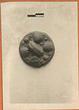
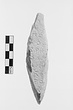
| Disk with four appliqué seashells around a semicircular projection.
Between the shells are small lumps of clay, smaller shells (?).
Unglazed.
Buff clay.
Possibly a small lid, the projection serving as ... 17 July 1931 |
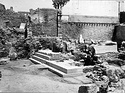
| View of the Altar and orthostate A 403 behind it ... northeast ... 5 Aug 1931 |
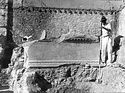
| Orthostate block from the Altar of Zeus Agoraios with consulting engineer ... Nomlas north ... 5 Aug 1931 |
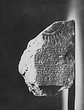
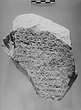
| Fragment from a large inscribed block.
Part of the bottom surface, rough picked, preserved; the others broken.
On the preserved face, the lower 0.10m. were not inscribed. The upper part of the inscribed ... 165/6 A.D. |
| Fragment Θ 26 a), from right side of inscribed block; fine picked on one side, rough picked on the back.
Fragment Κ 115 b), back and left side preserved. Fifteen lines of the inscription preserved.
Fragment ... 127/6 B.C. |
| Inscribed fragment.
Broken all round.
Pentelic marble.
Cf. Hesperia 26 (1957), pp. 41-42. Found at a late Roman level, east of the altar of Zeus. 482 Leica, 1-38 ... 21 July 1931 |
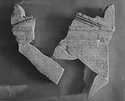
| Two fragments from the upper part of a stele with pedimental top.
Both corners, with finials, are preserved, the right hand piece mended from six fragments; the left hand, from two. The central part of ... 125/4 B.C. |
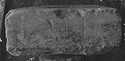
| Inscribed block of marble, with fourth century dedication.
Smoothed on the front, sides and top; rough picked on back and underneath; in the top, round hole.
Probably a statue base.
Hymmetian marble.
... 30 May 1931 |
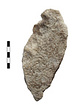
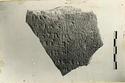
| Inscribed fragment.
Broad surface chip. Appears to be inscribed with a series of plain circles, six of them being preserved in a row 0.082m. long, and another 0.018m. away below the row. Surface weatherd; ... 17 March 1932 |
| Inscribed fragment.
Broken all around and behind.
Traces of eight lines of the inscription preserved, and part of a letter from a ninth.
Pentelic marble. Finished Found in a marble dump, in the area east ... 8 July 1933 |
| Inscribed block.
Broken away at left and below, and in back.
Hymettian marble. Found in the wall of the modern house 637/18, northeast of the Eponymous Heroes; actually section Ε. Leica, XXXI-15 ... 4th. century B.C. |
| Inscribed stone.
Part of inscribed surface and rough picked back preserved; also a bit of toothed surface at top.
The inscribed surface badly worn. Letters visisble only on lower part of left side.
Bits ... December 1934 |
| Inscribed fragment.
Inscribed face only preserved.
Four lines of the inscription preserved.
Hymettian marble.
ADDENDA Joins I 175. Found in modern wall at corner of Eponymon and Ptolemy Streets, north ... Ca. 232 B.C. |
| Inscribed fragment.
Broken at top, back, left side and bottom.
Right face dressed with chisel.
"POLETAI" record.
Parts of twenty lines of the inscription preserved; roughly stoichedon.
Margin to the right ... Second half of 4th. century B.C. |
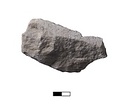
| Inscribed fragment.
Thin sliver, broken all around.
Fragments of four lines of the inscription preserved; apparently stoichedon.
Space between lines: ca. 0.003m.
Bluish-white marble. Found in mid. Roman ... 14 May 1951 |
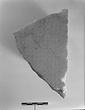
| Inscribed fragment.
Broken all around.
Preserves part of circular border formed by two incised circles.
Inside remain two letters.
Bluish marble. Found in mid. Roman context, initial triangle layer III, ... 5 March 1952 |
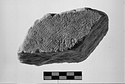
| Inscribed fragment.
Broken all around.
Preserves portion of seven lines of the inscription.
Space between lines: 0.005-0.007m.
Bluish-white fine grained marble. Found in mid. Roman context, initial triangle ... 5 March 1952 |
| Inscribed fragment.
Broken below and to right above.
Stone roughly curved above.
Inscription apparently complete.
Very dark bluish (?) marble. Found in 4th. century B.C. context, west of the southern ... 8 March 1952 |
| Inscribed fragment of stele.
Inscribed face and rough picked back only preserved.
Three lines of the inscription preserved.
Hymettian marble. Found in marble pile, in the area of the southwest corner of ... 19 March 1936 |
| Inscribed fragment.
Inscribed face and left face only preserved.
Five lines of the inscription preserved.
Pentelic marble. Found in late Roman context, north of the Civic Offices. Leica ... 21 March 1936 |
|
|