|
|
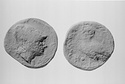
Uncertain Sultan ... "Ribbon fabric." Coin no. 12. GCM 778.12. 365 ... 15th-16th c. A.D. |
| Inscribed fragments.
Fragment Ζ 11, fragment from the left side of an inscribed block.
Broken top, bottom and back; the left side smooth picked. The lower part of the face is broken away at an obtuse ... (Ζ 11) 1933
(H 639) 17 May 1937
(Η 648) 25 May 1937 |
| Fragment from an inscribed block.
Only small bit of the inscribed surface is preserved, with parts of four lines of the inscription; non-stoichedon.
Pentelic marble. Pre-excavation. Found in the modern ... 1933 |
| Inscribed fragment of columnar grave stone.
From near the top, preserving part of the ring, and about half the circumference.
Parts of three lines of the inscription remain.
Hymettian marble. Pre-excavation ... 1933 |
| Inscribed fragment.
Broken all round.
One letter preserved.
Pentelic marble.
ADDENDA The letter probably a mason's mark.
Cf. the series of Doric cornice blocks A 238 and A 239, to which this fragment ... 1933 |
| Inscribed heptagonal base.
Bottom rough picked; top much worn and flaked, with a small round hole, near the inscribed face.
The circumference presents the deceptive appearance of what would have been an ... 1933 |
| Inscribed fragment.
Remains of an inscription in two columns, that to the right being a list of names. Parts of fifteen lines of the inscription preserved.
Pentelic marble. Pre-excavation. Found in the ... 1st. century B.C. (?). |
| Inscribed fragment from the right edge of the block, with part of the fine picked right surface preserved.
On the smooth finished face, the right side of a small wreath, open at the top, and the greater ... Middle of 1st. century B.C. |
| Left corner of small rectangular base.
Above and below were mouldings, now much damaged, and in the top a large hole for setting something; the top of the base finished smooth, the inside of the setting ... 1933 |
| Inscribed fragment.
Remains of two lines of the inscription, with three and a half letters in the lower, and part of two in the upper, preserved.
Pentelic marble.
ADDENDA Joined to I 275. Pre-excavation ... 1933 |
| Inscribed fragment of columnar grave monument.
Below convex band inscribed.
Inscribed surface only preserved.
Hymettian marble. Catalogued 1932. Found in wall of the modern house 631/26, northeast of the ... 1931 |
| Upper part of inscribed grave relief.
Mended from two fragments found on different dates.
The smaller left piece was found first; the two fragments do not meet along front edge; may have been cut apart ... 4th. century B.C. |
| Inscribed fragment.
Broad surface chip. Appears to be inscribed with a series of plain circles, six of them being preserved in a row 0.082m. long, and another 0.018m. away below the row. Surface weatherd; ... 17 March 1932 |
| Temple, Religious Unknown Limestone Foundations, Marble Superstructure Poor, foundations only and some blocks from the superstructure ... 5th B.C.
1st A.D. |
| Broken all around, only some mane and a bit of ear and part of piercing for spout remain.
From Temple of Ares.
Pentelic marble. Marble pile S.W. of Temple of Ares. Leica ... 5 July 1951 |
| Broken at left, and in back below. Joint preserved at right end. Very badly weathered. Trace of astragal molding along top of face.
From the Temple of Hephaistos (?).
Island marble.
ADDENDA Weathering ... July 1951 |
| Inscribed fragment.
From the front upper part of a statue base. The top is finished with toothed chisel. In the top is preserved part of the curved sinking for the plinth proper.
Archon Phanomachos.
Two ... 259/8 B.C. |
| Inscribed fragment.
Broken all around and behind.
Remains of three lines of letters, within a conventional wreath.
Hymettian marble. Found just below the floor of a Byzantine building (room xxi), east ... 12 February 1934 |
| Inscribed fragment.
Broken all around and behind.
Part of six lines of the inscription preserved.
Pentelic marble. Found just below the floor of a Byzantine building (room xxi), east of the Stoa of Zeus ... Ca. 158 B.C. |
| Inscribed fragment.
Original surface on face and right edge only.
Possibly an Ephebic Decree of the third century. Some of the demotic of Hermodoros or Herortious seems to be preserved.
Part of eight lines ... 244/3 B.C. |
|
|