|
|
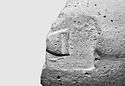
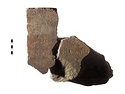
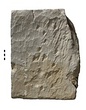
| Broken on all sides.
End of swirling drapery beside a figure (?). From clearing trench of inner rectangle in peristyle court of Heliaia. Context chiefly of late third quarter of 4th. century some later ... 27 April 1960 |
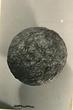
| Small fragment missing from one side.
Cut from hard breccia.
Cf. ST 702. From deep stony fill in middle of peristyle of Heliaia. 3471 Leica, 83-91 ... 3 August 1960 |
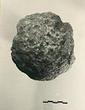
| Small fragment missing from one side.
Cut from hard breccia. From deep stony fill in middle of peristyle of Heliaia. 3471 Leica, 83-91 ... 3 August 1960 |
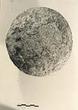
| Flake broken from side of ball.
Cut from hard breccia.
ADDENDA Balls found in Pompeion measure 0.14-0.35m.
Cf. AM 56 (1931), p. 4. From deep stony fill in middle of peristyle of Heliaia. 3471 Leica, 83-91 ... 3 August 1960 |
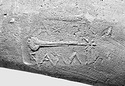
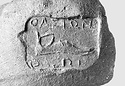
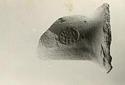
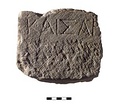
| Part of rim preserved.
Device star.
Early Thasian. Class: early Th* Finished From deep stony fill in middle of Peristyle of Heliaia. Θασίων
device star
Καλλί( 3471 Leica ... 3 August 1960 |
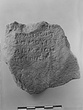
| Part of rim preserved. Cxt: for deposit see Summary of 27.vi.61 (VG)* Finished From clearing trench of inner rectangle in Peristyle court of Heliaia; context chiefly of late third quarter of 4th century ... 27 August 1960 |
| Shoe. Stoa, Area South 2-3, martyra, layer II; Middle Stoa Building Fill. Θασίων
shoe
Θάσων Leica ... 28 March 1953 |
| Wreath. West of “steps” to 27.00m. square; top of Hellenistic fill, working levels; surface Middle Stoa Building Fill at start of 1953 season. wreath
ΠΟΑ (Α within Ο)
(in O) 2060-2061 Leica ... 8 April 1953 |
Exploration in the peristyle of the Heliaea (1960); evidence for rebuilding in the third quarter of the 4th c. B.C. with some disturbance as late as 1st-2nd c. A.D. Date of reconstruction ca. 325 B.C ... Ca. 350- 325 B.C. |
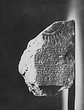
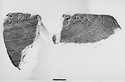
| Fragment Θ 26 a), from right side of inscribed block; fine picked on one side, rough picked on the back.
Fragment Κ 115 b), back and left side preserved. Fifteen lines of the inscription preserved.
Fragment ... 127/6 B.C. |
| Parts of inscribed block.
Fragment Κ 117a), broken away on all sides.
One line of the inscription remains, with five letters.
Fragment Κ 117b), part of the top is preserved; other sides broken.
One line ... (Κ 117a) 24 February 1934
(K 117b) 12 March 1934 |
| Inscribed fragment.
A piece of the top preserved; the other sides broken.
Slightly convex surface. Traces of moulding above and low relief at left and below (leaves of a crown?).
Two letters remain.
Pentelic ... 7 December 1933 |
| Corner of inscribed block.
Funeral base.
Fragment Κ 14 a), top and left side preserved; broken away on the right, the back, and below.
Part of one line of the inscription preserved, with three letters ... Ca. 500 B.C. |
| Part of an inscribed stele.
Broken away below and on the right.
Most of the surface at the top, and the crowning moulding have been battered away. Part of the left side is preserved.
Preamble of decree; ... 287/6 B.C. |
| Inscribed fragment of grave stele.
The left side preserved; elsewhere broken away.
Hymettian marble. Found in the wall of the church of Prophet Elias and St. Charalambos, north of the Southwest Fountain ... 5 March 1934 |
| Fragment of inscribed plaque; early Christian Epitaph.
Broken away above, below and to the left.
Pentelic marble. Found in the wall of the church of Prophet Elias and St. Charalambos, north of the Southwest ... 6 March 1934 |
| Part of a low inscribed base.
Broken away on the left and in back.
Two lines of the inscription preserved.
Hymettian marble. Found in the wall of the church of Prophet Elias and St. Charalambos, north ... 1st. century B.C. |
| A piece missing from the upper right hand corner of the block; otherwise complete.
The block has a perceptible curve, and the inscription occurs on the upper left hand corner of the concave side.
Poros ... 13 March 1934 |
| Fragment of inscription.
Left side preserved; others broken.
Rough picked surface below the letters.
Two lines of the inscription preserved; six letters and part of a seventh, in the lower line; part of ... 16 March 1934 |
| Inscribed fragment.
Broken away on all sides.
The face was covered with plaster, which flaked off easily, disclosing red color in the letters.
Five lines of the inscription preserved.
Pentelic marble ... Late 3rd. century B.C. |
|
|