|
|
Selīm I ... Probably Selīm I.
Mint = Constantinople, possibly Serez, and no mint name.
No date. Coin no. 15. GCM 867.15. 758, 761 ... 1512-1520 A.D. |
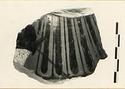
Uncertain Sultan ... "Ribbon fabric." Coin no. 16. GCM 867.16 758, 761 ... 15th-16th c. A.D. |
Uncertain Islamic ... "Local coinage of the second half of the 15th c. (?) ... Coins with unsystematic designs or markings ... Very few show characteristics that might be interpreted as imitations of Turkish legends. Mostly ... 8 June 1933 |
Edīrne Bursa ... Süleymān I ... Chronology: ca. 1521-1522 A.D.?
Mint = Edīrne or Bursa or local imitations. Coin no. 8. GCM 875.8. 921, 1586 ... Ca. 1521-1522 A.D. |
Miṣr ... Abd ül-Ḥamīd I ... Coin no. 9. GCM 875.9. 921, 1586 ... 1774-1789 A.D. |
L 1079 and L 1080 are identified as from a pit at 29/ΝΓ. L 1082 and P 2130 are from a pit at 26-29/ΜΘ-ΝΑ. Probably the same pit as indicated on a note in deposit cardex. The finds are recorded together ... 5th c. |
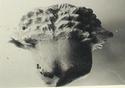
| Lower jaw and muzzle broken away and the whole head torn from the sima. Hair of crown schematically rendered by pyramidal tufts placed on checkerboard arrangement.
Assigned to either the Temple of Ares ... 5 February 1934 |
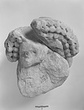
| Fragment from proper right side of a very large head with beard and corkscrew curls. Preserved is part of the side of the neck, and of the face with the right eye and beard, the fillet round the front ... Roman period. |
| Right knee of a kouros of the Sounion type, about one and half life-size.
Broken above and below, the breaks slanting up to the back.
Island marble.
Part of the same statue are:
S 287 (Θ 146), S 530 ( ... Ca. 600-590 B.C. |
| Broken all around. Face much battered, whole surface weathered.
Left side of head of lion with ruff and mane in archaic stylization.
Asymmetry of eyes and mouth suggests relief.
Island marble. From big ... 3rd quarter of 6th c. B.C. |
| Head and lower legs broken off.
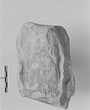
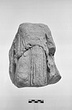
Three female figures back to back with arms and skirts touching at sides. Feet together, both arms lowered. Peplos girded at waist worn over chiton with buttoned sleeves ... 1st c. A.D. |
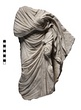
| Head, right arm, lower left arm, and legs below knees missing. Upper body battered.
The figure wears a Doric chitin with kelps. She is standing, the weight is on the left leg, the right knee bent. Traces ... 28 January 1936 |
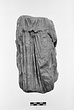
| Preserved from waist to above ankles. The figure wears a Doric chitin with long overfilled; standing with the weight on the right leg, the left leg bent.
Broken at sides; back rough-picked.
Pentelic marble ... 28 January 1936 |
| Head and feet missing; part of the relief background preserved at the left of the figure. Back rough-picked, sides broken.
The figure is wrapped in a Hymettian, its folds held at the breast by the right ... 28 January 1936 |
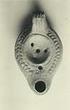
| Mended from four fragments; part of left side of top missing.
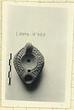
Along the outer edge of the rim, a thin line of herringbone, two deep grooves punctuated by tiny circles within.
On discus, whirling rosette ... 22 March 1933 |
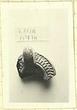
| Handle broken of on top; on the back of the body four broad grooves simulating a handle.
On rim, diagonal ridges, with dots along the inner edge; clear on the right side, dim on the left.
Discus, plain, ... 17 March 1933 |
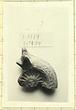
| Complete.
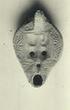
Herringbone on rim; plain concave discus with four filling holes; handle solid, triple grooved above, double below. Palm leaf-shaped on reverse, with double bounding lines starting from two small ... 6 June 1933 |
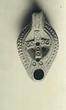
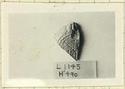
| Herringbone on rim (down sloping); the walls nearly vertical; on the almond-shaped discus a jewelled cross, with a filling hole in the middle, and two more in the lower quandrants. Two small impressed ... 6 June 1933 |
| Complete save for a small hole in the bottom.
Leaf pattern on rim; small plain discus, with three small circles at the start of the handle. The handle small, solid; double grooved below, and with a band ... 6 June 1933 |
| End of nozzle missing, and part of front of lamp below.
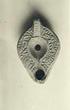
Herringbone on rim; small discus with simple rosette; handle solid, double grooved above and below; two almond-shaped grooves on the reverse, enclosing ... 6 June 1933 |
| Mended from five pieces; a bit missing from the wall at the left.
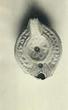
Rim sharply down sloping, with a row of small circles; plain concave discus, with seven filling holes. Handle solid, double grooved above ... 6 June 1933 |
| Leaf pattern on rim; on the discus a shell, rather faint; solid handle double grooved above and below. Double almond-shaped grooves on the reverse; palm branch within.
Unglazed.
Pinkish clay.
Type XXVIII ... 7 June 1933 |
| Nozzle, and front part below, broken away.
Herringbone on the rim; on the discus Christian monogram, with the tail of the "rho" to the right. Central filling hole, and two more in the lower quadrants ... 7 June 1933 |
| Fragment from back part.
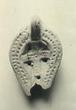
On the rim, next the handle, small panels of herringbone; some other motif beyond. On the discus, a head, left, with a coiffure resembling that of Men-Mithras.
Handle solid, double ... 8 June 1933 |
| Wavy lines on the rim, with groups of three dots on either side of the handle and nozzle.
Christian monogram on square discus; the tail of the "rho" to the right; filling holes in the lower quadrants ... 8 June 1933 |
| The end of the nozzle and the lower part of the lamp in front broken away; mended from two pieces.
Christian monogram on discus; the tail of the "rho" to the right; filling holes in the other three quadrants ... 8 June 1933 |
| On top surface, the lower part of a draped female figure; the garment is decorated with dot rosettes and broad irregular bands; sketchy relief lines. On the flange is an ovolo pattern; inside, plain black ... 25 July 1931 |
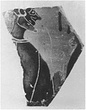
| From body of miniature lekythos(?). Preserved, fragment of drapery and foot of female figure fleeing to right, pursued by male clad in chlamys; his outstretched left hand and a bit of his drapery alone ... 1931 |
| A small fragment showing part of the pillar of Athena and a bit of the inscription.
Glaze in poor condition; thin glaze on the interior. Disturbed area. Leica ... 22 May 1933 |
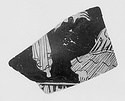
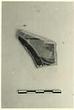
| From the wall of a krater; the inside glazed, with a bit of a reserved band preserved at the top of the fragment where it begins to curve out towards the rim. Bearded male figure to left. Relief contour ... 23 May 1933 |
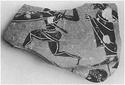
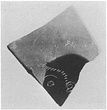
| A small fragment of the shoulder and the upper part of the wall of the side are preserved. On the shoulder a warrior is running left in full battle array: sword, helmet, greaves, shield and (presumably) ... 29 May 1933 |
| From the wall of a large pot. Head, shoulders, right leg below the knee, and all the left side of the body missing. The figure, nude save for a chlamys, fastened around his neck and hanging down behind ... 29 May 1933 |
| Late Roman C plate fragment. The fragment rises slightly in the center where it is stamped with a small cross(?) with dots in the quardrants and concentric squares above it. Around this are eight impressions ... Card: ca. 440-490 A.D. |
| From the shoulder of a large closed vase. Along the top a tongue pattern, the tongues alternately black and red. In the field a warrior to left, his spear upraised in his right hand, his left arm doubled; ... 11 April 1933 |
| From the center of a stemless cup; ring base more than one-quarter preserved. The figure of an athlete missing above the hips; the left hand, held close to the side, holds a long curving object (strigil?) ... 13 April 1933 |
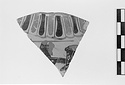
| The central medallion of the exterior is preserved, with a small bit of the ribbed sides. Central design: flower with four petals and four sepals, with a raised circle between each; bordered by similar ... 15 June 1933 |
| From edge of one-half of a double disk or bobbin(?). Around outside, a branch with berries in added red. Within part of uncertain scene. Underside reserved, reddened. Relief contour. Either near Civic ... December 1953 |
| Head and shoulders of woman, right; peplos, earring, necklace, knitted(?) sakkos. No relief contour. Added clay for ornaments; white for flesh; the dress once painted in an added color.
Pinkish-buff ... (1953) |
| Rim fragment from a large plate, neatly moulded. Part of ring foot with flat resting surface reserved. On rim, between reserved bands, ivy wreath, the leaves reserved, the stems and berries white. Late ... 1949 |
| Wall fragment. Head and shoulders of a satyr; body in front view, head profile to right; left hand rests on the head. White fillet round the head. Other white fillets in the background. No relief outline ... October 1950 |
| Only the crown of the head, the upper part of the face and the right side of the beard preserved.
A very crudely gouged head with round crown, staring eyes, elementary mouth and beard indicated by parallel ... 14 June 1933 |
| Left arm, shoulder and hip preserved.
Bracelet on wrist.
Covered with engobe on which both red and yellow were applied.
Coarse red clay. Lowest black earth filling lying on classical floor. Leica ... 14 June 1933 |
| From the floor of a heavy plate. Head and shoulders of draped figure right. Very poor condition; added white practically disappeared from face and part of clothes. Agora area, context unknown. Leica ... (February 1957) |
| Most of foot and center of floor preserved, with start of walls. Moulded ring foot.
Interior, mantel figure, right. Other figures on sides A and B. No relief contour. Glazed and reserved circles on underside ... March 1957 |
| From the floor of a very large plate; two moulded rings beneath; fish plate? Parts of four figures: leg of small standing figure, white, Eros. Knees and legs of draped seated female figure; standing female ... March 1957 |
| Wall fragment. Male head, wreathed and bearded, left. Partial relief contour. Surface of Panathenaic Way; Agora excavations. Exact provenience unknown. Leica ... March 1957 |
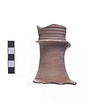
| Single fragment: neck, broken off below rim, with handle stump.
Tall narrow cylindrical neck with a thin flange on upper part; mouth section bears fine rilling. Stump of a shallow shoulder below. Top ... 17, 18, 20, 21 March 1933 |
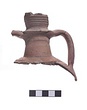
| Two joining pieces preserving neck, one handle and upper section of other, and part of shoulder. Stump of a funnel-mouth, rilled as on P 33438, above a thin flange; lower part of neck near-cylindrical, ... 17, 18, 20, 21 March 1933 |
| Single large rim fragment of Late Roman "Light-Colored" ware. Vertical rim with small overhang at bottom, oblique wall. Angle on interior at junction with rim, slight groove above. Row of shallow multiple-toothed ... 17-18, 20-21 March 1933 |
| Single fragment of rim and wall.
Low sloping rim; shallow sloping floor, thickening towards missing foot.
Brown clay, rather clean-breaking, purplish-brown semi-metallic slip all over, with polishing ... 17-18, 20-21 March 1933 |
| Part of rider, right, and at the left upper corner, legs of horses galloping behind; the latter in larger scale. Unglazed inside.
Buff-pink clay. Provenience unknown. Leica, 80-43-4 ... September 1954 |
| Single fragment preserves some of sharply out-turned rim and of wall. A draped standing figure facing left; facing him part of drapery of a second figure, the hand holding "discus" decorated with a cross ... 1 December 1954 |
| Man right, in himation; most of head, upper front part, right hand. Part of a second figure on the break to the right. Use of red. Part of a glazed band preserved inside.
Buff-pink clay; glaze somewhat ... May 1955 |
| Small wall fragment, from bowl(?). Outside: two concentric grooves. Inside: daisy with looped stem, painted in white and applied clay.
Clay pinkish-buff. Disturbed area. Leica ... 1933 |
| Fragment from upper wall, broken all around.
Part of Athena's head, left, with shield and spear.
White paint on her face. Interior covered with thin glaze. Clearing early foundation beddings in N.W ... 27 March 1936 |
| Wall fragment, broken all around. Part of youth's head to left.
Thin brown glaze inside. Clearing early foundation beddings in N.W. corner of section. Leica ... 27 March 1936 |
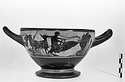
| Mended from many pieces; parts of wall, rim and one handle missing; restored in plaster. Deep skyphos with rounded walls, drawn in slightly at lip. Broad flaring foot; moulded rim at junction of foot and ... 1933 |
| Full thickness preserved as well as a portion of a relief, broken away on all sides.
High relief, possibly representing a seated dog whose long neck, shoulder and the beginning of his back are preserved ... 26 July 1969 |
| Preserved is a portion of sculpted relief. Broken away on all sides. Full thickness preserved. Front of surface partly broken away.
Represented is an arm against a large circular shield with another figure ... 20 July 1969 |
| Preserved is the upper part of a boy's figure, running (or kneeling?) left, and looking back to the right, his arms outstretched on either side. No relief contour; brown for the hair, with a black fillet(?) ... 1933 |
| Late Roman C plate fragment from the medallion. Stamped in the middle with a Christian monogram, with open rho, its tail apparently ends in a hook.
Dull red clay containing many particles of grit. Thin ... 7 April 1933 |
| Part of P 1521. Late Roman A plate fragment mended from five pieces. A bit of the rim and about one-third of the bottom of the plate preserved. Low ring foot; curving sides; downward rim with two grooves ... Card: ca. 440-500 A.D. |
| Late Roman B plate fragment. Mended from six pieces; restored in plaster. Possibly one-third of the plate is preserved. Ring foot edged by grooves; very flat sides; vertical rim with two grooves on outside ... Card: ca. 430-475 A.D. |
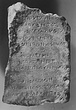
| Inscribed fragment.
Broken on all sides.
Four lines of the inscription preserved.
Pentelic marble. Finished Found in a marble pile, in the northwest corner of the Market Square. Leica ... 12 May 1934 |
| Inscribed fragment.
Broken all around and behind.
Citation.
Hymettian marble. Found in Byzantine context, below the floor of the room XVIII, of a Byzantine building, east of the Stoa of Zeus. Leica ... Ca. 200 B.C. |
| Fragment of inscription.
Broken on all sides.
Four lines of the inscription preserved.
Pentelic marble. Found in modern packing behind retaining wall, opposite the north wing of the Stoa of Zeus. Leica ... 19 July 1933 |
| Fragment of inscribed stele.
Part of right side preserved; otherwise broken.
Inventory of platters given by the prytanies and listed by archons.
Archons: Molon (362/1 B.C.), Nikophemos and Dynniketos (370/369 ... 350 B.C. |
| Inscribed fragment.
Broken on all sides.
Part of a moulding is preserved over the inscription.
Hymettian marble. Found in a marble dump, in the northwestern corner of the Market Square. Leica ... 19 October 1933 |
| Inscribed fragment.
Broken on all sides.
To the right of the piece, one line of the inscription, and a trace of a second.
Pentelic marble. Found in a marble dump, southeast of the Stoa of Zeus. Leica ... 2 January 1934 |
| Inscribed heptagonal base.
Bottom rough picked; top much worn and flaked, with a small round hole, near the inscribed face.
The circumference presents the deceptive appearance of what would have been an ... 1933 |
| Inscribed fragment.
Remains of an inscription in two columns, that to the right being a list of names. Parts of fifteen lines of the inscription preserved.
Pentelic marble. Pre-excavation. Found in the ... 1st. century B.C. (?). |
| Inscribed fragment from the right edge of the block, with part of the fine picked right surface preserved.
On the smooth finished face, the right side of a small wreath, open at the top, and the greater ... Middle of 1st. century B.C. |
| Upper left side of inscribed stele; on the head a tripod in relief.
The rough picked back, and more finely picked side surfaces are preserved. The top as preserved shows rough-picked scallops along the ... 4th. century B.C. (?). |
| Inscribed fragment.
The inscribed surface shows a horizontal curve, very slight.
Possibly from a columnar grave stone, but if so from a very large one.
Seven and a half letters preserved.
Pentelic marble ... 1933 |
| Inscribed fragment.
Right edge preserved; back rough picked.
Pentelic marble.
ADDENDA Joined to I 6170;
Joins I 3025, I 5855. Finished Found in context of late Roman time in plundered foundation trench ... 2nd. century A.D. |
| Convex side; herringbone on rim; plain discus; solid handle with double groove above; on reverse, enclosed in an almond-shaped groove connected with the handle by a raised grooved ridge, the inscription ... 14 June 1933 |
| The handle, and part of the rim, sides, discus, and bottom preserved.
Convex sides; solid handle with double groove above and below; herringbone on rim; plain discus, except for three small circles at ... 23 June 1933 |
| The handle, and part of the rim, sides, and discus preserved.
Double convex sides; ovules on rim; head of Helios, rayed, on discus; solid handle.
Reddish-buff slip.
Reddish clay.
Type XXVIII of Corinth ... 23 June 1933 |
| Fragment of sides and bottom preserved.
Convex sides; lower part of handle double grooved. In a raised border on the reverse: "I", with a circle above and below.
Buff slip and clay.
Type XXVIII of Corinth ... 23 June 1933 |
| A bit of the signed base is preserved.
Traces of the grooved handle outside the double grooved circle enclosing the signature.
Buff slip (?).
Light reddish-buff clay.
Type XXVIII (?) of Corinth collection ... 26 June 1933 |
| Part of bottom and sides preserved.
Within a double heart-shaped groove: "E I".
Traces of grooved handle above, flanked by three circles.
Buff slip.
Reddish clay.
Type XXVIII (?) of Corinth collection ... 26 June 1933 |
| Fragment of sides and bottom.
Within a double groove, almond-shaped, the signature.
Above, the start of a grooved handle.
Unglazed.
Buff clay.
Type XXVIII of Corinth collection.
Ashes. Leica ... 26 June 1933 |
| Small fragment from shoulder.
Head of Athena to right; tongues. Landscaping operations in the excavations; exact provenience unknown. Leica ... January 1955 |
| Fragment from near top. Head, shoulders and right hand of Athena, her face seen three-quarters to right. Spear in right hand. At right, a nude standing male figure, right; his right arm bent. Applied white ... 1947 |
| Foot and lower walls preserved. Resting surface and side of foot reserved. Figured zone, on border of three glazed lines, chariot and legs of two horses, right; standing figure at left.
Pink-buff clay ... May 1928 |
| Lat Roman red ware rim fragment.
Heavy hooked flange below rim on outside. Normal ware.
Late Roman Red Ware. Catalogued April 1967. Burnt layer, 1933. Leica PD 3083-140, DA 10001 ... (April 1967) |
| Late Roman red ware base fragment. Flat base. Series of small stamped palm branches on floor, between thin grooves.
Late Roman Red Ware. Catalogued April 1967. Burnt layer, 1933. Leica PD 3083-204, DA ... (April 1967) |
| Single fragment preserves about one-third of the base to near center of floor. Disk foot, slightly concave beneath; outer edge rounded. The center of the floor is depressed. In the raised area around the ... August 1961 |
| Broken all around. Unidentified representation from reverse of Panathenaic amphora. Agora excavations. Leica ... 5 February 1962 |
| Fragment from rim of bowl. Two grooves on outer face; V-shaped moulding below rim on inside.
Smooth orange-red slip, brownish on outside.
Late Roman Red Ware. Cf. H-I 7-8:1. Burnt layer, 1933. Leica ... 1964 |
| Rim of large plate. Flat floor, broad flat rim with groove at lip. Groove at edge of base.
Deep brownish-red clay and slip.
Late Roman Red Ware. Cf. H-I 7-8:1. Burnt layer, 1933. Leica PD 3083-153, DA ... 1964 |
| Rim and wall fragment, made up of two joining parts; stump of foot preserved. Curved wall, vertical rim. Three grooves on rim, broad band of rouletting on exterior of wall. Grooves at edge of floor.
Late ... 1964 |
| From rim of dish. Thickened rim, slightly hooked.
Deep brick red clay and slip.
Late Roman Red Ware. Cf. H-I 7-8:1. Burnt layer, 1933. Leica PD 3083-130, DA 10001 ... 1964 |
| Three joining fragments of floor of dish. Four stamped palm branches around center, pointing inwards, surrounded by two lines of crude rouletting.
Late Roman C. Cf. H-I 7-8:1. Burnt layer, 1933. Leica ... 1964 |
| Rim fragment of dish. Plain vertical rim, bearing rouletting on the outside.
Fired purple on outside.
Late Roman C.
Fragment added from A tin 29. Cf. I 7:1. Lime pits. Leica PD 3083-219, DA 10004 ... 1964 |
| Rim and base fragments of Late Roman bowl. Hemispherical bowl with low foot. Two grooves on inside below rim, two grooves on floor.
Light orange clay, thin metallic light purplish-brown slip.
Imported ... 1964 |
| Base fragment of Late Roman bowl or small dish. Low foot. On floor, edge of a central stamped motif (cross?), surrounded by two grooves.
Light orange-brown slip; light orange clay.
Import.
Cf. P 27166 ... January 1964 |
| Late Roman dish fragments.
a) Two joining fragments preserving profile.
b) Fragment from floor.
Short concave rim, low wall, low foot. Broad band of rouletting around floor.
Light orange clay, good ... January 1964 |
| Two inscribed fragments.
Fragment Η' 445 a), broken on all sides.
Fragment Η' 448 b), left side preserved, finely picked with tooth chisel.
Hymettian marble.
ADDENDA Belongs with I 1015, I 1017, and ... 186/5 B.C. |
| Fragments of inscription.
Fragment Η' 472 a), broken all round and probably behind.
Part of four lines of the inscription preserved.
Fragment Η' 475 b), broken all around and behind.
Part of six lines ... a) (Η' 472) 22 June 1933
b) (Η' 475) 23 June 1933 |
|
|