|
|
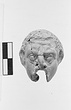
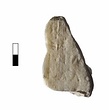
| Front part of egg-shaped head, with large features nearly obliterated.
Mould-made; hollow. Abundant remains of white paint, with traces of yellow and black.
Coarse light red clay.
Late Roman. 015/ΜΓ* ... 22 April 1932 |
| Inscribed heptagonal base.
Bottom rough picked; top much worn and flaked, with a small round hole, near the inscribed face.
The circumference presents the deceptive appearance of what would have been an ... 1933 |
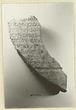
| Inscribed fragment.
Remains of an inscription in two columns, that to the right being a list of names. Parts of fifteen lines of the inscription preserved.
Pentelic marble. Pre-excavation. Found in the ... 1st. century B.C. (?). |
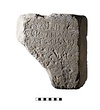
| Inscribed fragment from the right edge of the block, with part of the fine picked right surface preserved.
On the smooth finished face, the right side of a small wreath, open at the top, and the greater ... Middle of 1st. century B.C. |
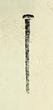
| Long tapering shaft; small head with edge slightly overhanging. Burnt layer. Leica ... 6 May 1933 |
| Inscribed fragment.
Broken on all sides.
Part of a moulding is preserved over the inscription.
Hymettian marble. Found in a marble dump, in the northwestern corner of the Market Square. Leica ... 19 October 1933 |
| Inscribed fragment.
Broken on all sides.
To the right of the piece, one line of the inscription, and a trace of a second.
Pentelic marble. Found in a marble dump, southeast of the Stoa of Zeus. Leica ... 2 January 1934 |
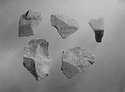
| Five fragments of an inscription.
Tribute Assesment.
Fragments Η' 255 a-d), are broken all round.
Fragment Η' 255 e), part of the left side is preserved, smooth dressed for 0.008m. back of the face; ... 410 B.C. |
| Very small inscribed fragment.
Broken top, bottom, right side and back.
Left side, smooth polished finish, like the face.
Pentelic marble.
ADDENDA Joining with this is another small fragment I 796.
I ... Before 9 B.C. |
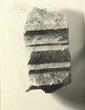
| Fragment from capping member of monument base.
Broken away at left end. It was topped by a projecting cornice, now broken away save for the bed moulding. The block lies upside down. Top proves to be rough ... 22 May 1933 |
| Inscribed fragment.
Right edge preserved; back rough picked.
Pentelic marble.
ADDENDA Joined to I 6170;
Joins I 3025, I 5855. Finished Found in context of late Roman time in plundered foundation trench ... 2nd. century A.D. |
| Inscribed fragment.
Broken on all sides.
Four lines of the inscription preserved.
Pentelic marble. Finished Found in a marble pile, in the northwest corner of the Market Square. Leica ... 12 May 1934 |
| Inscribed fragment.
Lettered face and right side only preserved.
Five lines of the inscription preserved.
Pentelic marble. Found in marble dump, in the northwest corner of the Market Square. Leica ... 23 May 1936 |
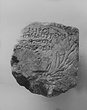
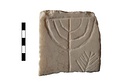
| Right and left edges only preserved. Other edges broken. The menorah and a palm branch are deeply incised on a thin piece of revetment; apparently placed symmetrically on thin strip of revetment. The right ... 8 May 1933 |
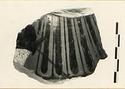
| Small fragment from shoulder.
Head of Athena to right; tongues. Landscaping operations in the excavations; exact provenience unknown. Leica ... January 1955 |
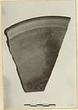
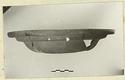
| Almost full profile preserved of dish. Shallow curving floor, with low vertical rim. Low triangular foot. Lightly burnished pattern of floor.
Orange-red ware, blackened in parts.
Late Roman Red Ware ... 1964 |
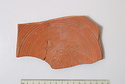
| Rim fragment of dish. Two grooves on outside below rim.
Late Roman Red Ware. Cf. H-I 7-8:1. Burnt layer, 1933. Leica PD 1083-149, DA 10000 ... 1964 |
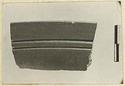
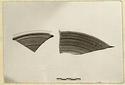
| Two non-joining fragments from rim and wall of Late Roman bowl. Several grooves and lines of rouletting on inside of wall; three grooves on outside. Short out-turned rim, slightly concave on top.
Light ... January 1964 |
| Five joining fragments preserving rather over half of the rim and about one-third of a Late Roman B bowl. Rim slightly overhanging and vertical; profile below convex-concave-convex continuing into rounded ... Ca. 360-420 |
| About one-half of base preserved, in two joining fragments, of a Late Roman C bowl. Stamped decoration: central kantharos surrounded by peacocks; two bands of triple rouletting.
Orange clay and surface ... 1933 |
|
|