|
|
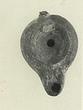
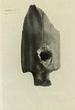
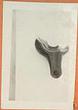
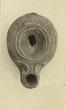
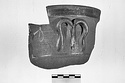
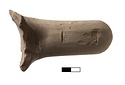
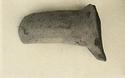
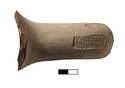
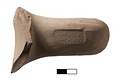
| Nozzle from phallic lamp.
Unglazed.
Coarse red clay. 645 Leica, LXIX-23 ... 1931 |
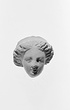
| Broken at back and neck.
The face is oval with small fairly delicate features. The hair has a central part and is drawn back from the face in loose waves. At the top of the head, behind the roll of hair, ... 7 August 1931 |
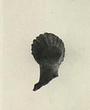
| Head of dove figurine.
Broken at neck.
Hooked beak; a very few details: round circle for eye, and oblique line setting off beak, added by large gouges.
Mold made with pared join along top. No glaze.
Clay ... 19 February 1932 |
| Back of head.
On left side part of neck preserved with top of garment.
Knot of back hair in form of stout peg. From this over head radiate gouged lines with carelessly placed cross hatching.
Mold made ... Card: Late 2nd or early 1st c. B.C. |
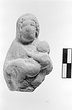
| Upper part preserved to under elbow left side, and to a little lower, right side.
She holds the naked infant with its head in the crook of her left arm, her right hand at its knees. Its hand seems to pull ... 2 March 1932 |
| Edges broken all around.
Life size nose from head or mask. Short nose, thick at nostrils.
Considerable traces of red paint.
Pale buff clay. Lowest red stratum. Leica ... 9 March 1932 |
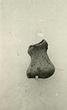
| Mold of a plastic vase in the shape of a knukclebone.
On the outside a roughly incised letter delta (Δ).
Pinkish clay. 415 Leica, 2-118 ... Card: 3rd c. B.C. |
| Large nose from tragic mask.
Preserved from bridge of nose to short upper lip.
Nostrils pierced.
Pinkish gray clay; much blackened. 620 Leica ... 7 September 1931 |
| Lower part of figure, seated on throne.
The bottom edge and right side of the mold is preserved; broken at the left side and at the top, at the knees.
The mold for the feet is shallow, without any differentation ... 28 July 1931 |
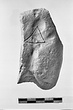
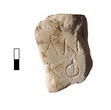
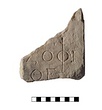
| Inscribed fragment.
Broken all around.
Fragment with imperial letters.
Pentelic marble.
ADDENDA Same inscription with I 10, I 60, I 64, I 815. Finished Found at a late Roman level, above the foundation ... 177-180 A.D. |
| Inscribed small fragment of grave monument.
The top surface meets the face in a beveled edge; other sides broken.
Traces of red in the letters.
Pentelic marble.
ADDENDA Belongs to I 47. Found at a late ... Late 6th. century B.C. |
| Wedge-shaped fragment inscribed on both faces.
Circular bit of upper surface preserved, joining face (b); other edge broken.
Pentelic marble. Finished Found in a modern wall, in the north part or northwest ... 2 July 1931 |
| Inscribed fragment from the right side of a block.
Right edge and original thickeness preserved; other edges broken; face roughly dressed; back has been rough picked, but is probably not original.
Pentelic ... 6 July 1931 |
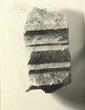
| Inscribed fragment.
Broken on all sides.
Part of a moulding is preserved over the inscription.
Hymettian marble. Found in a marble dump, in the northwestern corner of the Market Square. Leica ... 19 October 1933 |
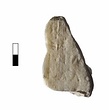
| Inscribed fragment.
Broken on all sides.
To the right of the piece, one line of the inscription, and a trace of a second.
Pentelic marble. Found in a marble dump, southeast of the Stoa of Zeus. Leica ... 2 January 1934 |
| Inscribed fragment.
Broken on all sides.
Four lines of the inscription preserved.
Pentelic marble. Finished Found in a marble pile, in the northwest corner of the Market Square. Leica ... 12 May 1934 |
| Inscribed fragment.
Lettered face and right side only preserved.
Five lines of the inscription preserved.
Pentelic marble. Found in marble dump, in the northwest corner of the Market Square. Leica ... 23 May 1936 |
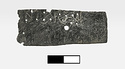
| Thin oblong plaque, inscribed.
The left end of the plaque is broken off. At the right end is the partially obliterated outline of a stamped Gorgoneion. On the reverse are traces of a rectangular stamp ... 20 July 1931 |
| Small fragment from shoulder.
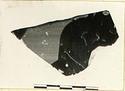
Head of Athena to right; tongues. Landscaping operations in the excavations; exact provenience unknown. Leica ... January 1955 |
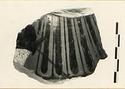
| Broken all around. Unidentified representation from reverse of Panathenaic amphora. Agora excavations. Leica ... 5 February 1962 |
| From the floor of a heavy plate. Head and shoulders of draped figure right. Very poor condition; added white practically disappeared from face and part of clothes. Agora area, context unknown. Leica ... (February 1957) |
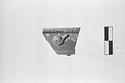
| Small wall fragment, from bowl(?). Outside: two concentric grooves. Inside: daisy with looped stem, painted in white and applied clay.
Clay pinkish-buff. Disturbed area. Leica ... 1933 |
| Arched horizontal handle attached at top of swelling body of pot, of which a bit of the flaring rim is also preserved; the handle is split into five by grooves. Set on each attachment a plastic female(?) ... 2 March 1932 |
| Base only preserved, probably from an open bowl. Scratched in dry clay of underside:
Attic clay; dark brown glaze. Nb. p. 642, #32. 642 Leica PD #1133-23(F 189) ... 1931 |
| Spiral coil in relief beneath moulded rim. Narrow raised band marks lower edge of rim. Rim vertical and seems to have projected slightly from body of vase.
Fine light red clay; good thick red glaze inside ... 1931 |
| Vertical handle broken away.
Body covered with raised dots.
Discus plain, rather deep; surrounded by triple groove and raised edge.
Nozzle rounded, decorated in volutes; set off from body by raised band ... 1 March 1932 |
| Lower part of "Telesphoros" lamp.
Back left plain, with a little of lower part preserved. Figure broken at ankles and a little below the neck; nozzle also broken away.
Figure muffled in cloak, with opening ... 19 February 1932 |
| Nozzle and fragment of rim preserved.
On rim, single rill, showing miltos red in bottom.
Long nozzle, broadening slightly toward tip.
Lustrous black glaze inside and outside.
Fine pink to ash gray clay ... 3 September 1931 |
| Complete except for handle.
Discus, plain, depressed, surrounded by two narrow raised bands. On throat double volutes. Vertical strap handle. Walls covered with raised dots.
Covered with thin purple metallic ... 6 September 1931 |
| Fragment from rim and wall, preserving one handle. A small krater with a collar around top of wall, and a double handle affixed to the wall throughout. On one side, part of a draped woman moving right ... 13 March 1939 |
| Fragment from top of wall. Vertical wall with a collar round its top outside, 0.03m. high and projecting ca. 0.01m. On the wall just below collar the top of a letter (Ο).
Collar and inside retain traces ... April-May 1952 |
| Appears to be typical, arched. Fragment preserves a good deal of ahndle but not in section with the neck.
Typical clay.
Very faint impression; letters round most of circumference worn away. Finished ... 9 March 1932 |
| Thick, rising, broken at curve; somewhat twisted.
Similar clay to typical Rhodian.
Impression much chipped round right end; worn in middle. Finished Σωκράτευ̣ς burning torch Leica ... 9 March 1932 |
| Slightly descending, with start of curve far from neck; broad; ribbed.
Coarse clay; large grey core; red near surface; light slip.
Small framed monogram; set close to neck; uneven depth.
Early Knidian ... 9 March 1932 |
| Arched; rising.
Typical clay; red core, large.
Impression rather careless for Rhodian. Finished Ἐπ' Ἰερέως
Ξενοφάν
του Leica ... 11 March 1932 |
| High rising.
Fine clay, reddish-buff with light red core; cream slip, traces of red paint.
Careless impression for Rhodian. Dte: 1/2 3c BC (VG v.62)*Dip: traces of red paint* Finished Lowest stratum ... First half of 3rd century B.C. |
| Rising; neck not preserved.
Fine clay; resddish-buff, redder at core; cream slip; surface pitted.
Left end of the impression broken away with part of one letter; worn.
Cf. SS 31. Par: SS 00031*
Dte: ... First half of 3rd century B.C. |
| Slightly rising; broad, ribbed, broken at curve.
Coarse clay; red, grey at core; light slip.
Impression incomplete above an d below; retrograde. Dte: 188--167 BC (VG, v.62)* Lowest stratum. [Ε]ὐ̣κ̣ρ̣ ... 188-167 B.C. |
| Rising; angular.
Buff clay, red at cote; traces of cream slip. Surface including breaks blackened; much damaged.
Doubled impression, flaked off left end. Stp: doubled*Dte: 3/4 3c BC (VG v.62)* Lowest ... Third quarter of 3rd century B.C. |
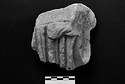
| Fragment of right shoulder covered by Isis shawl (four narrow folds preserved), one long lock curled on shoulder and narrow arc of smooth-surface of flesh at neck, are preserved. No drilling of lock of ... Period of Trajan. |
|
|