|
|
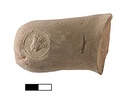
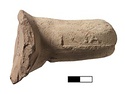
| Complete.
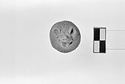
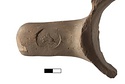
Probably intended for plastic heads to be attached as spouts to gutti.
Outside incised while clay was still soft with letter Σ twice.
Fine buff clay, well baked. Clearing bedrock at west side ... 1932 |
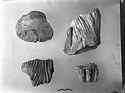
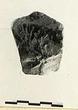
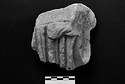
| Four fragments of statue.
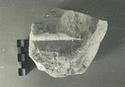
Fragment a) broken all around. Part of a human body with something in contact with it.
Greenish yellow clay containing dark grit, surfaced with a film of firm clay, the surface ... 14 June 1936 |
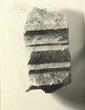
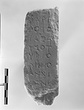
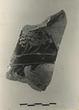
| Inscribed fragment.
Broken on all sides.
Part of a moulding is preserved over the inscription.
Hymettian marble. Found in a marble dump, in the northwestern corner of the Market Square. Leica ... 19 October 1933 |
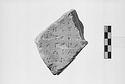
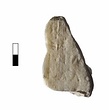
| Inscribed fragment.
Broken on all sides.
To the right of the piece, one line of the inscription, and a trace of a second.
Pentelic marble. Found in a marble dump, southeast of the Stoa of Zeus. Leica ... 2 January 1934 |
| Inscribed fragment.
Small fragment, broken on all sides and behind.
Seven lines of the inscription preserved; stoichedon.
Space between lines, five including: 0.059m.
Space between letters, five including: ... 22 May 1940 |
| Inscribed fragment.
Inscribed on two band, the upper projecting.
"POLETAI" record or prytany decree (?)
Two lines of the inscription preserved.
Pentelic marble. Found in marble dump on Kolonos Agaraios, ... 24 March 1936 |
| Inscribed fragment.
Right edge and face only preserved.
Nine lines of the inscription preserved, trace of tenth; stoichedon.
Pentelic marble. Finished Found in dump, on the north slope of Kolonos Agoraios ... 27 April 1937 |
| Inscribed fragment.
Broken on all sides.
Four lines of the inscription preserved.
Pentelic marble. Finished Found in a marble pile, in the northwest corner of the Market Square. Leica ... 12 May 1934 |
| Inscribed fragment.
Lettered face and right side only preserved.
Five lines of the inscription preserved.
Pentelic marble. Found in marble dump, in the northwest corner of the Market Square. Leica ... 23 May 1936 |
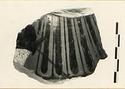
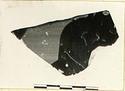
| Small fragment from shoulder.
Head of Athena to right; tongues. Landscaping operations in the excavations; exact provenience unknown. Leica ... January 1955 |
| Broken all around. Unidentified representation from reverse of Panathenaic amphora. Agora excavations. Leica ... 5 February 1962 |
| From the floor of a heavy plate. Head and shoulders of draped figure right. Very poor condition; added white practically disappeared from face and part of clothes. Agora area, context unknown. Leica ... (February 1957) |
| Small wall fragment, from bowl(?). Outside: two concentric grooves. Inside: daisy with looped stem, painted in white and applied clay.
Clay pinkish-buff. Disturbed area. Leica ... 1933 |
| Preserved: most of helmet, forehead, eye and part of hair of Athena.
Probably by the same artist who decorated the Panathenaic of Ariarathes V (163-130 B.C.) in the National Museum (ArchEph (1948-1949), ... (1956) |
| Arched; rising; broken at curve; none of neck preserved.
Not ver fine clay, otherwise typical; traces of red paint.
Impression so shallow set that most of the circumference is missing. Dip: traces of ... 9 March 1932 |
| Similar to angular Rhodian; twisted.
Fairly fine reddish-buff clay; cream slip.
Impression incomplete above; large letters. Finished [ Ἱεροκλεῦς]
ΙΑ Leica ... 10 March 1987 |
| Large fragment with part of rim. Angular, rising.
Typical clay.
Impression set carelessly and close to neck. Only a few letters legible. Finished [Σ]οσ[ι]κλε̣[υς]?
rose
(in O) Leica ... 10 March 1932 |
| Thick; rising; broken before curve.
Fairly fine clay; tan with small right red core. Pinkish-cream slip.
Impression set close to neck; centre of upper line damaged. Finished Below ground level of late ... 10 March 1932 |
| High arched curve close to neck.
Coarse, orange-red clay, greyish at core.
Impression shallow set on top of curve. Par: SS 00280* Below ground level of late building. ΠΥΧ (Π,Υ,Χ monogram in O) Leica ... 10 March 1932 |
| Fragment of right shoulder covered by Isis shawl (four narrow folds preserved), one long lock curled on shoulder and narrow arc of smooth-surface of flesh at neck, are preserved. No drilling of lock of ... Period of Trajan. |
|
|