|
|
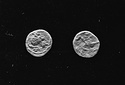
| Athens ... Coin no. 6.
Casts stored in Lab Case no. 52B. Red fill under Late Roman mosaic floor. Head of Athena r., wearing Corinthian helmet. Border of dots. A-[ΘΕ]
Artemis, quiver at shoulder, running r., carrying ... 70's-40's B.C. |
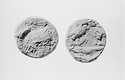
| Athens ... Coin no. 63; 61.00 -4.30 to stereo. Green sand drain fill. Head of Athena r., wearing Attic helmet. Legend illegible.
Double-bodied owl standing on mystic staff. 189 85-17-12, 85-17-13 ... Ca. early-mid 330's - 322/317 B.C. |
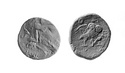
| Athens ... Double-struck. Coin no. 1.
Cast stored in Lab Case no. 52B. Long N.S. late wall. Head of Athena r., wearing Attic helmet. Θ/Α/Ε
Owl standing three-quarters r., facing, wings lifted; at r., plemochoe. 1225 ... Ca. 224/223-198 B.C. |
Ptolemy IX, Ptolemaic Kings ... Cyrenaica mint. Ptolemy X. Coin no. 1. Foundation of long N.S. late wall. Head of Zeus Ammon r. BAςIλ[Eως πTOλ]EMAI[OY]
Isis crown; at l. and r., ς-ω. 1230 ... 117-81 B.C. |
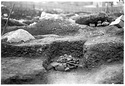
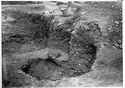
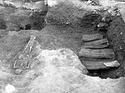
Filling of early N-S road and related fills, in the area of the Geometric Cemetery south of the Tholos; various levels including plundered foundation trench.
For late, disturbed or uncertain levels over ... 7th-6th c. B.C. |
Rodney S. Young ... Grave 1 in notebook. Slightly disturbed by the digging of Pit A.
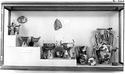
A large oil jar/amphora lay on its side with a flat stone stopping its mouth. The three small vases offered at the burial were found, together ... Ca. 600 B.C. |
Grave 3 in notebook. Grave partly destroyed by well B. Skeleton and offerings lost. The amphora mouth was doubly stopped by the bases of two other amphoras, one in its neck, the other in its mouth ... 750-725 B.C. |
| Rodney S. Young ... Grave 4 in notebook. Amphora, no other pots but carbonized remains of food offerings. Over urn two stone slabs, on top, mass of small stones containing Late Geometric sherd ... Late Geometric |
| Rodney S. Young ... Grave 5 in notebook.
The grave had been somewhat disturbed by the digging of Well B. The hydria lay on its side; in it was found the skeleton of a small child lying on its side with the knees drawn up ... Late 8th-early 7th c. B.C. |
| Grave 7 in notebook. Area disturbed in Roman times; outlines of the shaft had been obliterated.
The northwest end, however, was preserved in a cutting in the rock of the sloping hillside. This cutting, ... 750-700 B.C. |
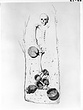
| Grave 7b in notebook. Inhumation in Tholos Cemetery; The skeleton positioned directly below the male in Grave 7, but with direction reversed, i.e., head at southeast end. Most grave offerings at lower ... 750-725 B.C. |
| Urn Burial in Tholos Cemetery. Grave 9 in notebook.
Amphora containing bones of a small child. Little pots had been put under its neck ... Late 8th-Early 7th c. B.C. |
| Burned Deposit. A thick deposit of ash, cinders and pottery fragments extending alongside wall of cemetery. Character of pottery like the pyre of F 12:2 ... Late Geometric |
Circular well cut through the old road after it had gone out of use, and filled probably at the time of the building of the drain and building A, and the throwing of fill over the road ... Ca. 430-400 B.C. |
| Located in Tholos Trench E, beneath floor, beneath layer III.
Diameter 1m. Cf. P 4952 with fragment from this deposit and E-F 12-14.2.
Similar the well filling, H 6:5 Originally called H 12:5
Ann Steiner ... Ca. 470-460 B.C. |
John Camp ... Late Geometric or Early Proto-attic |
Dug as Tholos Trench V, Room E, burnt filling of plundered wall trench of S wall of court. See also lot Ζ 484 ... Late 6th c. B.C. |
Various layers and dates, primarily from Tholos Tr. L (area of early road drain), Q (area of road) and V (area of road).
Also Room G of Trench V listed with G-H 11-12 probably has road layers (no finds, ... 8th c.-ca. 480 B.C. |
Archaic house with Distyle Porch (= Building J) in southeast of section: packing beneath floors (Layers a and b of Tholos Trench S.Layer b=Beneath original floor dated to ca. 500 B.C.
Layer a=Between original ... 6th-early 5th c. B.C. |
Fillings in and to the north of Building A/Poros Building/Greek Building ("Strategeion"), the accumulation mostly a late archaic dump, but not deposited till near the middle of the century. Most of the ... First half of 5th c. to ca. 460-450 B.C. |
|
|