|
|
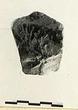
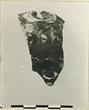
| Fragment of large mold for tail end of fish right (?).
Back smoothed, with rounded edges.
Coarse pinkish buff micaceous clay, full of large bits; Exact provenience uncertain. Leica ... 17 March 1932 |
| Inscribed fragments.
Fragment Δ 382, inscribed stele with outline of pediment cut in preserved top.
Broken into seven pieces. Upper left corner, bottom, and a section from both right and left sides missing ... Late 3rd. century A.D. |
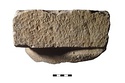
| Fragment of inscribed columnar base for dedication.
Front and left surfaces of the capital preserved, of abacus from corner for distances indicated by "W" and "T" measurements.
Top surface rough picked ... 1931 |
| Fragments from upper part of inscribed stele with relief above.
Fragment Δ 75 a), broken all around save front and back.
The better preserved surface shows legs and feet apart of frontal figure standing ... 100-150 A.D. |
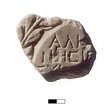
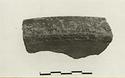
| Inscribed fragment.
Inscribed face only preserved.
Part of wreath around.
Ten letters remain.
Pentelic marble. Finished Found in modern context outside the Market Square, to the southeast. Leica ... 2 April 1935 |
| Athens ... Coin no. 16.
Casts stored in Lab Case No. 52C Red fill under Roman floor. Head of Athena r., wearing Attic helmet. Θ/A/E within three crescents, horns inwards, arranged in circle. 117 85-21-20 ... 4th c. B.C. |
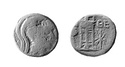
| Athens ... Coin no. 13. West side. Head of Athena Parthenos r. Border of dots. Α?-ΘΕ
Tripod; in field l., poppy; in field r., thunderbolt. 105 82-49-28 ... 42/41-39 B.C. |
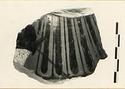
| Small fragment from shoulder.
Head of Athena to right; tongues. Landscaping operations in the excavations; exact provenience unknown. Leica ... January 1955 |
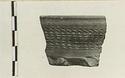
| Part of a high foot and part of floor of a dish(?). Multiple rouletting on outside of foot and round floor.
Buff ware, with thin grayish-brown coating.
Late Roman. Black fill. Leica PD 3083-19, DA 10008 ... February 1966 |
| From rim of a dish. Vertical curving rim, thickened on inside.
Orange ware and slip, fired a deep red-brown on outside of rim.
Late Roman C. Black fill. Leica PD 3083-218, DA 10004 ... February 1966 |
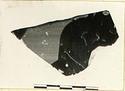
| Broken all around. Unidentified representation from reverse of Panathenaic amphora. Agora excavations. Leica ... 5 February 1962 |
| From the floor of a heavy plate. Head and shoulders of draped figure right. Very poor condition; added white practically disappeared from face and part of clothes. Agora area, context unknown. Leica ... (February 1957) |
| Torso of standing draped female preserved from shoulder to thigh; left shoulder missing, broken behind. She wears a heavy chiton with long ungirt overfold fastened on the right shoulder only. Considerable ... 5 April 1954 |
| Fragment from the wall of a bell krater, preserving part of a draped figure and part of a staff. The drawing glaze has fired black; the background glaze, and the glaze on the interior, red. Late Roman ... October 1947 |
| From a large bowl? On outside, band of bead and reel and egg pattern in relief.
Gray clay; gray to black glaze; much flaked on inside. Heavy fabric. Provenience unknown. Leica ... August 1947 |
| Much chipped around the edges. Walls concave, spreading above and below to form broad flat projecting rim and ring foot, respectively. Groove around inner edge of rim, separating it from top, which curves ... 22 April 1948 |
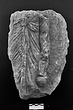
| Broken on all sides. Back rough-picked.
Head, feet and right arm missing of figure, which appears to be female holding some object, a situla, at end of hanging arm. Drapery focussed in knot on bosom ... 14 March 1932 |
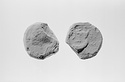
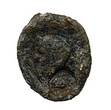
| A: male head, left.
Small circular countermark, perhaps cock, at bottom.
B: faint impression of earlier stamp. West side. Leica ... 15 February 1932 |
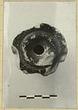
| Fragment showing upper left part of negro head, including eye and curls above forehead. At top, pour-hole.
Black glaze outside and inside. Added white for eyeball.
Pinkish-buff clay. Worthy sherds from ... 1956 |
| Unglazed fragment. On the outside, a white slip, on which the letters (four) are painted in red: Above the inscription the pot is ribbed horizontally.
Pink clay, somewhat micaceous. Fill of red earth, ... 3 February 1934 |
|
|