|
|
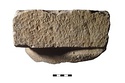
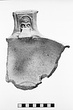
| Fragment of large mold for tail end of fish right (?).
Back smoothed, with rounded edges.
Coarse pinkish buff micaceous clay, full of large bits; Exact provenience uncertain. Leica ... 17 March 1932 |
| The head and part of the shoulders missing, and the bottom broken.
Late Roman.
Cf. T 525. Red fill. Leica ... 13 February 1934 |
| First interpretation: head of woman in peaked hood.
Broken off at the neck.
The high peaked hood (or handle) is pierced at the top as if for suspension.
Gouged technique.
Red clay.
Late Roman. In brown ... 26 February 1934 |
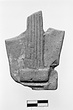
| First interpretation: in relief, a column, with incised fluting, and a square abacus.
Broken at bottom and upper right (or lower left) corner. The upper and side edges finished. The sides of the column ... 3-12 March 1934 |
| Mended from two pieces. The lower part of the face, broken off at the level of the eyes. A bit of the finished edge preserved beneath the chin. Part of the right eye hole remains.
Light slip.
Red clay ... 27 February 1934 |
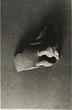
| Mended from two pieces; left leg and body from back of neck missing.
Gouged technique. Unglazed.
Pinkish buff clay.
Cf. T 1422. Well. Black fill. Leica ... 27 February 1934 |
| Part of a woman 's face, consisting of nose, upper lip, right cheek and part of right eye, preserved. Part of the pierced hole remains.
Light red clay, buff slip.
Cf. T 1818. Black fill. Leica ... 27 February 1934 |
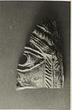
| Part of a woman 's face, the upper left side with part of the left cheek and the left eye preserved, and elaborately rendered hair.
A finished edge along the side; the eye hole large.
Red clay with white ... 2 March 1934 |
| Mended from three pieces; waist to knee.
The figure stands with the weight on the left leg, the right knee advanced.
The signature, the letter E, scratched in wet clay on the back.
Traces of white paint ... 12 March 1934 |
| Inscribed fragments.
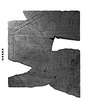
Fragment Δ 382, inscribed stele with outline of pediment cut in preserved top.
Broken into seven pieces. Upper left corner, bottom, and a section from both right and left sides missing ... Late 3rd. century A.D. |
| Fragment of inscribed columnar base for dedication.
Front and left surfaces of the capital preserved, of abacus from corner for distances indicated by "W" and "T" measurements.
Top surface rough picked ... 1931 |
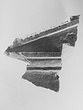
| Fragments from upper part of inscribed stele with relief above.
Fragment Δ 75 a), broken all around save front and back.
The better preserved surface shows legs and feet apart of frontal figure standing ... 100-150 A.D. |
| Fragment of inscribed stele.
Part of a pediment preserved, broken off at the right and behind; rough picked on the top. Close to the apex, part of an acroterion.
Inscribed below the pediment, the inscribed ... 122/1 B.C. |
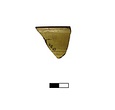
| Part of the lip and side wall remains.
Steep wall, slightly flaring lip. There are two shallow grooves around the outside of the lip, and at least three farther down on the side wall. The bowl was probably ... 3-12 March 1934 |
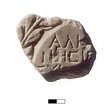
| Inscribed fragment.
Inscribed face only preserved.
Part of wreath around.
Ten letters remain.
Pentelic marble. Finished Found in modern context outside the Market Square, to the southeast. Leica ... 2 April 1935 |
| Ca. one quarter of fire and one lug remain.
Floor of bowl pierced with round holes, one at center and two more farther out. On inner face of rectangular lug a satyr mask.
Dull red clay containing much ... March 1934 |
| Small fragment from shoulder.
Head of Athena to right; tongues. Landscaping operations in the excavations; exact provenience unknown. Leica ... January 1955 |
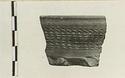
| Part of a high foot and part of floor of a dish(?). Multiple rouletting on outside of foot and round floor.
Buff ware, with thin grayish-brown coating.
Late Roman. Black fill. Leica PD 3083-19, DA 10008 ... February 1966 |
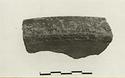
| From rim of a dish. Vertical curving rim, thickened on inside.
Orange ware and slip, fired a deep red-brown on outside of rim.
Late Roman C. Black fill. Leica PD 3083-218, DA 10004 ... February 1966 |
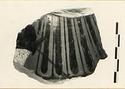
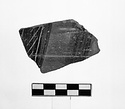
| Small fragment of wall preserving part of a vertical black-figure motif.
Clay brownish, streaky sepia glaze. Roman well, context 4th. c. A.D. with much Hellenistic mixed in. Leica, 89-4-17 ... 1962 |
|
|