|
|
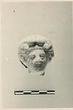
| Broken off below chin.
The hair is drawn back in ridges beneath a heavy band; above the middle of the forehead, a small double coil; at the back of the head a large bun.
Made from a very dull mould; hollow ... 7 March 1939 |
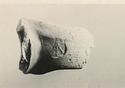
| Slightly chipped.
On its face a (negative) impression of a warrior to right, from the waist up, shield and spear in left hand, right hand raised. He wears attic helmet with plume, short-sleeved tunic with ... 10 March 1939 |
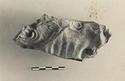
| Edges broken save for a small bit just in front of eye.
Preserved is part of the mold for the right side of the head of a large animal with a heavy shaggy coat, with much of the eye and part of the small ... 10 March 1939 |
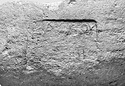
| Round stamp with monogram. North-south cut on 50.00m. line, area of road, layer VII. ΑΨ (Α,Ψ monogram in O) 1071 Leica ... 10 March 1939 |
| Device(?). Finished Early Byzantine context. Κάδμ̣ου
[device]
[---] Leica ... 27 April 1936 |
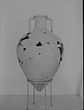
| Plain amphora; tip and many wall fragments missing; plump body, short neck, massive down-turned lip.
Buff clay, yellow on surface; slightly micaceous.
Stamp on one handle.
Naxian(?). Dim: WxTh of stp ... 31 March-2 April 1936 |
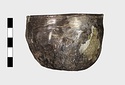
| A small puncture in the side; otherwise intact.
A thin wall blown into a calyx mould.
Oxidized to greenish brown.
Broken in vitrine and mended (with Paraloid B72) resulting in substantial hole in the ... 24 March 1936 |
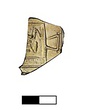
| A fragment from the side of a cylindrical cup.
Around the neck panels, and in one of them a tabella ansata with lettering in relief: Ε Ν Ν Ι Ω Ν
Ε Π Ο Ι Ε Ι.
Yellow glass oxidized to blue.
Fragment of ... Card: early 1st c. A.D. |
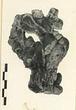
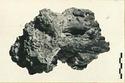
| Rough hemispherical piece of brown slag, probably iron bearing with some gray and some dull black. Catalogued 2 July 1973. Agora sample no. 620. Working establishment in courtyard, North-West of Agora ... 10 March 1939 |
| Heavy fragmentary piece preserving dull black sluggish drippings. Catalogued 2 July 1973. Agora sample no. 621. Working establishment in courtyard, North-West of Agora and South of road to Agora from Dipylon ... 10 March 1939 |
| Heavy piece of slag consisting of smooth sluggish gray to mauve drips, turning pink at ends originating at large irregular porous lump of orange to brown material which turns partly gray at base of dripped ... 10 March 1939 |
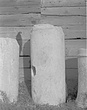
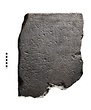
| Inscribed statue base.
Broken away to left and behind; much worn by traffic on its underside, its top in its second use.
Part of a plain plinth with the mark of the left foot of a life-sized bronze statue ... 31 March 1939 |
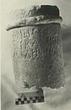
| Inscribed fragment of columnar grave monument.
Broken away below; much worn behind.
Three lines of the inscription preserved.
Hymettian marble. Found in Byzantine context in the southwest corner of the ... End of 1st. century A.D. |
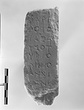
| Inscribed fragment.
Right edge and face only preserved.
Nine lines of the inscription preserved, trace of tenth; stoichedon.
Pentelic marble. Finished Found in dump, on the north slope of Kolonos Agoraios ... 27 April 1937 |
| Inscribed fragment of grave monument.
Top has been chipped away. In one side at midheight, a round sinking.
Twice used, the two inscriptions appearing on opposite sides.
Three lines of the inscription ... 20 May 1936 |
| Inscribed fragment.
Back surface smooth dressed, preserved; otherwise broken.
Imperial letter (?); mentions Herodes.
Eight lines of the inscription preserved.
Pentelic marble.
ADDENDA I 4457 joins. Finished ... 28 April 1936 |
| Inscribed fragment.
Broken away on right side, cut away below.
In the bottom a rounded cutting dating from a reuse.
Five lines of the inscription preserved.
Hymettian marble. Found in Byzantine context ... Ca. 180 B.C. |
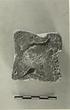
| Square.
Obverse: dolphin to left, with Δ and Ε in field.
Reverse: scooped out. Cistern, main chamber.
Ca. 300 B.C. Leica ... 4 April 1936 |
| Sides pushed in; the bottom scooped out.
On top, a dolphin to left, diagonally. In field letters ? Cistern, main chamber.
Ca. 300 B.C. Leica ... 7 April 1936 |
| Hard gray poros, finished rough to receive stucco, of which a little remains.
The top surface is so rough as to suggest a wooden epistyle. Note a cutting for a hook-clamp toward middle of one side.
For ... 2 June 1936 |
|
|