|
|
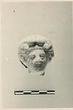
| Broken off below chin.
The hair is drawn back in ridges beneath a heavy band; above the middle of the forehead, a small double coil; at the back of the head a large bun.
Made from a very dull mould; hollow ... 7 March 1939 |
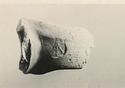
| Round stamp with monogram. North-south cut on 50.00m. line, area of road, layer VII. ΑΨ (Α,Ψ monogram in O) 1071 Leica ... 10 March 1939 |
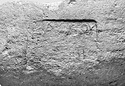
| Device(?). Finished Early Byzantine context. Κάδμ̣ου
[device]
[---] Leica ... 27 April 1936 |
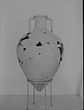
| Plain amphora; tip and many wall fragments missing; plump body, short neck, massive down-turned lip.
Buff clay, yellow on surface; slightly micaceous.
Stamp on one handle.
Naxian(?). Dim: WxTh of stp ... 31 March-2 April 1936 |
42-50/Ζ-ΙΑ: below uppermost Byz. Floor at level of top of railroad retaining wall (cf. also 50/Ι: from packing of floor). Coins:
24 March 1936 #18-#22
26 March 1936 #9-#10 ... Early Byzantine |
N-S Cut on 50m. line (area of Road, area of Stoa, area N of Stoa) various levels and dates over the three areas.
Investigations to the northwest of the market square in the area of the road running out ... Prehistoric to Roman |
It seems possible that the well ... was originally associated with the late Roman reconstruction of the Stoa, being later carried up to serve the Byz. houses. [Nbp. 364] Coins:
6 March 1939 #1-#9 ... Late 4th-early 5th century |
Cistern with considerable dumped fill at the north foot of Kolonos Agoraios. It may have been abandoned ca. 295-295 B.C.; it will have been filled by 280 B.C.
Multiple vessels share same stamps, and painted ... Ca. 325-250 B.C. |
|
|