|
|
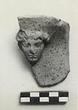
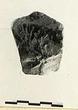
| First interpretation: woman 's head in relief; of good period and style.
Top and back edge finished; broken below and to left.
There never was more than a head: the neck is not modelled.
Moulded. Unglazed ... 27 March 1935 |
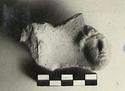
| That is part of a twin female head, which is preserved at the left edge.
Similar to T 785, in shape and treatment. But somewhat smaller and double. The neck is not modelled. Now joined to the right of ... 28 March 1935 |
| Stirrup-shaped pulley with a ring for hanging at the top, and a cylindrical bar for the string across the bottom. Well 5.
5th c. B.C. Leica ... 29 March 1935 |
| Fragment of inscribed base; grave monument (?).
Upper left corner of base, broken below, behind, and to the right.
Mouldings below.
Part of four lines of the inscription; non-stoichedon.
Pentelic marble ... 29 September 1933 |
| Small fragment from shoulder.
Head of Athena to right; tongues. Landscaping operations in the excavations; exact provenience unknown. Leica ... January 1955 |
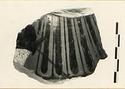
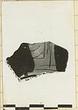
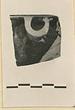
| Broken all around. Unidentified representation from reverse of Panathenaic amphora. Agora excavations. Leica ... 5 February 1962 |
| From the floor of a heavy plate. Head and shoulders of draped figure right. Very poor condition; added white practically disappeared from face and part of clothes. Agora area, context unknown. Leica ... (February 1957) |
| Wall fragment, ridge along break on exterior; probably from a stemless cup. Interior, part of border around medallion only; wave pattern in black on reserved ground. Exterior, lower part of draped figure ... (1956) |
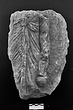
| Broken on all sides. Back rough-picked.
Head, feet and right arm missing of figure, which appears to be female holding some object, a situla, at end of hanging arm. Drapery focussed in knot on bosom ... 14 March 1932 |
| Horizontal loop handle at back broken off.
Low broad base.
Glaze red to black.
Type 21B of Agora collection, type IV (later 5th. century group) of Corinth collection.
Cf. Agora IV, nos. 164-170, pp ... Ca 475-425 B.C. |
| A: in relief a nude woman right, seated on prow of a trireme.
B: plain.
Black glaze. Modern earth in Γ, being used in ΣΤ, for terracing. Leica ... 20 April 1935 |
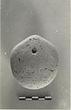
| Conical.
Pierced near the top for suspension.
Brownish red glaze, except on bottom. Well 5. Leica ... 21 March-16 April 1935 |
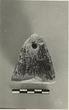
| Circular, with the top of the circumference flattened to make a peak.
Hole for suspension. Unglazed.
Pinkish buff clay. Well 5. Leica ... 21 March-16 April 1935 |
| Circular bead-shaped, pierced through the middle. Unglazed.
Greenish buff clay. Well 5. Leica ... 21 March-16 April 1935 |
| Circular bead-shaped, pierced through the middle. Unglazed.
Pinkish buff clay.
Similar in shape to MC 212, but smaller. Well 5. Leica, 84-271 ... 21 March-16 April 1935 |
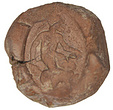
| An oval impression.
A: a nude bearded male figure, right, in process of sacrificing a ram.
Odysseus sacrificing a ram before his trip to the underworld (?)
B: smooth.
Unglazed.
Pinkish clay. Clearing ... 12 June 1937 |
| Part of rim preserved; moderate outcurve. Upper part of cloaked figure, left; fillet hanging on wall.
Pinkish-buff clay; glaze somewhat metallic. Provenience unknown. Leica ... (1953) |
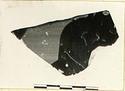
| From the reverse of a fairly late Panathenaic amphora. Two naked youths running to the left, one behind the other -- foot race.
Pinkish buff clay. Glaze much peeled. Provenience uncertain. Leica ... 1934 |
| From the side of a closed pot; unglazed inside. Part of a nude male figure facing right, right arm swinging downward behind.
Somewhat micaceous buff clay. Provenience uncertain. Leica ... 1934 |
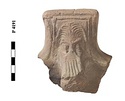
| Fragment from rim of a coarse-ware brazier, consisting of one of the three upward projecting lugs decorated in relief on the inner side with a bearded male head; the beard projects inward toward the center ... 1934 |
|
|