|
|
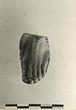
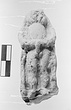
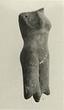
| Part of mold of left foot for large figure, broken off at ankle.
Foot finely modelled, with long toes.
Dark red micaceous clay, gray at core as if from burning.
ADDENDA C. G: Suggests from metal original ... 1956 |
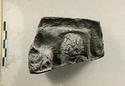
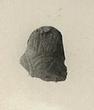
| Tragic mask of youth, preserved from eyes to chin.
Hellenistic type (?).
Light buff clay. Surface find. Leica, 81-33-26 ... 27 April 1957 |
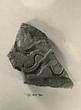
| Back part of a very large head, the hair rendered in gouged technique: checkerboard at back, narrow lines around face, herringbone on top-knot over forehead. Right ear preserved set well down on neck ... 10 May 1957 |
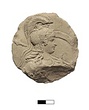
| Very carefully modeled head of Athena with Parthenos helmet, shield and spear.
Roughly circular plaque, the back rough and irregular. Slightly chipped around edges.
Head and shoulders of Athena Parthenos ... 29 May 1957 |
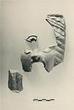
| Fragment, mended from three, gives nose, upper part of gaping mouth, lower part of eyes, and hair on the mask's left side from nose to top of fragment.
A non-joining piece (fragment b) gives also two locks ... 28 March 1939 |
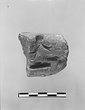
| First interpretation: Mold signed fragment.
Broken at left and chipped along outer edge at top.
Preserved is a male figure, bearded and partly draped, reclining on a couch and playing the double flutes, ... 27 March 1939 |
| Sloping surface at bottom where front part of stand or base is broken away.
Hermaphroditus see ostendens.
Head missing.
Buff clay, white sizing.
ADDENDA Cf. Agora XI, p. 173.
Compare with T 1808. North ... 7 October 1949 |
| Flat back and one original edge preserved of mold for a large plaque.
Back legs and tail of a lion walking right.
Coarse brown clay with red bits in it. South Cut A, packing below bath drain, above earlier ... 4 November 1949 |
| Fragment from mold for upper left corner of high relief; depressed frame.
Relief widens towards bottom of fragment.
In the positive, upper front part of head in profile left; above it a thyrsos, horizontally, ... 1949 |
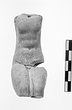
| Nude male figure.
Mended from six fragments. Head and arms missing; with holes for attachment; lower legs missing, and large part from left side.
Traces of white.
Buff clay.
ADENDA Cf. Delos IV, pp. 26 ... 1949 |
| Nose and lower legs broken off. Trace of rider or girth on back.
Fragmentary.
Buff clay with black glaze remaining over much of body.
Cf. Hesperia 2 (1933), pp. 617-620. Just outside break in north wall ... 2 August 1967 |
| Rider and head mended to body. Lower legs and all of right hand leg of horses missing. Head of rider is broken off and only stumps of his arms remain. Traces of rider's hands remain grasping horse's neck ... 3 August 1967 |
| Orange-buff clay, rather micaceous.
Rectangular stamp with mask at centre. Finished Cleaning weeds from Piraeus street. Θασί̣[ων]
mask
Ἀπολλ[όδωρος] Leica ... 13 May 1968 |
| Complete; chipped on striking surface all around.
Small thick disk of grayish-blue micaceous stone. Well; container 60; layer IV; third quarter of 3rd. century A.D. Leica, 81-640 ... 9 June 1939 |
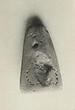
| Pyramidal.
Irregularly made.
Two adjacent sides ornamented with circle of gouges simulating rosettes. Corner between the rosettes, with part of them, chipped away.
Unglazed.
Pinkish buff clay. Surface ... 1 April 1932 |
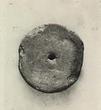
| Plain disk, chipped on one side.
Pierced in center. Unpainted.
Dull buff pinkish clay. Terracotta deposit area. Upper geometric layer. Leica, 3-46 ... 31 March 1932 |
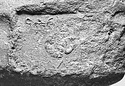
| Fragment of mold with portion of snake (?) or animal tail (?).
Rather coarse pinkish clay with small red and blue bits. Area of Roman intrusion into Geometric area. Leica ... 14-16 April 1932 |
| Torso of joined female doll.
Preserved from neck to knee joints. Right shoulder and breast broken away.
Hole for attachment of arms at shoulders and legs below knees, which are missing.
Solid carefully ... 12 February 1932 |
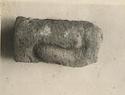
| Right leg with high sandal, preserved to a little below mid-calf.
Flat underneath. Toes divided by gouged lines.
Mold made; solid.
Red wash. Clay fine red; yellow at center. Leica ... 16 Feb 1932 |
| Fragment from left side of head of cock figurine.
Front (beak, etc. ) broken away.
Fluted comb indicated over large eye; start of beak set off from head by double groove; neck feathers faintly indicated ... 13 February 1932 |
|
|