|
|
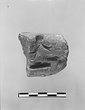
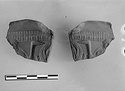
| First interpretation: Mold signed fragment.
Broken at left and chipped along outer edge at top.
Preserved is a male figure, bearded and partly draped, reclining on a couch and playing the double flutes, ... 27 March 1939 |
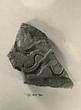
| Flat back and one original edge preserved of mold for a large plaque.
Back legs and tail of a lion walking right.
Coarse brown clay with red bits in it. South Cut A, packing below bath drain, above earlier ... 4 November 1949 |
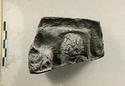
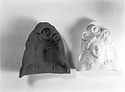
| Fragment from mold for upper left corner of high relief; depressed frame.
Relief widens towards bottom of fragment.
In the positive, upper front part of head in profile left; above it a thyrsos, horizontally, ... 1949 |
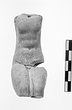
| Nude male figure.
Mended from six fragments. Head and arms missing; with holes for attachment; lower legs missing, and large part from left side.
Traces of white.
Buff clay.
ADENDA Cf. Delos IV, pp. 26 ... 1949 |
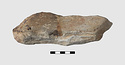
| Straight sides, irregularly pointed ends, roughly triangular in section. Side next to chisel shows considerable wear; worn slightly conacve in middle.
Adhering to chisel (IL 1062).
ADDENDA July 1950: ... 29 June 1949 |
| Cut off just below shoulder.
Woman facing with hair hanging down beside face, and crown of three circular disks on her head.
Attic clay, slipped.
Cf. Hesperia 24 (1955), p. 178, no. 1. Well A.
Late 5th-375 ... 19 April 1935 |
| From a shallow mould, perhaps circular.
The edge of the mold preserved at the top.
Frame, leaf pattern. Inside, part of woman holding torch and moving right; in front of her the shoulder of another figure ... 19 April 1935 |
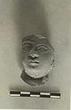
| Broken off behind and at neck.
Traces of red paint.
Gritty red clay.
Late Roman. Cleaning bedrock. Leica ... 13 May 1935 |
| Rectangular stamp; broken at left; three lines. Msc: prob from jar dated in the term of =ARISTAINOS=* Layer 3 (Hellenistic) of Martyr I; Great Drain. [ Ἀ]ν̣δρῶν Ἀγί
[α Ἀ]ρ̣ιστογέ
νευς
(Α broken-barred) ... 12 June 1939 |
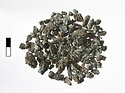
| Over 150 miniscule fragments and amorphous lumps of bronze or copper representing item of jewelry or personal adornment worn by the deceased during cremation and melted out of shape. Original object unidentifiable ... 8-10, 12 April 1948 |
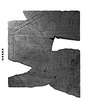
| Inscribed fragments.
Fragment Δ 382, inscribed stele with outline of pediment cut in preserved top.
Broken into seven pieces. Upper left corner, bottom, and a section from both right and left sides missing ... Late 3rd. century A.D. |
From Section ΟΟ. See other pieces in Study Collection-
For images, see P 20177. Grave 3. |
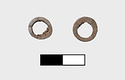
| Two simple undecorated rings, neatly sawn from the same long bone. Finished Grave 3. Inside burial amphora. Stoa Gallery Case 3103-3110 Leica, color slide PD 2774-98 ... 29 June 1949 |
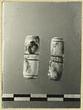
| Hollow cylinder with straight sides, the ends very slightly tapered inward.
Decorated with pairs of closely spaced incised grooves around the outside at each end, and a more widely spaced pair of grooves ... 12 April 1948 |
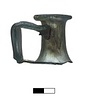
| Narrow neck with flat lip; angular strap handle, and part of horizontal shoulder preserved.
Greenish blue glass. East-west Street, road fill 4.
2nd-3rd c. A.D. 3490 Leica ... 13 October 1949 |
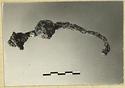
| This and the following number are assigned to the many burned fragments which cannot be joined, and which preserve parts of at least two long pins with flat disk heads and large spheres of bronze on their ... Card: 900 B.C. |
| Fragments of a pin with disk head and ball on shaft.
Less of the shaft preserved (three fragments) than for B 740.
The ball somewhat less corroded.
Cf. B 840 (OO 619) Geometric Grave. Found with bones ... Card: 900 B.C. |
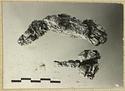
| Part of the bow of one fibula is clear, consisting of two rounded masses of bronze set at an angle to each other. Probably a third made up the bow.
One fragment seems to show the spiral spring at the inner ... Card: 900 B.C. |
| A large fragment probably from the center of the bow of a similar fibula.
Cf. B 842 (OO 621). Geometric Grave. Found with bones inside burial amphora P 19, 228 (OO 594). nestled in ethafoam to prevent ... Card: 900 B.C. |
| Broken into five pieces and very fragmentary.
Inscribed. From the "dump". Store in ziplock polyethylene bag and in area with 40% r.h. or lower.
Wear cotton or latex gloves when handling. Do not bang around ... 25 October 1947 |
|
|