|
|
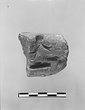
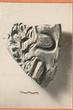
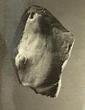
| First interpretation: Mold signed fragment.
Broken at left and chipped along outer edge at top.
Preserved is a male figure, bearded and partly draped, reclining on a couch and playing the double flutes, ... 27 March 1939 |
| Sloping surface at bottom where front part of stand or base is broken away.
Hermaphroditus see ostendens.
Head missing.
Buff clay, white sizing.
ADDENDA Cf. Agora XI, p. 173.
Compare with T 1808. North ... 7 October 1949 |
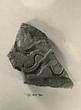
| Flat back and one original edge preserved of mold for a large plaque.
Back legs and tail of a lion walking right.
Coarse brown clay with red bits in it. South Cut A, packing below bath drain, above earlier ... 4 November 1949 |
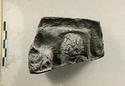
| Fragment from mold for upper left corner of high relief; depressed frame.
Relief widens towards bottom of fragment.
In the positive, upper front part of head in profile left; above it a thyrsos, horizontally, ... 1949 |
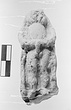
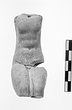
| Nude male figure.
Mended from six fragments. Head and arms missing; with holes for attachment; lower legs missing, and large part from left side.
Traces of white.
Buff clay.
ADENDA Cf. Delos IV, pp. 26 ... 1949 |
| Edge of large Medusa mask with short curling individual locks of hair plus parts of two curling snakes preserved.
Outer piece, roughly triangular; broken on two edges.
Cf. T 2920, T 2925. On foundation ... 6 April 1949 |
| Fragment from mold for large antefix (?).
A little of the lower part of the face preserved, with tongue, row of teeth and jowls.
Broken all around and at back.
Firm pink clay, fairly fine.
Cf. T 2918, ... 1 April 1949 |
| Uncertain subject.
Heavy fabric, reddish-brown at back, light cream on surface.
Flat back; broken all around.
Architectural (?). In trench through marble chip floor, House F, Room 4. Leica ... 1 June 1949 |
| Original edge preserved at top.
Left side of a cow head. Delicate modeling of mouth, eye area, and muscles around jawline.
Perhaps a Rhyton? N.W. of building D 1; layer a; early Roman fill. 1145 Leica ... 19 March 1948 |
Displaced curbing stone had fallen into top of shaft; fill with and around it is presumably second half of 2nd c. A.D. Below tumbled filling at top, shaft was empty to 10.80m. Tiles were missing to ca ... Late 1st-early 2nd c. |
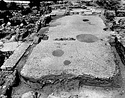
| Mosaic hall (Room A2) ... north 4329 Horizontal (normal) ... 23 Jul 1968 |
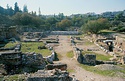
| Civic, Possibly Commercial Unknown Limestone Poor, foundations and lines of walls ... Mid 5th B.C. |
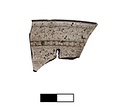
| Fragment from plain rim of open bowl.
On inside lip, bounded by two grooves, with notched ridge below lower one. Smaller sharper groove lower down.
Moulded glass. For context see Hesp. 20 (1951), p. 183 ... 22 April 1948 |
| Two joining rim fragments, and non-joining bottom.
Ring foot; pinched in sides, slightly flaring lip.
Thin glaze, yellow green tinge. For context see Hesp. 20 (1951), p. 277. Well, lower fill.
1st c. A.D ... 13 June 1949 |
| Three joining rim fragments and several pieces from bottom. No base.
Short neck, round mouth with flaring lip, handle with projecting ends, from lip to shoulder. Bottom slightly concave.
Blue green glass ... 13 June 1949 |
| Narrow neck with flat lip; angular strap handle, and part of horizontal shoulder preserved.
Greenish blue glass. East-west Street, road fill 4.
2nd-3rd c. A.D. 3490 Leica ... 13 October 1949 |
| Broken into five pieces and very fragmentary.
Inscribed. From the "dump". Store in ziplock polyethylene bag and in area with 40% r.h. or lower.
Wear cotton or latex gloves when handling. Do not bang around ... 25 October 1947 |
| Complete except for chip from head.
Large-headed hook (if right angle in shaft is original); otherwise a nail.
Head flat. Shaft rectangular in section, tapering to a point, now bent. N.W. room, Poros Building, ... 7 June 1949 |
| Right half of a dikast ticket.
No trace of reuse and no symbol at right end. Punched dots at ends of hastas of letters.
Last letters of name and of demotic preserved. Ca. 3 metres north of Poros Building, ... 2 November 1949 |
| Squat truncated pyramid.
The stub of a projecting pin (for handle or attachment ?) on the bottom. M. Farnsworth reports that although the material is bronze, it appears to contain more lead than is usual ... 15 May 1939 |
|
|