|
|
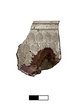
| From rim and wall of a fairly large bowl, moulded.
Bowl with plain slightly out-turned rim. Two grooves around the rim. On the wall a scale pattern formed of oval depressions.
Colorless glass. Agora sample ... 9 July 1947 |
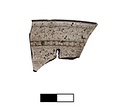
| Fragment from plain rim of open bowl.
On inside lip, bounded by two grooves, with notched ridge below lower one. Smaller sharper groove lower down.
Moulded glass. For context see Hesp. 20 (1951), p. 183 ... 22 April 1948 |
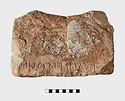
| Broken into five pieces and very fragmentary.
Inscribed. From the "dump". Store in ziplock polyethylene bag and in area with 40% r.h. or lower.
Wear cotton or latex gloves when handling. Do not bang around ... 25 October 1947 |
| One nozzle broken off in two pieces, but complete except for small chip.
Globular body on thin ring foot. Central filling hole with short neck and flat projecting rim, grooved on the upper surface.
Three ... 8 April 1949 |
| Complete except for chip from head.
Large-headed hook (if right angle in shaft is original); otherwise a nail.
Head flat. Shaft rectangular in section, tapering to a point, now bent. N.W. room, Poros Building, ... 7 June 1949 |
| Squat truncated pyramid.
The stub of a projecting pin (for handle or attachment ?) on the bottom. M. Farnsworth reports that although the material is bronze, it appears to contain more lead than is usual ... 15 May 1939 |
| Inscribed fragment of Herm of Zeno.
Fragment from the sloping upper part of a portrait herm; left side and inscribed face only preserved.
Herm of Zeno, son of Mnaseas, the Stoic philosopher.
One line of ... 2nd. century A.D. |
| Inscribed fragment.
Letters inscribed on a partially smoothed down broken surface; back worn smooth; worn breaks at sides and top, in crude pediment form, may be contemporary with inscription; broken at ... 1st. century B.C. |
|
|