|
|
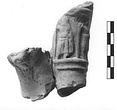
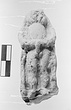
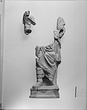
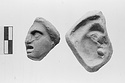
| Chin elaborated modelled; locks on neck; cornucopia shows relief of draped male looking left, draped female looking right between mouldings.
Head mostly missing. Cornucopia broken all around.
Traces of ... 8-9 April 1947 |
| First interpretation: Mold signed fragment.
Broken at left and chipped along outer edge at top.
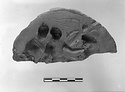
Preserved is a male figure, bearded and partly draped, reclining on a couch and playing the double flutes, ... 27 March 1939 |
| Sloping surface at bottom where front part of stand or base is broken away.
Hermaphroditus see ostendens.
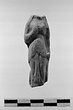
Head missing.
Buff clay, white sizing.
ADDENDA Cf. Agora XI, p. 173.
Compare with T 1808. North ... 7 October 1949 |
| Fragment from mold for upper left corner of high relief; depressed frame.
Relief widens towards bottom of fragment.
In the positive, upper front part of head in profile left; above it a thyrsos, horizontally, ... 1949 |
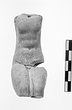
| Nude male figure.
Mended from six fragments. Head and arms missing; with holes for attachment; lower legs missing, and large part from left side.
Traces of white.
Buff clay.
ADENDA Cf. Delos IV, pp. 26 ... 1949 |
| Four pieces of twisted rope with two or three small bits.
Notes on 17 November 1981: Longest piece remaining: P.L. 0.068, Diam. 0.012, fourteen pieces total. Container 16. Well. Leica ... 20 May 1949 |
| Joining fragments preserve upper part of neck and of both handles, all of rim.
Stamp on one handle; caduceus(?).
Early Thasian. Finished Well; containers 12-13; 4th century B.C. [---]
caduceus? Leica ... 17 May 1949 |
| Small fragment from near toe of unguentarium or amphoriskos.
Light red brown clay; traces of matt red streaked on surface.
One end of a rectangular stamp preserved. Dark Age fill; Byzantine disturbance ... 19 March 1948 |
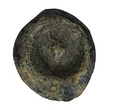
| Broken off below.
An impression made by pressing a heavy lump of clay against some circular object, presumably a mirror-cover.
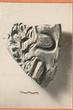
The upper part of the scene is preserved; three figures and a hovering Eros ... 3 May 1939 |
| Left side of face and top of head broken away; back missing; broken near base of neck.
Broad nose, slanting eyes, hair combed down straight on sides from central part.
Crude modelling; gouged style. Traces ... 23 June 1939 |
| Drapery for one side of a small standing female figure, preserved about from shoulder to mid-calf (?).
Part of one side preserved.
Plain surface at the right.
From a mold for a relief (?).
Cf. T 3935 ... 23 June 1947 |
| Edge of large Medusa mask with short curling individual locks of hair plus parts of two curling snakes preserved.
Outer piece, roughly triangular; broken on two edges.
Cf. T 2920, T 2925. On foundation ... 6 April 1949 |
| Fragment a), mended from many pieces, preserves the rectangular base and much of the lower part of a standing figure with a littler of the left side to the shoulder. The figure wears a cloak reaching to ... 8-9 April 1949 |
| The right hand held up to breast. High girt chiton with long overfold.
Back plain.
Solid figurine, head and feet broken off.
Reddish-buff clay. Clay fill about level of Poros Building floor; fourth century ... 21 May 1949 |
| Uncertain subject.
Heavy fabric, reddish-brown at back, light cream on surface.
Flat back; broken all around.
Architectural (?). In trench through marble chip floor, House F, Room 4. Leica ... 1 June 1949 |
| Original edge preserved at top.
Left side of a cow head. Delicate modeling of mouth, eye area, and muscles around jawline.
Perhaps a Rhyton? N.W. of building D 1; layer a; early Roman fill. 1145 Leica ... 19 March 1948 |
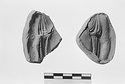
| Mold for the left side of a mask, apparently a female face; hair rolled back from face, eyebrows exaggerated.
Two finished edges preserved.
ADDENDA Cf. T 2439; close type. Well; near bottom, container ... 4 Oct 1947 |
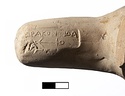
| Several joining fragments give the neck substantially complete to a point below the lower handle attachment.
Stamp on one double handle only. Corpus no. 571.
Prof: PD 1454-88*
Dim: Drim 0.12* Cistern, ... 7 April 1949 |
| Part of rim preserved.
Anchor. Cistern, upper fill; container 4; third quarter of 2nd century B.C. Δρακοντίδα
anchor, pt l. Leica ... 8 April 1949 |
| Narrow neck with mouth and part of rim preserved.
Rectangular stamp with urn. Date: see Ag 12*
Dim: Drim: outer 0.099, inner 0.07 (VG)* Finished Well; container 8. Θασίων | [ Ἀρισ | τοτέλης]
vaseVIII ... Ca. 350-325 B.C. |
| Two non-joining fragments one from base and one (mended from two) from side wall; the latter preserves part of the lip.
Wide-mouthed round bodied open cup or bowl, the sides decorated with raised ribs ... 14 June 1939 |
| Fragment preserving part of a broad projecting rim with down-turned outer edge.
A groove at inner and outer edge of rim.
Opaque bluish white glass. Late Roman fill. 868 Leica, XXXIII-26 PD 505, PD 2023-14 ... 18 June 1947 |
| From rim and wall of a fairly large bowl, moulded.
Bowl with plain slightly out-turned rim. Two grooves around the rim. On the wall a scale pattern formed of oval depressions.
Colorless glass. Agora sample ... 9 July 1947 |
| Fragment from plain rim of open bowl.
On inside lip, bounded by two grooves, with notched ridge below lower one. Smaller sharper groove lower down.
Moulded glass. For context see Hesp. 20 (1951), p. 183 ... 22 April 1948 |
| Broken into five pieces and very fragmentary.
Inscribed. From the "dump". Store in ziplock polyethylene bag and in area with 40% r.h. or lower.
Wear cotton or latex gloves when handling. Do not bang around ... 25 October 1947 |
| One nozzle broken off in two pieces, but complete except for small chip.
Globular body on thin ring foot. Central filling hole with short neck and flat projecting rim, grooved on the upper surface.
Three ... 8 April 1949 |
| Complete except for chip from head.
Large-headed hook (if right angle in shaft is original); otherwise a nail.
Head flat. Shaft rectangular in section, tapering to a point, now bent. N.W. room, Poros Building, ... 7 June 1949 |
| Squat truncated pyramid.
The stub of a projecting pin (for handle or attachment ?) on the bottom. M. Farnsworth reports that although the material is bronze, it appears to contain more lead than is usual ... 15 May 1939 |
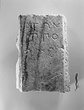
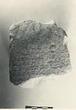
| Inscribed fragment.
Rough edges all around, but right side and back may represent original surface of stone as used.
Letters roughly cut on poor surface.
Blue limestone. Found in Byzantine context east ... 4 April 1947 |
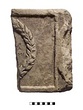
| Inscribed fragment of grave stele.
Upper left half of stele with pediment top; broken at bottom and right, and acroterion at left broken off. Rough picked back.
Two lines of the inscription preserved ... 15 May 1947 |
| Inscribed fragment of Herm of Zeno.
Fragment from the sloping upper part of a portrait herm; left side and inscribed face only preserved.
Herm of Zeno, son of Mnaseas, the Stoic philosopher.
One line of ... 2nd. century A.D. |
| Inscribed fragment.
Letters inscribed on a partially smoothed down broken surface; back worn smooth; worn breaks at sides and top, in crude pediment form, may be contemporary with inscription; broken at ... 1st. century B.C. |
| Inscribed fragment.
Inscribed face and part of right side preserved; also sloping top with cutting at edge of break.
Probably a Herm.
Seven lines of the inscription preserved.
Pentelic marble. Finished ... 13 June 1947 |
| Inscribed fragment.
A hunk of stone with letters on a very rough surface. Edges and back very rough, but may be contemporary with inscription.
Conglomerate; mortgage Horos.
Five lines of the inscription ... 13 June 1947 |
| Inscribed fragment.
Inscribed face and left side, smooth-finished preserved.
Three lines of the inscription preserved, vacat below.
White, probably Pentelic marble. Found in latest Roman-early Byzantine ... 16 June 1947 |
| Inscribed fragment.
Fragment of a roof-tile (cover tile) reused for the purpose of the inscription.
Part of one end of the tile is preserved.
Two lines of the inscription preserved.
Pentelic marble. Found ... 5th. century B.C. |
| Inscribed fragment of grave stele.
Broken at bottom and left.
Inscribed face, rough picked back, and most of the original curved top preserved.
Hymettian marble. Found in Roman wall in the industrial area, ... 3 May 1949 |
| Inscribed fragment.
Inscribed on two adjacent faces; the left edge of face A and the right side of face B preserved; otherwise broken.
On face A, nine lines of the inscription preserved, on face B, nine ... 5th. century B.C. |
| Inscribed fragment.
Top and bottom, roughly dressed preserved, and smooth dressed back; broken at left; right side chipped along face but original edge probably preserved at back.
Shallow frame, within ... 5 May 1939 |
| A: deep incuse stamp of boukranion.
B: plain. Picked up on roman house wall, house C, room 3. Leica ... 1 July 1947 |
|
|