|
|
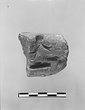
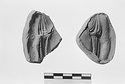
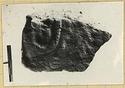
| First interpretation: Mold signed fragment.
Broken at left and chipped along outer edge at top.
Preserved is a male figure, bearded and partly draped, reclining on a couch and playing the double flutes, ... 27 March 1939 |
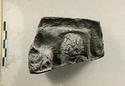
| Fragment from mold for upper left corner of high relief; depressed frame.
Relief widens towards bottom of fragment.
In the positive, upper front part of head in profile left; above it a thyrsos, horizontally, ... 1949 |
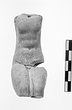
| Nude male figure.
Mended from six fragments. Head and arms missing; with holes for attachment; lower legs missing, and large part from left side.
Traces of white.
Buff clay.
ADENDA Cf. Delos IV, pp. 26 ... 1949 |
| Small fragment from near toe of unguentarium or amphoriskos.
Light red brown clay; traces of matt red streaked on surface.
One end of a rectangular stamp preserved. Dark Age fill; Byzantine disturbance ... 19 March 1948 |
| Drapery for one side of a small standing female figure, preserved about from shoulder to mid-calf (?).
Part of one side preserved.
Plain surface at the right.
From a mold for a relief (?).
Cf. T 3935 ... 23 June 1947 |
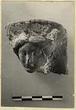
| Female head, a polos and veil crowing the softly waved hair.
Broken below the chin and along the right side. Nose chipped; open behind.
Considerable remains of white.
Grayish clay. Washed down by last ... 10 June 1949 |
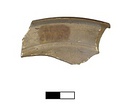
| Fragment preserving part of a broad projecting rim with down-turned outer edge.
A groove at inner and outer edge of rim.
Opaque bluish white glass. Late Roman fill. 868 Leica, XXXIII-26 PD 505, PD 2023-14 ... 18 June 1947 |
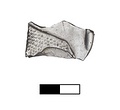
| Small piece from the curving wall of a vase.
Part of a wing (?) and the end of a straight band, added in a second layer of glass. Small dots on the wing.
Thin colorless glass. On pebble mosaic floor. Container ... 11 July 1947 |
| Broken into five pieces and very fragmentary.
Inscribed. From the "dump". Store in ziplock polyethylene bag and in area with 40% r.h. or lower.
Wear cotton or latex gloves when handling. Do not bang around ... 25 October 1947 |
| Squat truncated pyramid.
The stub of a projecting pin (for handle or attachment ?) on the bottom. M. Farnsworth reports that although the material is bronze, it appears to contain more lead than is usual ... 15 May 1939 |
| Inscribed fragment.
Rough edges all around, but right side and back may represent original surface of stone as used.
Letters roughly cut on poor surface.
Blue limestone. Found in Byzantine context east ... 4 April 1947 |
| Inscribed fragment.
Letters inscribed on a partially smoothed down broken surface; back worn smooth; worn breaks at sides and top, in crude pediment form, may be contemporary with inscription; broken at ... 1st. century B.C. |
| Inscribed fragment.
Inscribed face and part of right side preserved; also sloping top with cutting at edge of break.
Probably a Herm.
Seven lines of the inscription preserved.
Pentelic marble. Finished ... 13 June 1947 |
| Inscribed fragment.
A hunk of stone with letters on a very rough surface. Edges and back very rough, but may be contemporary with inscription.
Conglomerate; mortgage Horos.
Five lines of the inscription ... 13 June 1947 |
| A: deep incuse stamp of boukranion.
B: plain. Picked up on roman house wall, house C, room 3. Leica ... 1 July 1947 |
| Fragment from lower left part; bottom and side preserved; broken elsewhere.
Relief decoration on front much worn, but enough of tendrial and three letters in relief below remain to assign the fragment ... 3 April 1947 |
| Inscribed fragment.
Part of the top preserved, and perhaps part of the right side.
Four lines of the inscription preserved; stoichedon.
Space between lines, two including: 0.027m.
Space between letters, ... 6-11 February 1939 |
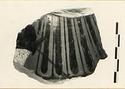
| Small fragment from shoulder.
Head of Athena to right; tongues. Landscaping operations in the excavations; exact provenience unknown. Leica ... January 1955 |
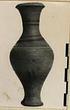
| Fusiform shape. Complete except for chips from the foot. Several rings of purplish-brown.
Slightly porous dark buff clay. A 2 of Southwest Bath, south end, west half, layer VI. 4665 Leica ... 12 June 1969 |
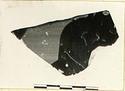
| Broken all around. Unidentified representation from reverse of Panathenaic amphora. Agora excavations. Leica ... 5 February 1962 |
|
|