|
|
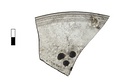
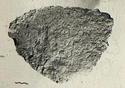
| Broken at top and back. Palmette with volutes and tendrils.
Gritty red clay; traces of white stucco. Signature along lower edge in raised letters: ΗΡΑΚΛΕΙΔΟΥ.
Cf. A 1347 (ΟΟ 469). In late wall over D 1 ... 18 March 1948 |
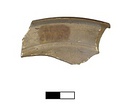
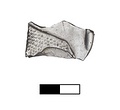
| Plain rim fragment of shallow bowl.
Two shallow grooves on outside of rim; cluster of dots in relief on side.
Mold made (?) Light green glaze; dots blue (?) Dirt fill.
Late Roman. Leica, XXXIII-24 PD 505 ... 2 May 1947 |
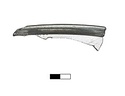
| Fragment preserving part of a broad projecting rim with down-turned outer edge.
A groove at inner and outer edge of rim.
Opaque bluish white glass. Late Roman fill. 868 Leica, XXXIII-26 PD 505, PD 2023-14 ... 18 June 1947 |
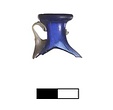
| A single fragment preserves the neck, the flaring rounded rim, and one handle, with the upper attachment of the other, of a miniature amphora.
Dark blue glass; the handles white glass. For contaxt see ... 2 July 1947 |
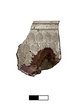
| From rim and wall of a fairly large bowl, moulded.
Bowl with plain slightly out-turned rim. Two grooves around the rim. On the wall a scale pattern formed of oval depressions.
Colorless glass. Agora sample ... 9 July 1947 |
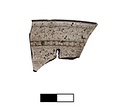
| Small piece from the curving wall of a vase.
Part of a wing (?) and the end of a straight band, added in a second layer of glass. Small dots on the wing.
Thin colorless glass. On pebble mosaic floor. Container ... 11 July 1947 |
| Fragment from plain rim of open bowl.
On inside lip, bounded by two grooves, with notched ridge below lower one. Smaller sharper groove lower down.
Moulded glass. For context see Hesp. 20 (1951), p. 183 ... 22 April 1948 |
| Fragment a): from vertical rim with ridges inside and out.
Fragment b): from flat bottom curving without break into side wall.
Pontil. Bubbles and spirals. Rim polished after folding.
Light blue glass; ... 30 June 1947 |
| Broken into five pieces and very fragmentary.
Inscribed. From the "dump". Store in ziplock polyethylene bag and in area with 40% r.h. or lower.
Wear cotton or latex gloves when handling. Do not bang around ... 25 October 1947 |
| Complete except for chip from head.
Large-headed hook (if right angle in shaft is original); otherwise a nail.
Head flat. Shaft rectangular in section, tapering to a point, now bent. N.W. room, Poros Building, ... 7 June 1949 |
| Squat truncated pyramid.
The stub of a projecting pin (for handle or attachment ?) on the bottom. M. Farnsworth reports that although the material is bronze, it appears to contain more lead than is usual ... 15 May 1939 |
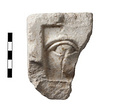
| Inscribed fragment of plaque.
Broken at right and bottom.
In sunken panel, of which bottom edge is preserved, an eye carved in relief.
Inscribed along the top on the raised frame of the panel.
Almost certainly ... 221/0 B.C. |
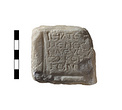
| Inscribed fragment.
Broken at right and back.
Part of small rectangular base with rectangular cutting, rough picked in top. Left side smooth finished; bottom deeply picked. Shallow groove as frame for ... 24 April 1947 |
| Inscribed fragment of a plaque.
Preserves part of inscribed face, right side and rough picked back.
Part of one line of the inscription preserved, within a wreath.
White crystalline marble. Found in late ... 3 May 1947 |
| Inscribed fragment.
Inscribed face only preserved.
Parts of five lines of the inscription preserved.
Hymettian marble. Finished Found in early Byzantine context, east of the Great Drain, in the industrial ... 13 May 1947 |
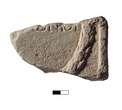
| Inscribed fragment.
Letters inscribed on a partially smoothed down broken surface; back worn smooth; worn breaks at sides and top, in crude pediment form, may be contemporary with inscription; broken at ... 1st. century B.C. |
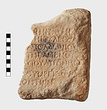
| Inscribed fragment.
Inscribed face and part of right side preserved; also sloping top with cutting at edge of break.
Probably a Herm.
Seven lines of the inscription preserved.
Pentelic marble. Finished ... 13 June 1947 |
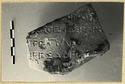
| Inscribed fragment.
A hunk of stone with letters on a very rough surface. Edges and back very rough, but may be contemporary with inscription.
Conglomerate; mortgage Horos.
Five lines of the inscription ... 13 June 1947 |
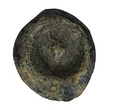
| A: a twisting snake (?)
Letters in field giota (Γ) and alpha (Α) at top, sigma (Σ) to right.
B: plain. Entered as coin, no. 8, for the day. Red fill (1).
With coin no. 9. Leica ... 14 May 1947 |
| A: deep incuse stamp of boukranion.
B: plain. Picked up on roman house wall, house C, room 3. Leica ... 1 July 1947 |
|
|