|
|
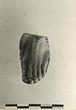
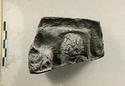
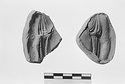
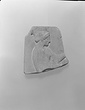
| Part of mold of left foot for large figure, broken off at ankle.
Foot finely modelled, with long toes.
Dark red micaceous clay, gray at core as if from burning.
ADDENDA C. G: Suggests from metal original ... 1956 |
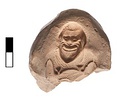
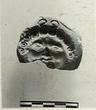
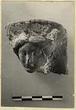
| Tragic mask of youth, preserved from eyes to chin.
Hellenistic type (?).
Light buff clay. Surface find. Leica, 81-33-26 ... 27 April 1957 |
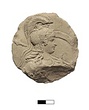
| Very carefully modeled head of Athena with Parthenos helmet, shield and spear.
Roughly circular plaque, the back rough and irregular. Slightly chipped around edges.
Head and shoulders of Athena Parthenos ... 29 May 1957 |
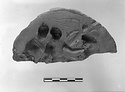
| First interpretation: Mold signed fragment.
Broken at left and chipped along outer edge at top.
Preserved is a male figure, bearded and partly draped, reclining on a couch and playing the double flutes, ... 27 March 1939 |
| Sloping surface at bottom where front part of stand or base is broken away.
Hermaphroditus see ostendens.
Head missing.
Buff clay, white sizing.
ADDENDA Cf. Agora XI, p. 173.
Compare with T 1808. North ... 7 October 1949 |
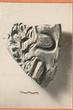
| Fragment from mold for upper left corner of high relief; depressed frame.
Relief widens towards bottom of fragment.
In the positive, upper front part of head in profile left; above it a thyrsos, horizontally, ... 1949 |
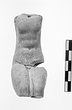
| Nude male figure.
Mended from six fragments. Head and arms missing; with holes for attachment; lower legs missing, and large part from left side.
Traces of white.
Buff clay.
ADENDA Cf. Delos IV, pp. 26 ... 1949 |
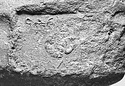
| Orange-buff clay, rather micaceous.
Rectangular stamp with mask at centre. Finished Cleaning weeds from Piraeus street. Θασί̣[ων]
mask
Ἀπολλ[όδωρος] Leica ... 13 May 1968 |
| Small fragment from near toe of unguentarium or amphoriskos.
Light red brown clay; traces of matt red streaked on surface.
One end of a rectangular stamp preserved. Dark Age fill; Byzantine disturbance ... 19 March 1948 |
| Broken off below.
An impression made by pressing a heavy lump of clay against some circular object, presumably a mirror-cover.
The upper part of the scene is preserved; three figures and a hovering Eros ... 3 May 1939 |
| Lower right corner of mold preserved.
Raised band around edge of mould.
The forepart of an animal, probably a cow, standing right.
Heavy fabric.
Coarse reddish-brown clay.
ADDENDA: Forepart of boar. Other ... 10 May 1939 |
| The upper part of a mold for a bearded figure with mask-like head, wearing a speckled garment (Papposilenus).
He is bending forward and clasping some object (wine-skin ?).
Careful work.
Fine pinkish clay ... Publication: before 350 B.C. |
| Left side of face and top of head broken away; back missing; broken near base of neck.
Broad nose, slanting eyes, hair combed down straight on sides from central part.
Crude modelling; gouged style. Traces ... 23 June 1939 |
| Drapery for one side of a small standing female figure, preserved about from shoulder to mid-calf (?).
Part of one side preserved.
Plain surface at the right.
From a mold for a relief (?).
Cf. T 3935 ... 23 June 1947 |
| In fairly high relief, the upper part of a female figure, right, her head slightly bent, her arms outstretched from the elbows (the hands missing). She wears a thin chiton which covers her arms to the ... 19 September 1947 |
| Lower part broken off. Surface inside somewhat cracked.
Mold for relief Gorgon head, with snail-shell curls around the face, and two snaky loops rising from the hair at the center above.
Pinkish clay ... 24 April 1940 |
| Edge of large Medusa mask with short curling individual locks of hair plus parts of two curling snakes preserved.
Outer piece, roughly triangular; broken on two edges.
Cf. T 2920, T 2925. On foundation ... 6 April 1949 |
| Uncertain subject.
Heavy fabric, reddish-brown at back, light cream on surface.
Flat back; broken all around.
Architectural (?). In trench through marble chip floor, House F, Room 4. Leica ... 1 June 1949 |
| Female head, a polos and veil crowing the softly waved hair.
Broken below the chin and along the right side. Nose chipped; open behind.
Considerable remains of white.
Grayish clay. Washed down by last ... 10 June 1949 |
| Original edge preserved at top.
Left side of a cow head. Delicate modeling of mouth, eye area, and muscles around jawline.
Perhaps a Rhyton? N.W. of building D 1; layer a; early Roman fill. 1145 Leica ... 19 March 1948 |
| Part of bottom, with edge projecting below, and of the right side preserved.
On the front, the leg of a table and part of a long bench under it.
Attachment hole through the plaque, under the bench.
Broken ... 13 August 1947 |
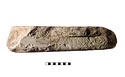
| Fragment of slab with inscribed band on one edge.
The height, though uneven, may be approximately complete; upper and lower surfaces fairly smooth. Back and sides sloping.
The inscription is on a smooth ... 13 February 1932 |
| Plain double-conical.
Pierced through center; hole much larger and slightly off-center at one side. The edges of the hole at its larger opening, show signs of wear.
Greenish-blue glass. Geometric grave ... 16 May 1939 |
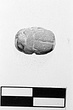
| Pierced through lengthwise, close to base. Incised on base an ibex (?).
Blue faience. Geometric grave 3. 1233-1235 Leica, XVIII-93, XX-50, 81-281, 79-11-34, 79-11-35, 79-11-36, 79-16-21, 79-16-22, 79-16-23, ... 17 May 1939 |
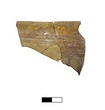
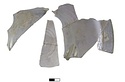
| Two non-joining fragments one from base and one (mended from two) from side wall; the latter preserves part of the lip.
Wide-mouthed round bodied open cup or bowl, the sides decorated with raised ribs ... 14 June 1939 |
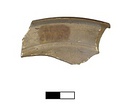
| Fragment preserving part of a broad projecting rim with down-turned outer edge.
A groove at inner and outer edge of rim.
Opaque bluish white glass. Late Roman fill. 868 Leica, XXXIII-26 PD 505, PD 2023-14 ... 18 June 1947 |
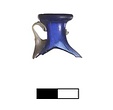
| A single fragment preserves the neck, the flaring rounded rim, and one handle, with the upper attachment of the other, of a miniature amphora.
Dark blue glass; the handles white glass. For contaxt see ... 2 July 1947 |
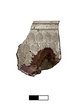
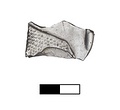
| From rim and wall of a fairly large bowl, moulded.
Bowl with plain slightly out-turned rim. Two grooves around the rim. On the wall a scale pattern formed of oval depressions.
Colorless glass. Agora sample ... 9 July 1947 |
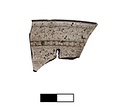
| Mended from four pieces; profile preserved to inside foot ring.
Ring foot; nearly flat bottom, upturned to form a very low wall; broad flat insloping rim, lightly grooved near inner and outer edges.
Nearly ... July 1947 |
| Small piece from the curving wall of a vase.
Part of a wing (?) and the end of a straight band, added in a second layer of glass. Small dots on the wing.
Thin colorless glass. On pebble mosaic floor. Container ... 11 July 1947 |
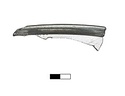
| Fragment from plain rim of open bowl.
On inside lip, bounded by two grooves, with notched ridge below lower one. Smaller sharper groove lower down.
Moulded glass. For context see Hesp. 20 (1951), p. 183 ... 22 April 1948 |
| Fragment a): from vertical rim with ridges inside and out.
Fragment b): from flat bottom curving without break into side wall.
Pontil. Bubbles and spirals. Rim polished after folding.
Light blue glass; ... 30 June 1947 |
| Broken into five pieces and very fragmentary.
Inscribed. From the "dump". Store in ziplock polyethylene bag and in area with 40% r.h. or lower.
Wear cotton or latex gloves when handling. Do not bang around ... 25 October 1947 |
| Complete except for chip from head.
Large-headed hook (if right angle in shaft is original); otherwise a nail.
Head flat. Shaft rectangular in section, tapering to a point, now bent. N.W. room, Poros Building, ... 7 June 1949 |
| Squat truncated pyramid.
The stub of a projecting pin (for handle or attachment ?) on the bottom. M. Farnsworth reports that although the material is bronze, it appears to contain more lead than is usual ... 15 May 1939 |
| Each is somewhat oval in shape and each is made of a single piece of heavy bronze wire so bent that the two ends overlap at the joint.
One (a) is of slightly thicker wire than the other. Geometric grave ... 17 May 1939 |
| Inscribed fragment.
Inscribed face only preserved; mended from two pieces
Shallow scratched letters in uneven lines; lower part of face rough picked; upper part coarsely dressed with tooth chisel.
Hymettian ... 17 June 1939 |
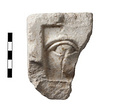
| Inscribed fragment of plaque.
Broken at right and bottom.
In sunken panel, of which bottom edge is preserved, an eye carved in relief.
Inscribed along the top on the raised frame of the panel.
Almost certainly ... 221/0 B.C. |
| Inscribed fragment.
Rough edges all around, but right side and back may represent original surface of stone as used.
Letters roughly cut on poor surface.
Blue limestone. Found in Byzantine context east ... 4 April 1947 |
| Inscribed fragment.
Letters inscribed on a partially smoothed down broken surface; back worn smooth; worn breaks at sides and top, in crude pediment form, may be contemporary with inscription; broken at ... 1st. century B.C. |
|
|