|
|
| First interpretation: Mold signed fragment.
Broken at left and chipped along outer edge at top.
Preserved is a male figure, bearded and partly draped, reclining on a couch and playing the double flutes, ... 27 March 1939 |
| Sloping surface at bottom where front part of stand or base is broken away.
Hermaphroditus see ostendens.
Head missing.
Buff clay, white sizing.
ADDENDA Cf. Agora XI, p. 173.
Compare with T 1808. North ... 7 October 1949 |
| Fragment from mold for upper left corner of high relief; depressed frame.
Relief widens towards bottom of fragment.
In the positive, upper front part of head in profile left; above it a thyrsos, horizontally, ... 1949 |
| Nude male figure.
Mended from six fragments. Head and arms missing; with holes for attachment; lower legs missing, and large part from left side.
Traces of white.
Buff clay.
ADENDA Cf. Delos IV, pp. 26 ... 1949 |
| One edge of mold preserved.
Upper part of female figure (?). Sandy late Roman fill. 109 Leica ... 23 April 1947 |
| From one side of a heavy mould, apparently from a plaque of shallow relief, with the curving rim of the mold preserved. Byzantine fill at S.E. corner of section. Leica ... 30 April 1947 |
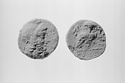
| Mold for bearded head (Pan?)with shaggy hair.
Chip missing at right.
Green-buff clay.
Cf. Fuchs (1963), Mahdia, pl. 53. ΜΣΤ-ΜΖ*
C 17 Great Drain; gravel below elliptical drain tiles. 411 Leica ... 8 May 1947 |
| The hair is drawn up into a bow-knot on the top of the head (or is this actually a bow?), and is gathered at the back in a plain projecting .
Earrings. Hair indicated by straight and crosswise grooves ... 15 July 1947 |
| Fragment preserving upper part of face.
Beetling brows; nose and mouth askew; pierced eyes.
Considerable remains of white, with red over.
Smooth blond-buff clay. N.-S. Trench VI; Late Roman fill. 510 Leica, ... 21 July 1947 |
| Edge of large Medusa mask with short curling individual locks of hair plus parts of two curling snakes preserved.
Outer piece, roughly triangular; broken on two edges.
Cf. T 2920, T 2925. On foundation ... 6 April 1949 |
| Part of male thigh.
Metal impression.
Slightly micaceous cinnamon clay.
ADDENDA T 2924 consists of two fragments (a,b) but they were not from the same mould. They were catalogued on one card, but now ... 19 April 1949 |
Preserved is a leg in low relief, and two paws.
Metal impession.
Slightly micaceous cinnamon clay.
ADDENDA T 2924 consists of two fragments (a,b) but they were not from the same mould. They were catalogued ... 19 April 1949 |
| Nude male figure, seated right, on the stepped base of a herm, leaning against the pillar, and looking back left. His cloak beneath him; left arm on bent left knee, right arm at side, the hand holding ... 19 April 1949 |
| Uncertain subject.
Heavy fabric, reddish-brown at back, light cream on surface.
Flat back; broken all around.
Architectural (?). In trench through marble chip floor, House F, Room 4. Leica ... 1 June 1949 |
| Original edge preserved at top.
Left side of a cow head. Delicate modeling of mouth, eye area, and muscles around jawline.
Perhaps a Rhyton? N.W. of building D 1; layer a; early Roman fill. 1145 Leica ... 19 March 1948 |
| Hole at 57/ΛΣΤ = Pottery Dump at 57/ΛΣΤ. May well have accumulated on the spot where it was found, its fragmentary state being attributable to the later rubble wall laid over it.
Cf. also P 19982 (ΟΟ ... Ca. 400-375 B.C. |
| Pyre /Burial (?) disturbed, in the area of the Poros Building west of the Areopagus. In northeast corner of room 4 west.
Concentration of artifacts, tiny slivers of bone, and burning in a layer of fill ... Early 4th c. B.C. |
Great Drain fills, including "packing over elliptical tiles" and "gravel fills". The central drain area covered by the sections below; other sections are with other deposits. Coins:
9 May 1947 #2-#5
16 ... 1st c. A.D. |
This is associated with Building A. It had a circular marble well-head with a rectangular well slab beneath. The construction throughout was of well tiles. It produced little to a depth of -8.60m. Between ... 4th c. A.D. |
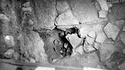
| Pottery dumb beside wall of the Poros Building. Deposit D 17:6 ... north Horizontal (normal) ... 14 Jun 1949 |
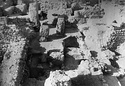
| South central area, showing pit with pottery dumb at lower left. Deposit D 17:6 ... north Horizontal (normal) ... 14 Jun 1949 |
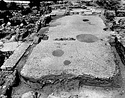
| Mosaic hall (Room A2) ... north 4329 Horizontal (normal) ... 23 Jul 1968 |
| Two joining fragments of base and lower wall; no finished edge.
Wheelmade, translucent, dark yellowish -brown. Thin-walled shallow bowl with narrow ribs and slightly concave base. Two narrow horizontal ... 14 July 1947 |
| Single piece of base and lower wall; no finished edge.
Wheelmade; colorless, with pale green tinge. Thin-walled shallow bowl with narrow ribs, flat base.
Context early 1st century AD. Added 9 July 2001 ... 14 July 1947 |
| Single piece of rim and upper wall. (Dropped and broken by Records office in August 2003. Now mended from several fragments.)
Blown glass, translucent yellowish-brown. Slightly everted rim, ground. Vertical ... 14 July 1947 |
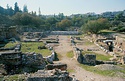
| Civic, Possibly Commercial Unknown Limestone Poor, foundations and lines of walls ... Mid 5th B.C. |
| Two joining fragments give part of bottom and start of wall.
Group of shallow grooves at outer edge of bottom.
Pale greenish glass with dark blue laminations, appearing as dark blue blobs, inside and out ... 15 July 1947 |
| Handle and immediately adjacent part of wall only preserved.
Projecting thumb-rest and two spurs on handle.
Pale green glass. ΛΖ-ΜΣΤ* Great Drain, gravel. Early Roman. 1067 Leica ... 15 July 1947 |
| Piece of dark brown glass with creamy striations. North-South Trench VII, north-east corner of latrine.
4th c. B.C. fill. 562, 1042 Leica ... 4 August 1947 |
| Fragment from plain rim of open bowl.
On inside lip, bounded by two grooves, with notched ridge below lower one. Smaller sharper groove lower down.
Moulded glass. For context see Hesp. 20 (1951), p. 183 ... 22 April 1948 |
| High base and part of side preserved.
No pontil but roughish on bottom. Walls thin rapidly to top.
Dark green glass. Bubbles and spirals. Slight iridescent; no other weathering. Fill of 5th or 6th c. A.D ... 23 April 1947 |
| Two fragments from a very small very thin-walled vase, mould-blown, with a pattern in low relief. Small horizontal handle (this common mould-blown type, usually has two handles, occasionally one, Stern, ... 20 April 1949 |
| Broken into five pieces and very fragmentary.
Inscribed. From the "dump". Store in ziplock polyethylene bag and in area with 40% r.h. or lower.
Wear cotton or latex gloves when handling. Do not bang around ... 25 October 1947 |
| Complete except for chip from head.
Large-headed hook (if right angle in shaft is original); otherwise a nail.
Head flat. Shaft rectangular in section, tapering to a point, now bent. N.W. room, Poros Building, ... 7 June 1949 |
| Squat truncated pyramid.
The stub of a projecting pin (for handle or attachment ?) on the bottom. M. Farnsworth reports that although the material is bronze, it appears to contain more lead than is usual ... 15 May 1939 |
| Athens ... Sv. 23.47--49; Kleiner 1976, pl. 3:52, 53 (Type 7)http://thetis.agora/id/agora/notebookpage/ΟΟ-17-63 Coin no. 2. Great Drain ΛΖ-ΜΣ, gravel. Found with P 33818. Head of Athena r., wearing Attic helmet ... ca. 196--190 B.C. |
Pergamon ... Municipal coinage. Coin no. 9. Great Drain ΛΖ-ΜΣ, gravel. Found with P 33818. Bust of Athena l., wearing aegis and Corinthian helmet. [πEPγAMHNωN] Asklepios stg., facing, with staff. 717, 1064, 3316 ... Ca. 197-133 B.C. |
| Inscribed fragment.
The left part of a crowning member for a monument with recessed niche, and with horizontal cornice, not pediment.
Broken at right; top roughly picked with front sloping down and small ... 30 April 1947 |
| Inscribed fragment.
Inscribed face, left edge and back preserved.
Nine lines of the inscription preserved.
Pentelic marble.
Cf. I 10 and related. Found in late Roman context in a well southwest of the ... 22 July 1947 |
| Inscribed fragment.
About half the circumference preserved of a small round column with mouldings (chipped away) below the flat top. On top part of the round dowel hole is preserved.
Letters below the ... 5 May 1949 |
|
|