|
|
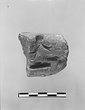
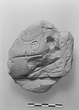
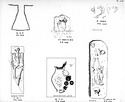
| First interpretation: Mold signed fragment.
Broken at left and chipped along outer edge at top.
Preserved is a male figure, bearded and partly draped, reclining on a couch and playing the double flutes, ... 27 March 1939 |
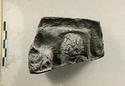
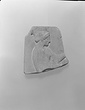
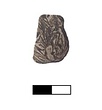
| Fragment from mold for upper left corner of high relief; depressed frame.
Relief widens towards bottom of fragment.
In the positive, upper front part of head in profile left; above it a thyrsos, horizontally, ... 1949 |
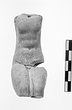
| Nude male figure.
Mended from six fragments. Head and arms missing; with holes for attachment; lower legs missing, and large part from left side.
Traces of white.
Buff clay.
ADENDA Cf. Delos IV, pp. 26 ... 1949 |
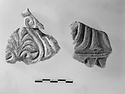
| Moulded corner fragment, perhaps from an altar.
Leaf band in relief along edge. Top (or bottom) plain.
Hearts of leaves painted alternately red and black with reserved slits down centers; a red and a black ... 22 June 1939 |
| From one side of a heavy mould, apparently from a plaque of shallow relief, with the curving rim of the mold preserved. Byzantine fill at S.E. corner of section. Leica ... 30 April 1947 |
| Fragment from a thin flat circular plaque; preserved is the upper part of a lotus flower ornament in low relief, within a raised band. Above (around) the band, a series of triangular projections.
Apparently ... 8 July 1947 |
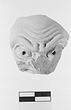
| Fragment preserving upper part of face.
Beetling brows; nose and mouth askew; pierced eyes.
Considerable remains of white, with red over.
Smooth blond-buff clay. N.-S. Trench VI; Late Roman fill. 510 Leica, ... 21 July 1947 |
| In fairly high relief, the upper part of a female figure, right, her head slightly bent, her arms outstretched from the elbows (the hands missing). She wears a thin chiton which covers her arms to the ... 19 September 1947 |
| Nude male figure, seated right, on the stepped base of a herm, leaning against the pillar, and looking back left. His cloak beneath him; left arm on bent left knee, right arm at side, the hand holding ... 19 April 1949 |
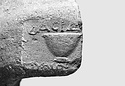
| Rectangular stamp broken off at right; bowl at centre, line above and below. Finished Drain; at level of change from red to green sand. Θασίων̣
vaseIX
Πυθίων̣ [Λυ] 1776 Leica ... 9 June 1939 |
First half of 5th c. B.C. |
Well, neatly stone-curbed to bottom. Diameter 0.70m. The use filling, from about 3.50m to bottom, consisted chiefly of water-jars with a few small vases and some black-figured fragments.
Upper filling, ... Use filling of ca. 575-550 B.C. |
Second half of 6th c. B.C. |
Ostrakon deposit, sand fill in a shallow channel in bedrock at the bottom of the Great Drain in the valley between the Areopagus and the Hill of Nymphs.
This group of ostraka may well come from a single ... Ca. 490-480 B.C. |
| Different plans and sections. Top row: in ΠΘ, storage pit (Deposit B 14:5); in ΓΓ inhumation of a child, (Deposit E 19:2); Protoattic oinochoe fragment P 13284. Bottom row: in ΓΓ inhumation of a male (Deposit ... E. Brann (PD 1040, PD 1053) Piet de Jong (PD 434, PD 435) John Travlos (PD 1065 a, b) ... PD 1053 PD 1040 PD 435 PD 434 PD 1065-a PD 1065-b no grid for Q 17:6; Horizontal (normal) ... 1958 |
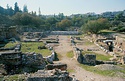
| Civic, Possibly Commercial Unknown Limestone Poor, foundations and lines of walls ... Mid 5th B.C. |
| Piece of dark brown glass with creamy striations. North-South Trench VII, north-east corner of latrine.
4th c. B.C. fill. 562, 1042 Leica ... 4 August 1947 |
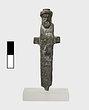
| Complete.
Bearded head with low polos-like cap.
Herm ends below in a spike.
Cf. Hesperia 90 (2021), p. 399, n. 112. Μικροσκοπική χάλκινη Ερμαϊκή στήλη. Σχεδόν ακέραια. Great Drain, sand fill; dump. Stoa ... 12 August 1947 |
| Broken into five pieces and very fragmentary.
Inscribed. From the "dump". Store in ziplock polyethylene bag and in area with 40% r.h. or lower.
Wear cotton or latex gloves when handling. Do not bang around ... 25 October 1947 |
|
|