|
|
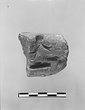
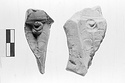
| First interpretation: Mold signed fragment.
Broken at left and chipped along outer edge at top.
Preserved is a male figure, bearded and partly draped, reclining on a couch and playing the double flutes, ... 27 March 1939 |
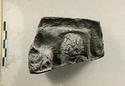
| Fragment from mold for upper left corner of high relief; depressed frame.
Relief widens towards bottom of fragment.
In the positive, upper front part of head in profile left; above it a thyrsos, horizontally, ... 1949 |
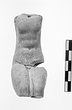
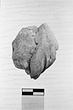
| Nude male figure.
Mended from six fragments. Head and arms missing; with holes for attachment; lower legs missing, and large part from left side.
Traces of white.
Buff clay.
ADENDA Cf. Delos IV, pp. 26 ... 1949 |
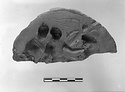
| Broken off below.
An impression made by pressing a heavy lump of clay against some circular object, presumably a mirror-cover.
The upper part of the scene is preserved; three figures and a hovering Eros ... 3 May 1939 |
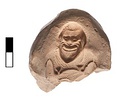
| The upper part of a mold for a bearded figure with mask-like head, wearing a speckled garment (Papposilenus).
He is bending forward and clasping some object (wine-skin ?).
Careful work.
Fine pinkish clay ... Publication: before 350 B.C. |
| Preserved is the upper part of a nude female figure in relief , her right arm outstretched, her left arm hanging at her side. A child's figure leans on her left shoulder, as if standing on something beside ... 28 May 1947 |
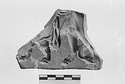
| The legs and the part of the body of a lion or panther walking right. Animal leg with drapery falling over is preserved, suggests it had rider (who perhaps holds a staff?).
Part of the lower edge preserved ... 29 May 1947 |
| Seated male figure, nude to the waist and draped below; long hair curling to his shoulders; his left arm rests on a large round object (part of mold missing).
Preserved edges on both sides, but a large ... 30 May 1947 |
| The shell mold made; the underside and the legs stuck on by hand; vent-hole beneath. The legs are turned down, not out.
Complete except for head and one leg broken off.
No traces of color.
Pinkish clay ... 23 July 1947 |
| Lower part broken off. Surface inside somewhat cracked.
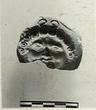
Mold for relief Gorgon head, with snail-shell curls around the face, and two snaky loops rising from the hair at the center above.
Pinkish clay ... 24 April 1940 |
| Mold for the mid-part of a standing male figure, probably an actor.
One edge preserved; the other chipped away.
Broken off top and bottom.
ADDENDA Cf. Hesperia 20 (1951), p. 274. This filling is associated ... 1 August 1947 |
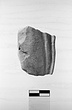
| The right shoulder of a large draped figure; drapery over shoulder.
The arm broken off below. House H, Room 10, Brown fill, mixed Hellenistic; 4th. to 2nd. B.C. 5545, 5568, 5582 Leica, 80-9-29 ... 22-24 July 1947 |
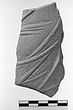
| Broken across the top, about at the knee, and at one side.
A fall of heavier drapery at the side.
Extremely fine engraved lines and carefully stepped chiton-hem. House H, Room 12, loose brown fill; 4th ... 4 August 1947 |
| Part of a draped figure, perhaps a thigh with drapery over it.
Buff slip, white paint.
Blond clay; pinkish surface. House N, Room 12, loose brown fill; 4th. to 2nd. B.C. 5889, 5899, 5911 Leica, 80-9-26 ... 4 August 1947 |
| Part of bottom, with edge projecting below, and of the right side preserved.
On the front, the leg of a table and part of a long bench under it.
Attachment hole through the plaque, under the bench.
Broken ... 13 August 1947 |
| Fragment a), part of the body of a large standing draped figure, the drapery drawn tight in rather shallow diagonal folds.
One edge preserved.
Fragment b), a second fragment appears to belong, and gives ... 11-12 August 1947 |
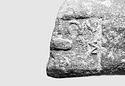
| Curve fragment.
Rectangular stamp; club. Finished Brown early Roman fill. [Θασ]ίων
club Αἰ
[Βουλ]ή̣κριτο | ς Leica ... 16 May 1947 |
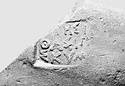
| Curve fragment.
Rectangular stamp; no device.
early Thasian. Finished Fill with broken tiles between wall and drain. [Κ]τ̣ησι
Θασίω(ν)
Σκύμ(νος) 4863 Leica ... 31 May 1947 |
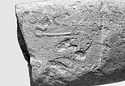
| Curve fragment.
Rectangular stamp; kantharos(?) and kyathos. Rdg: dev: vase(AB)* Finished Cleaning late brown fill. Θασίων
ladle
device
[ Ἀ]ρι[στο]κλῆς 1733 Leica ... 17 May 1939 |
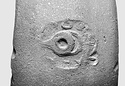
| Wide, heavy handle.
Highly micaceous red clay.
Stamp: “alpha”. Hellenistic fill in corner of retaining walls. ΑΔ (Α,Δ lig, inc) 5015 Leica ... 13 June 1947 |
| Handle complete.
Edges of stamp not struck; symbol, lamp(?), with letters around.
Early Thasian. Brown 4th century B.C. fill with marble chips. Δι | κηκ̣[ράτης Φειδι]π̣πο(ς) Θασι(
lamp ... 20 June 1947 |
| Small square stamp with three lines; no device.
Early Thasian. Finished Brown 4th century B.C. fill with marble chips. Κτησι(
Θάσ̣ι̣ο(ν)
Μ̣[ύλ]λ̣ο(ς) 5064 Leica ... 20 June 1947 |
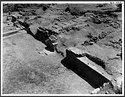
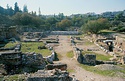
| Southeast corner of the Aiakeion after removal of the Hellenistic fill. Front foundation of the South Stoa II in lower left ... south 3424 Horizontal (normal) ... 29 Jul 1960 |
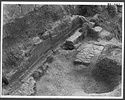
| West side of the building. Modern masonry supports remains of the aqueduct (marked "XX") ... northeast 3436 Horizontal (normal) ... 29 Jul 1960 |
| Poros Aqueduct at the southwest corner of the "Heliaia" (now identified as the Aiakeion). Foundation for south wall of the "Heliaia" in middle right ... southwest 3447 Horizontal (normal) ... 29 Jul 1960 |
| Late Roman Fortification Wall overlying the foundations of the Propylon. Arrows mark the corners of the Propylon. A) Fragment (I 4720m) from the Bouleutic list of 304/3; B) Dedicatory statue base, I 4850; ... I 4850 and I 4713 were found in section ΘΘ. (SD) east 227 Horizontal (normal) ... 6 Jun 1959 |
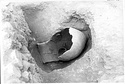
| RSY Grave 51.
The grave lay on the slope of the Areopagus in Roman house O, just east of the line where the hillside is scarped for the foundation of the west wall of the house.
Cutting:the pit cut in ... Archaic period/6th or 7th c. |
Well in house R of industrial area west of the Areopagus. This well, originally tiled, was abandoned and filled at the time of the conversion of the house into a stone-cutters' workshop.
Tiled well but ... Ca. 425-400 B.C. |
A supplementary fill dumped when the original had settled ... To ca. 390 B.C. |
Tiled well (diameter 0.78, water level -3.50m) at 65/Κ (64/Κ) with poros wellhead. Built as early as 2nd c. Post-Herulian filling.
Tiled well, tiles 0.60m high ... 4th-5th c. A.D. |
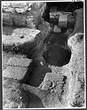
Well at 63/ΙΒ (in House H, Room 15). Upper fill mixed Hellenistic to 2nd c. or later. Probably thrown in in Early Roman times when House H was built. Contained many figurines; probably part of Koukla factory ... 12 August 1947 |
Byzantine pottery begins after 4.70m.; above that Roman.
Diameter 0.92m; water level -5m. Tiled well; height of tiles 0.62m ... Byzantine re-use of Roman well. |
Marble Chip Fill at 67-69/ΚΑ-ΚΖ (now C 19:5). Asterisk: C 19:15* |
| Child's grave in House H, Room 14. At left, wall between Rooms 12-14. The skull of the child is inside the pithos (P 19737). Deposit C 19:1 ... This grave was not found in the enclosed area of the cemetery. (SD) west 6005 ... 1947 |
| Civic, Possibly Commercial Unknown Limestone Poor, foundations and lines of walls ... Mid 5th B.C. |
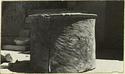
| Drum of well tiles, intact when removed; one tile broken and repaired.
Normal type with hand-holes and thickened upper rim. Red clay.
Scratched on the top of the rim of each tile: /Α. Well; the third drum ... 11 August 1947 |
| Small pieces missing. Rim slightly thickened above and below.
Large square lifting hole set near one edge. Well, Fill 4, late 5th century B.C. (earliest tiled well in the Agora). 6999 Leica ... 18 October 1947 |
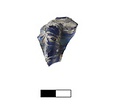
| From the wall of a moulded bowl, ribbed outside.
Blue and white striations. Brown fill. Early Roman level over Roman drain in area west of Areopagus. 4555 Leica ... 16 May 1947 |
|
|