|
|
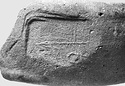
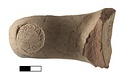
| Curve fragment.
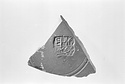
Rectangular stamp, two lines, separated by a horizontal; right side and lower edge not struck. Finished Brown fill. arrow
ΑΘ or ΛΟ (AB) Leica ... 14 April 1939 |
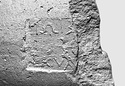
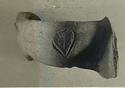
| Curve fragment.
Left end of stamp only; device, cluster; letter above and below; retrograde. Par: cf Bon 1957, nr 1396, p350 for spelling(VG i.76)*Msc: no such Th
word in Agora or Pridik 1917(i.e. w/out ... 3 May 1939 |
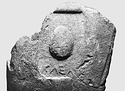
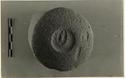
| Long fragment; whole handle.
Rectangular stamp0 with egg or pine-cone at centre; letters above and below. Par: cf type of =Kleufw^n= (sic) w/ mask - Th 92 etc(VG 30.vi.54)*
Msc: however there is nothing ... 30 April 1940 |
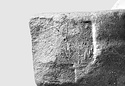
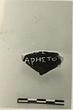
| Rectangular stamp with down-curve; on end, chipped away. Rdg: does not seem to match anything on file(VG)* Finished West terrace, layer I. [---]όφων 2760 Leica ... 9 May 1940 |
| Circular stamp, letters around; no symbol. Finished West terrace, layer VII. Ἐπὶ Θρασυδάμου
dot?
(in O) 2792 Leica ... 18 May 1940 |
| Complete handle, with finger hollow at its base.
Heart-shaped stamp; double axe; no letters. West terrace, Triangle; layer IV, south; 420-390 B.C. double axe (in heart) Leica ... 23 May 1940 |
| Small round stamp with uncertain symbol. West terrace, layer V, south, lowest red fill. Γ device (in O) 3014 Leica ... 24 May 1940 |
| Toe of an amphora preserved.
Unglazed, brownish-buff clay.
In circular depression on bottom, an almond-shaped gem stamp; a herm in relief.
Cf. P 26445. West terrace, south end; early fill, layer IV ... 17-24 May 1940 |
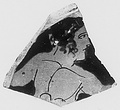
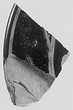
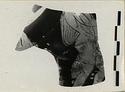
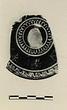
| Part of medallion: upper part of body frontal, and head to right of youth; white wreath. Reserved band on underside. Partial relief contour. Ring foot broken off. Provenience unknown. Leica ... 1949 |
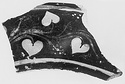
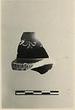
| From edge of one-half of a double disk or bobbin(?). Around outside, a branch with berries in added red. Within part of uncertain scene. Underside reserved, reddened. Relief contour. Either near Civic ... December 1953 |
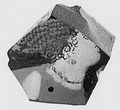
| Head and shoulders of woman, right; peplos, earring, necklace, knitted(?) sakkos. No relief contour. Added clay for ornaments; white for flesh; the dress once painted in an added color.
Pinkish-buff ... (1953) |
| Two joining fragments give half the circumference of the rim with part of the neck and the flat shoulder. Heavy rolled rim; a moulded ring about the middle of the neck. Lip, ridge and shoulder set off ... 1948 |
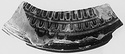
| Rim fragment from a large plate, neatly moulded. Part of ring foot with flat resting surface reserved. On rim, between reserved bands, ivy wreath, the leaves reserved, the stems and berries white. Late ... 1949 |
| Single fragment preserving part of foot and floor. Thick high moulded ring foot with broad flat resting surface; the foot glazed inside and out, the resting surface reserved. On the floor, towards the ... 1949 |
| Joins P 19126. Fragment of a red figure kylix mended from five pieces. Outside: Komos. Two youths to right; both have loose himatia, the left one a stick. Head, neck, shoulders, arms, feet of first youth ... 1949 |
| Broken all around; wall fragment from an amphora. Man riding a horse; the horse's mane between his hands; a rein in his right hand.
Dull glaze; buff clay.
Some resemblance to P 18567, but that is glazed ... 1951 |
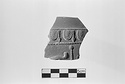
| Fragment of pyxis lid(?); domed top decorated with a rinceau in thin clay paint. The edge of the broad projecting flange reserved and stamped with an egg pattern.
Good black glaze inside and out; brownish ... 14 March 1939 |
| A single fragment preserves part of the flat top and plain downturned rim; knob handle broken off. Unglazed beneath. Around base of handle, tongue and dot pattern; around outer edge of top, egg pattern ... 30 March 1939 |
| From the floor of a bowl; double groove around floor; stamp in center:
Graffito on bottom:
Western Sigillata. Brown gravelly fill. Leica, 93-41-2, 93-41-3 PD 1172-7 ... 1 April 1939 |
| Fragment from a bowl or open pot; broken all around; glazed inside. Outside, moulded decoration: large egg and dart band in relief; below it, a star on a pole, and an animal's tail(?).
Thick fabric of ... 1 April 1939 |
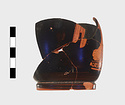
| Two joining fragments from upper wall of bell krater. Preserved: upper half of draped female figure, right, face missing; edge of egg band around handle attachment. Stray; picked up in section. Leica, ... 16 August 1941 |
| Flat angular lagynos handle, ribbed down the middle, and part of narrow round neck preserved.
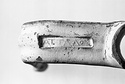
Stamped on top of handle: Α Τ Τ Α Λ Ο Υ
Buff clay with pink core; heavy white slip over all, somewhat peeled ... 24 June 1946 |
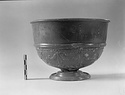
| Mended from several fragments; about half of body missing. Moulded foot; short stem; shallow convex body; high straight rim with out-turned lip. In relief on body: boukrania with pendent ribbons, garlands ... 20 July 1946 |
| Fragment from wall of coarse unglazed amphora.
Incised on outside: West Terrace, layer I, late Hellenistic fill. 2760 Leica ... 7-9 May 1940 |
| Part of ring foot and center of floor preserved. Round stamp at center of floor: bird, right, in relief.
Pinkish-buff clay, somewhat grayed (by burning?); poor black glaze, inside only.
ADDENDA Knidian ... 13-14 May 1940 |
| From the bottom of a small black glazed cup with fine ring foot.
Incised inside: Dump, probably from late 5th. c. fill at south end of West Terrace. Leica PD 1133-6(D 42) ... April-May 1940 |
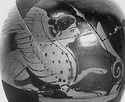
| Mouth and pieces of body missing; mended from many fragments. Restored in plaster. Ring foot; round body. Raised moulding at base of neck. On front of body, a winged sphinx, sejant, right, with one paw ... 17-24 May 1940 |
| The bell mouth, neck, handle, and upper body at one side preserved. Raised band at base of neck; grooves around neck. On front, a winged sphinx, sejant right. Lower body and legs missing. Careless drawing ... 17-24 May 1940 |
| Fragment from front of body, with base of neck. At front, a winged sphinx, sejant right. Part of uncertain object in front of her. West Terrace, south end, early fill, layer IV. 3017 Leica ... 17-24 May 1940 |
| Mended from several pieces; part of body, foot and shoulder preserved. Protome, with female(?) head, right, wearing a tall cap. In front of her, a floral ornament. West Terrace, south end, early fill, ... 17-24 May 1940 |
| Single fragment from body. Female protome, right, with necklace. Floral ornament in front. Much worn. Little inner drawing shows. West Terrace, south end, early fill, layer IV. 3017 Leica ... 17-24 May 1940 |
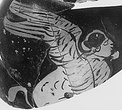
| About half of body, from lower neck to just above foot preserved; fragments missing at front. Winged draped figure, a Nike, flying right. Carelessly drawn. West Terrace, south end, early fill, layer IV ... 17-24 May 1940 |
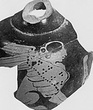
| Part of neck and about half of body preserved, with missing pieces. Nude male winged figure flying right, holding a bit of drapery in right hand. Traces of ornament in thinned clay paint in front. West ... 17-24 May 1940 |
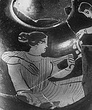
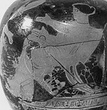
| Full height preserved; neck missing, and body fragmentary. A draped woman, seated, right, in a chair, to whom a nude winged youth presents a wreath. To right below, Eros. Remains of band of eggs under ... 17-24 May 1940 |
| Nine pieces make up to two non-joining fragments.
a) Handle, part of neck and of body with heads of two figures.
b) Foot and nearly half of body.
Tongue pattern on lower neck; egg pattern as ground line ... 17-24 May 1940 |
| a) Most of body and lower part of handle, pieces missing.
b) Non-joining mouth and upper neck.
Restored in plaster.
Tongue pattern at base of neck; egg pattern as ground line. Draped woman left, seated ... 17-24 May 1940 |
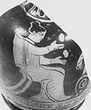
| Fragment preserving foot and one side of body up to base of neck. Tongue pattern at base of neck; egg pattern ground line. Draped woman, seated right, juggling two balls. Part of standing draped figure ... 17-24 May 1940 |
| Full height preserved, more than half of body missing. Restored in plaster. Upper part of draped woman right; hanging object behind her head; shapeless reserved space, still further back. West Terrace, ... 17-24 May 1940 |
| Nine joining pieces preserve handle, lower neck, about one-quarter of body and part of foot. Restored in plaster. Tongue pattern at base of neck; egg pattern as ground line. A draped standing woman, right, ... 17-24 May 1940 |
| Four joining fragments preserve part of neck, lower mouth and shoulder. Tongue pattern at base of neck. Heads and upper parts of two figures facing each other preserved: at right, a draped woman; at left ... 17-24 May 1940 |
|
|