|
|
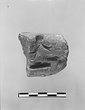
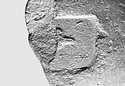
| First interpretation: Mold signed fragment.
Broken at left and chipped along outer edge at top.
Preserved is a male figure, bearded and partly draped, reclining on a couch and playing the double flutes, ... 27 March 1939 |
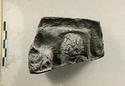
| Fragment from mold for upper left corner of high relief; depressed frame.
Relief widens towards bottom of fragment.
In the positive, upper front part of head in profile left; above it a thyrsos, horizontally, ... 1949 |
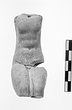
| Nude male figure.
Mended from six fragments. Head and arms missing; with holes for attachment; lower legs missing, and large part from left side.
Traces of white.
Buff clay.
ADENDA Cf. Delos IV, pp. 26 ... 1949 |
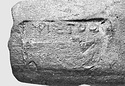
| Rectangular stamp, lower part not struck; symbol across middle.
Cf. Pridik (1917), pp. 41, 54, nos. 112, 411, pl. VII, 22, 23. Par: for dev cf Pridik 1917, Pl 7, 22, 23 (text 54,411 and
41,112)(VG)* Finished ... 6 May 1939 |
| One end of rectangular stamp with device (bird on wing) at centre. Finished Fill II. [Θα]σ̣ί̣ων
bird on wing
[ Ἀρισ]το̣φά(νης) 156 Leica ... 24 April 1940 |
| Part of rim of double handle preserved.
Rectangular stamp with thunderbolt; stamped on one half.
Cf. SS 609. Corpus no. 730. Fill II. thunderbolt 161, 228 Leica ... 30 April 1940 |
| Broken into five pieces and very fragmentary.
Inscribed. From the "dump". Store in ziplock polyethylene bag and in area with 40% r.h. or lower.
Wear cotton or latex gloves when handling. Do not bang around ... 25 October 1947 |
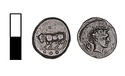
| Gela ... Χάλκινο: Γέλα 5ος αιώνας π.Χ. Coin no. 1. Casts. Black fill of gravel and broken stereo. Horned head of river god r.; behind, wheat grain. Border of dots. ΓΕΛΑΣ above
Bull walking l. In exergue, three ... Ca. 420-405 B.C. |
Late Hellenistic-Early Roman |
| Inscribed fragment.
Part of the top preserved, and perhaps part of the right side.
Four lines of the inscription preserved; stoichedon.
Space between lines, two including: 0.027m.
Space between letters, ... 6-11 February 1939 |
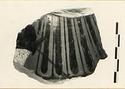
| Small fragment from shoulder.
Head of Athena to right; tongues. Landscaping operations in the excavations; exact provenience unknown. Leica ... January 1955 |
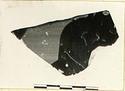
| Broken all around. Unidentified representation from reverse of Panathenaic amphora. Agora excavations. Leica ... 5 February 1962 |
|
|