|
|
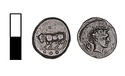
| Gela ... Χάλκινο: Γέλα 5ος αιώνας π.Χ. Coin no. 1. Casts. Black fill of gravel and broken stereo. Horned head of river god r.; behind, wheat grain. Border of dots. ΓΕΛΑΣ above
Bull walking l. In exergue, three ... Ca. 420-405 B.C. |
Megara ... Coin no. 1. Hoard IGCH 157. Hard red earth with cinders south of Southern pier. MEγ below Prow l. Tripod between two dolphins upward; border of dots ... second quarter 3rd century B.C. |
Megara ... BMC 21-29 Coin no. 6. Great Drain to south; sand. Prow l. ΜΕΓ? between
Two dolphins swimming r. in circle. Border of dots. 1482, 1786, 8004 ... last half or third of 4th--early 3rd century B.C. |
Megara ... BMC 30-34.
[Kleiner 1976, p. 19, no. 142.(A-B 19-20:1)] Coin no. 5. Great Drain to south. Sand fill (Hellenistic). MEγA above Prow l. Tripod between two dolphins upward; border of dots. 1486, 8004 ... Second quarter 3rd century B.C. |
| Athens ... Sv. 24.58, 59 Casts
Coin no. 7. Great Drain to south. Sand fill (Hellenistic). Head of Athena r., wearing Corinthian helmet. Α/Θ between. Two owls stg. l. and r., facing; all in olive wreath. 1486, 8004 ... ca. 270 B.C. |
| Pit (6x10) in the valley between the Areopagus and the Hill of the Nymphs. Large cutting in bedrock with 540 ostraka, mainly of the late eighties of the 5th. c. B. C. Much pottery, principally of the early ... Ca. 500-450 B.C. |
| Pyre(?) in House N, S.W. Room. (=House C, Room 10)
In room 10. Vessels from an earlier pyre were found dispersed in the makeup of the latest "floor" in the room, with tile fragments trodden into its surface ... First quarter of the 4th c. B.C. |
Well K: PG, ELS ... Protogeometric |
Pits ( A 19:3, A 19:4, A 19:5, A 19:6 in area 96-100/ΝΕ-ΝΘ (lower east slopes of Hill of the Nymphs, near extreme west edge of excavated area).
Sometimes called as "Pit 2". Pit with reddish black fill ... 350-300 B.C. |
Pits in area 96-100/ΝΕ-ΝΘ (lower east slopes of Hill of the Nymphs, near extreme west edge of excavated area).
Pit with bones. Many fills in areas A 19 and A 20 similar in character to the fills in these ... 350-300 B.C. |
Pits in area 96-100/ΝΕ-ΝΘ (lower east slopes of Hill of the Nymphs, near extreme west edge of excavated area).
Scanty debris filling in a pit. Many fills in areas A 19 and A 20 similar in character to ... 325-300 B.C. |
Pits in area 96-100/ΝΕ-ΝΘ (lower east slopes of Hill of the Nymphs, near extreme west edge of excavated area).
Shallow pit in bedrock against N. face of wall. dMax. depth 0.20m.d.
Many fills in areas ... Ca. 325-300 B.C. |
Early cutting beside Great Drain: 103-111/Λ-ΛΓ (= "Deep cutting" Pit at 107/ΛΑ).
Abandonment filling in channel for early drain; the fragment of a red figured bell krater, P 17000, probably to be dated ... Ca. 425-395 B.C. |
| (RSY=Pyre 2). Pyre in the industrial area west of the Areopagus, in House B. In northern corner of room. No pit discerned. A deposit of small stones (a marker/) lay 0.30m above the level of the pyre, ... Third quarter of the 4th. century. |
| A compact group of four complete vases and a lamp, found on a house floor; possibly the remains of a sacrificial pyre but without evidence of burning or the characteristic votive vases.
Layer II, "nest ... 425-400 B.C. |
E.L. Smithson: Group H: Collapsed well west of the Great Drain.
First described as 105-107/Protogeometric Pit ... Protogeometric |
Fills from construction and reconstruction of a house. "Brown House" = House A (RSY Hesp. 20) (and pit under Layer 4) in the industrial area west of the Areopagus.
Under the original floor of this house ... Second half of the 5th. c. B.C. |
Scanty debris filling in a pit. The wishbone-handled bowl (P 16753) is of the middle of the third quarter of the 5th. c. century, as are also two red figured fragments, P 25820 and P 25821; the deposit ... Ca. 450-400 B.C. |
Grave (?) under wall 4. Infant burial(?); a kados, P 16747, lying sideways with a tall cylindrical stand, P 16748, set over it as a cover; the upper parts of the pots cut away ... Late 6th. c. B.C. |
Fillings to either side of the Great Drain, in the southern part of the area west of the Areopagus; various levels, late 6th. and early 5th c. B.C. to Sullan destruction. Coins:
26 July 1946 #1-#2
30 July ... Late 6th. c. B.C.-1st. c. A.D. |
|
|