|
|
House N, room 6=House T: Pit with Kalikia in Room 2W. Roughly rectangular pit, length 7.10m., possibly dug to obtain clay for flooring in nearby houses ... Ca. 500-480 B.C. |
| Pyre in House N, room 2, layer 5 (RSY=Pyre 8).
Near northern corner of room 6. Artifacts, bone, burnt logs, and cinders in square pit dug from level of layer 5, through layers 5 and 6; thin clay floor ... 325-300 B.C. |
| Pyre in House N, room 4 (RSY=Pyre 7), in the industrial area west of the Areopagus.
Pottery, mall pieces of calcined bone, log, wood cinders, and charcoal in diamond-shaped pit in floor sequence. The pyre ... Late 4th-early 3rd c. B.C. |
House N, Room 4: Fillings in and over floors (Layers 7 and 8). Lower level probably antedating the building of the Great Drain in this area; the upper level apparently contemporary with remodeling of the ... 425-400 B.C. |
Fillings below the courtyard floor of the Poros Enclosure west of the Areopagus. The lowest layer, over bedrock, is of the archaic period and may have accumulated on the spot before the start of building ... First half of 5th c. B.C. |
Surface layer ... First half of 5th c. B.C. |
Pit in floor of House S ... Geometric to mid-5th c. |
| Located in House H, Room 13 on the lower northwest slope of the Areopagus ... Late 2nd c. B.C. |
House R, fill under drain tiles and fillings associated with house K in industrial area, including what was C 19:15, plus C 19:16 and
C 19:17.
a) House built as dwelling in second half of 5th.c.
b) Used ... Ca. 5th and 4th c. B.C. |
Well P: EG ... Middle Geometric |
RSY Grave A.
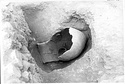
Under the Roman House with three rooms floored with mosaic near the southwest side of the area. The burial consisted of a pot laid on its side over the bedrock, presumably containing a child ... 7 August 1947 |
House N, Room 4, Pit through layers 5-6. Debris filling, mixed context. Estimated Grid ... Late 4th. c. B.C. into early 3rd c. B.C. |
Deposit in the industrial area west of the Areopagus, underlying a Roman bath. Pottery examined in June 1955; latest pieces noted: one fragment Pergamene and one fragment brittle ware; no certainly post-Sullan ... Late 2nd c. B.C. |
Well M: EG, under the south court of the Poros Building.
Hesperia 20 (1951), p. 144 (noted) ... Middle Geometric |
Great Drain sand fill under Roman bath including small area at north end under tiles that was excavated separately.
See also A-B 19-20:1 for additional Great Drain sand fill at ca. 70-113/* Subdivisions: ... 30 July-11 August 1947 |
Coins:
30 July 1947 #3-#11
31 July 1947 #4-#19
1 August 1947 #1-#9
4 August 1947 #1-#20
5 August 1947 #3-#20
6 August 1947 #1-#38
7 August 1947 #1-#21
8 August 1947 #1-#41
9 August 1947 #3-#6
57-59/*
66-67/* ... 28-31 July 1947
6-9 August 1947 |
| RSY Grave 51.
The grave lay on the slope of the Areopagus in Roman house O, just east of the line where the hillside is scarped for the foundation of the west wall of the house.
Cutting:the pit cut in ... Archaic period/6th or 7th c. |
Well, unfinished?
The shallow depth, small diameter, lack of water and any use fill make it possible that this was not a well, although the character of the cutting is difficult to explain otherwise. The ... Ca. 440-420 B.C. |
Well in house R of industrial area west of the Areopagus. This well, originally tiled, was abandoned and filled at the time of the conversion of the house into a stone-cutters' workshop.
Tiled well but ... Ca. 425-400 B.C. |
A supplementary fill dumped when the original had settled ... To ca. 390 B.C. |
|
|