|
|
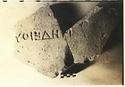
| Inscribed fragment.
Original rough picked back and inscribed surface preserved; broken elsewhere.
The letters follow a curved line.
Below second line of letters the same curve can be followed, below which ... 4th. century B.C. |
| Brown clay, containing much coarse grit. Stored with ἀγνωστα.
Dim: W 0.052*Rdg: prhps %tri?* Propylon, drain cut, disturbed surface. Δ Leica ... 5 April 1935 |
| Dolphin right.
Early Thasian. Dte: prhps Period I(VG 19.xi.52)*
Par: closely resembles type of =DAMASTHS-DEWFANHS=, but is apptly not
the same? (cf =O= before =L=)(VG)* Finished Disturbed area. [Θ]ά̣σι̣ο̣[ν] ... 5 April 1935 |
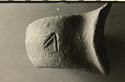
| Inscribed fragments.
Back and both sides broken, under surface worked, though unevenly; apparently the projecting crowning moulding of a stele.
Fragment from monument which apparently represents in miniature ... (Ε 83) 9 February 1932
(Ε 444) 6 April 1935 |
| Fragment of columnar grave monument.
Badly weathered and broken away below.
Six letters remain.
Hymettian marble. Found in modern wall, over the central part of the Odeion. Leica, XXXVII-85 ... 4 April 1935 |
| Inscribed fragment.
Inscribed face and back preserved; elsewhere broken away.
A protuberance from the upper part of the block has been broken away also.
Eleven letters remain.
Hymettian marble. Found in ... 5 April 1935 |
| Inscribed fragment.
Inscribed face and back preserved.
Two lines of the inscription preserved.
Pentelic marble. Found in late Roman context, over the central part of the Odeion. Leica ... 6 April 1935 |
| Inscribed fragment.
Broken at top, bottom, and right.
The inscribed face is slightly concave.
The left edge and part of the back at right angles to the left edge is preserved.
Eight letters of the inscription ... 4 April 1935 |
| Inscribed fragment; twice used as Ionic capital.
Originally the crowning block of a small monument or stele, on the front face the projecting moulding is preserved, and below a curved line marking the ... 2nd.-3rd. centuries A.D. |
| Inscribed fragments.
Fragment Ξ 329 a), inscribed face only preserved.
Red paint still in the letters.
Four lines of the inscription preserved.
Fragment ΘΘ 275 b), inscribed face only preserved. Inscribed ... a) (Ξ 329) 6 April 1935
b) (ΘΘ 275) 8 June 1937
c) (ΒΒ 32) 5 October 1938 |
| Three fragments, two large, and one small of a monument.
Fragments Ο 552 a-b), two joining fragments, one of which preserves part of the bottom of the monument. Inscribed on a convex surface.
On fragment ... 5 April 1935 |
| Inscribed fragment.
Fragment from capping course of grave monument.
Part of undercut edge preserved, below; otherwise broken.
Parts of six letters remain.
Pentelic marble.
ADDENDA With I 2757 (?). Found ... 6 April 1935 |
| Inscribed fragment.
Inscribed face only preserved.
Parts of nine letters remain.
Hymettian marble.
ADDENDA I 3687 belongs. Found in the foundation of the modern house Q, about 20.00m. southwest of the ... 6 April 1935 |
| A: two standing figures, Athena at right, Nike holding a wreath at left.
Border of dots. Two illegible countermarks.
B: plain.
May 2002-some surface disintegration Two other tokens from the same fill ... 6 April 1935 |
| Two joining fragments. The letters large, neat and deep.
Pinkish to buff clay with particles. The stamp is retrograde.
ΜΗΔΕΙΟΥ series. Debris of Burnt Building. Leica ... 4 April 1935 |
| Metroon series. Debris of Burnt Building. Leica ... 4 April 1935 |
| Obverse : illegible.
Reverse : Bakkhos ring
Cf. Svoronos (1923), class VIII, pl. 102, no. 30. Originally entered as coin no. 1. Footing trench of Hellenistic Metroon. Leica ... 4 April 1935 |
| Curve fragment.
Rectangular stamp; in centre amphora. Dim: W 0.04* Finished Turkish fill. Θασίων
vaseII
Χοῖρος Leica ... 6 April 1935 |
| Relief surface and right edge preserved. Broken elsewhere.
The head and shoulders of a man with face in profile to the left remain. On the right edge, towards the back, the beginning of the top molding ... 5 April 1935 |
| Rounded convex body merging with rim which is slanted inward and grooved on its upper surface. Fairly long nozzle.
Bluish-black glaze inside and out.
Type 24A of Agora collection, type V (second variety) ... Late in 3rd. quarter of 5th. century B.C.-400 B.C. |
|
|