|
|
From a circular mold for Medusa mask with a heavy rim.
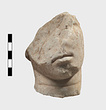
Preserved is part of a cheek with short windblown hair above.
Fairly fine orange pink clay.
Joins T 429.
The two fragments as joined give a good ... 28 March 1933 |
Broken off at the middle of the neck.
The head (priest of Isis type ?) is bald, and his ears stand straight out from his head. The line of a veil which passes over the crown of his head and down his neck ... 30 March 1933 |
Broken above, below and at the back; the edge of the mold preserved at one side.
Heavy features; large eyes; the hair parted in the middle, and drawn in waves down to the neck.
Hollow. No traces of color ... 30 March 1933 |
Broken all round.
A small face with very large features. Eyes deeply punched. Over the hair, which is indicated by ridges around the brown is worn a veil (?) with a row of dots along its front.
Mould-made, ... 30 March 1933 |
Broken off at the neck.
Heavy features. The hair is worn in a broad braid looped up at the back in the manner of the end of the second and the beggining of the 3rd c. A.D. (cf. coins of Crispina N 6438) ... 28 March 1933 |
Face of figurine.
Broken at the back.
Hollow. Remains of white on the eyes.
Light red clay, with red wash.
Type of a priest of Isis (?) Μ-ΜΘ* N.W. trench, north end. Leica ... 30 March 1933 |
| Inscribed fragments.
Fragment Ζ 313, broken all round; face dressed with toothed chisel.
Inscribed stoichedon.
Another fragment (Π 152), joining the first, with four lines of inscription, stoichedon ... (Ζ 313) 28 March 1933
(Π 152) 22 February 1935 |
| Inscribed fragment.
Broken on all sides; surface polished.
One letter and parts of two others deeply and carefully cut.
Pentelic (?) marble. Found in late Roman fill, east of the Tholos. Leica ... 30 March 1933 |
| Fragment from right side of inscribed stele.
Broken at the top; the left side broken and later worked or worn smooth. In the bottom a rough picked cutting, leaving a raised band at the front and left, ... Ca. 280-275 B.C. |
| Inscribed fragment.
Broken on all sides.
List of names; "POLETAI" record.
Nine lines of the inscriprion preserved.
Fine grained bluish-white marble. Found in a marble pile, in the northwest corner of the ... Early 2nd. century B.C. |
| Inscribed fragments.
List of names; "POLETAI" record.
Fragment Ζ 331 a), inscribed fragment.
Broken on all sides.
Nine lines of the inscription preserved, with a space between the fourth and fifth.
Fragment ... First half of 4th. century B.C. |
Fragment of columnar grave monument.
Broken all round.
Five letters preserved in one line; parts of two in the line above.
Hymettian marble. Found in a marble pile, in the northwestern part of the Market ... 28 March 1933 |
Inscribed fragment from the top of a large stele or monument (?).
Top rough picked; bottom hacked away, behind a beveled front edge; sides and back broken.
Inscribed in two lines, below a decorated band ... 2nd. century A.D. |
| Broken on left end, finished with anathyrosis on right end; rough picked on back; very rough worked on bottom. The thickness at the front is less than that at the back.
At the right end on the under side ... 30 March 1933 |
Inscribed fragment of top of small grave stele.
Sides and top smooth picked; back rough picked.
Two lines of the inscription and part of a third preserved.
Hymettian marble. Found northeast of the Civic ... 2nd.-1st. centuries B.C. |
Inscribed fragment from right side of stele.
Broken at top, bottom, and left; back rough picked, side smoothed.
Surface damaged, especially at the right edge of the inscription.
Parts of nine lines of ... Early 2nd. century B.C. |
| Upper right corner of inscribed block.
Top and bottom preserved, and part of the right edge.
Traces of five lines of the inscription preserved.
Hymettian marble. Found in a modern cellar wall of the house ... 28 March 1933 |
| Inscribed fragment.
All sides broken except the bottom which has a rough picked surface.
Inscription on profile.
The lower edge of the inscription has a beveled edge, and the single line of the inscription ... 30 March 1933 |
| Inscribed fragments.
Fragment Ι 187 a), broken on all sides.
The face of the inscription is rough picked.
Part of two lines of the inscription preserved, and of one letter in a third line above.
Fragment ... Ca. 20 A.D. |
| Inscribed fragments.
Two fragments, which join, preserve the width and thickness of the stele; broken at top and bottom.
Tapering lightly toward the top. Sides smooth picked; back rough.
The upper part ... 155/4 B.C. |
|
|