|
|
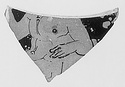
| Piece shows considerable curvature. Part of male figure seated left. Head, shoulders and legs of figure missing; also most of right arm which is bent at elbow and raised. Relief lines.
Attic clay, unglazed ... 3 May 1932 |
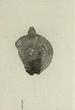
| Top part and right side of a lamp preserved. End of nozzle, and most of left side of lamp broken away.
On rim, ring of small dots between ridges.
Discus, sharply sunken round central filling hole; radiating ... 3 May 1932 |
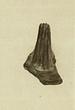
| Fragment of top of multiple nozzled lamp with central handle.
Only the triple grooved, pierced handle is preserved, with a small bit of the top, with parts of two oil holes.
Unglazed.
Pinkish-buff clay ... 3 May 1932 |
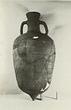
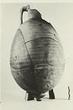
| Small fragments of body missing; restored in plaster. Somewhat warped and discolored in firing. Flaring mouth, narrow neck, horizontal grooves on upper part of elongated ovoid body. Rounded bottom ending ... Early 4th. c. A.D. |
| Mouth, one handle, and some of neck and body missing; body restored in plaster. Narrow neck, inverted egg-shaped body with horizontal ribbing. Rounded bottom with profiled knob. Short broad handles.
... 3 May 1932 |
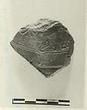
| A single fragment, broken all around, preserves some of the floor of a plate(?). Stamped in a zone marked off inside and out by a pair of grooves is a lion facing right and part of a palmette.
Pinkish-buff ... 3 May 1932 |
| Well ... Δ-3 447, 448 Δ 384 P 707 Δ 385 P 708 Δ 386 P 709 Δ 387 P 710 Δ 388 P 711 Δ 389 P 712 Δ 390 Δ 391 Δ 392 Δ 393 Δ 394 Δ 382 I 231 Δ:1932.0428:1 N 12607 Δ:1932.0428:2 Δ:1932.0428:3 Δ:1932.0428:4 F 15:1 F 16:2 ... 248-328 A.D. |
|
|
.jpg.icon.jpg)
