|
|
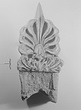
| Full height preserved; width and thickness of the antefix preserved, the cover tile broken off at the back.
The nine-petalled palmette, in low relief, rises from an acanthus bed; below this decoration ... 24 May 1933 |
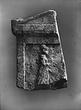
| The fragment is from the upper left corner of a probably inscribed pedimental stele. No letters are preserved; the figure of Athena, facing right, is broken away below the knees. She wears a chiton girded ... 25 May 1933 |
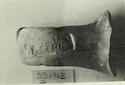
| Broad handle with short arched upper part.
Coarse red clay; peeling light slip.
Impression complete all round; herm. Study: Die 1*
Par: SS 00239, SS 00824; Dumont 1871, p302, nr 12, 14* Agora. Sct Η', ... 26 May 1933 |
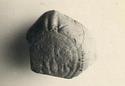
| Little or no slip.
Impression incomplete above and worn; same die as SS 843. Par: same die as SS 00843* Middle Stoa Building Field; Hellenistic filling. With SS 1711 ( Θ 1480). [ Ἐπὶ] Ε̣ὐκρά(τευς)
Θευφείδε(υς) ... 24 May 1933 |
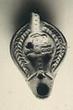
| Complete.
Wavy lines on the rim; plain discus; handle solid, triple grooved above and double below. A small band of hatching sets off the rim from the nozzle.
On the reverse, double almond-shaped groove, ... 24 May 1933 |
| Fragment from back part; the start of the single grooved handle preserved, part of the wall, and a bit of the rim with the ends of several raised lines belonging to the decoration.
Double circular groove ... 25 May 1933 |
| Back part of top preserved.
Herringbone on rim; solid handle, double grooved. Shaggy dog, with tail upraised, stands to right. Filling hole above.
Unglazed.
Pinkish-buff clay.
Type XXVIII of Corinth collection ... 25 May 1933 |
| Complete save for chip at tip of handle.
Herringbone on rim; pear-shaped discus, with jewelled Christian cross; tail of "rho" to right; three filling holes between the arms of the cross.
Handle solid, ... 26 May 1933 |
|
|