|
|
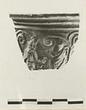
A bearded head, wearing a high modius.
Broken off at the top of the neck.
The back shows only a few wavy lines to indicate the hair. The front is in much greater detail. Finished flat top of modius preserved ... 19 June 1933 |
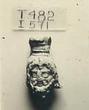
| Broken off at the ankles and the neck.
The left arm rests on the thigh, the right arm across the bosom.
Traces of white paint. Buff slip.
Fine pinkish clay. Attalos Stoa, Shop X, footing trench for stoa ... 19 June 1933 |
| Inscribed fragment.
Broken all round.
Traces of two lines of the inscription preserved, much damaged.
Pentelic marble.
ADDENDA Joins with I 1647, I 1748, I 1768, I 1806. Found in marble dump, north of ... Ca. 30-20 B.C. |
Inscribed fragment.
Broken all round.
The inscribed surface shows a convex horizontal curve, and has two deep horizontal grooves.
Pentelic marble. Found in late wall, over the Propylon to the New Bouleuterion ... Ca. 170 A.D. |
| Inscribed fragment.
Broken away on right side and below.
In the middle of the top, a dowel cutting.
Part of three lines of the inscription preserved.
Hymettian marble. Found in modern foundation, in front ... 4th. century B.C. |
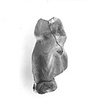
Smoothly broken at base, where it was attached.
Feathers incised on both sides. Rectangular drain.
Middle of 3rd c. A.D. Leica, LIX-63 ... 20 June 1933 |
Rectangular in section throughout.
Broken at pointed end. Bent and pitted. Rectangular drain.
Middle of 3rd c. A.D. Leica, LIX-63 ... 20 June 1933 |
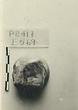
Point and probably much of the shaft broken away.
The head is almost spherical, flattened where it is attached. The shaft rectangular.
A pin or a nail ? Rectangular drain.
Middle of 3rd c. A.D. Leica, ... 20 June 1933 |
| The 'stele' tapers sharply toward the bottom, where it is broken; otherwise complete; nose chipped.
The beardless head wears either a close fitting cap or a coiffure imitated from the archaic; round the ... 20 June 1933 |
| Part of the wall of the vase, with deep vertical "reeding". Outside, above the reeding, apparently a row of raised dots, deeply cut, and a plain rim. Over the reeding a thick hollow bar handle, also ribbed, ... 19 June 1933 |
A fragment from the side and the flaring rim of a small Late Roman bowl. On the upper side of the rim a fish in relief, left.
Red clay; red wash. Red earth. Leica ... 20 June 1933 |
The fragment appears to be the base, solid and like a truncated cone, of a vase.
Inside, in the bottom of the vase is the letter, written in black glaze: Ε
Clay fine pinkish with traces of mica; unglazed ... 19 June 1933 |
| Complete save for chips to rim and base. Wheel ridges around the neck; just below the straight lip a deep groove. One of the handles much bent in the making.
Coarse red clay.
Accidentally broken in ... 19 June 1933 |
Rim fragment of bowl with vertical side and out-turned lip concave above. Two ridges on top of wall. Relief ornament: two figures between trees.
Buff clay; orange-red glaze on outside, brown-red on inside ... 19 June 1933 |
Double convex sides; slightly sunken, plain discus; pierced lug in a sort of "swirl" on one side; blunt nozzle; low ring base with slightly raised center.
Poor black glaze. Wheel made.
Buff clay.
Type ... 20 June 1933 |
Preserved to the tip of the nozzle.
On the reverse, a single circular groove enclosing the signature, with a heart-shaped motif in relief between the letters.
Unglazed.
Pale greenish-yellow clay.
Type ... 20 June 1933 |
| A boy crouches to right, his elbow below his knee. Only a part of his right side, from the flat bottom of the lamp proper to his shoulder, is preserved.
Pinkish-brown clay, with black to reddish-brown ... 19 June 1933 |
Battered fragment of rather small handle.
Fired light clay.
Rather worn losange-shaped impression probably frpm same die as SS 277; attribute like a shoe dole. Par: same die as SS 00277* Under layer ... 19 June 1933 |
Curve fragment.
Greyish-red clay, remains of light slip.
Impression worn down middle; incomplete to right and in lower left corner; short handle.
Cf. Dumont (1872), p. 209, nos. 396, 399. Par: Dumont ... 20 June 1933 |
|
|