|
|
Macedonia ... Alexander III, Kings of Macedonia ... BMCAlexander 338--370.
[Kleiner 1976, p. 16, no. 2. (A--B 19--20:1)]
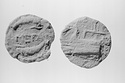
Alexander Α[ΛΕΞ]ΑΝΔΡΟ[Υ] Coin no. 51. Great Drain, sand. Young male head r., diad. AλEχANδPOY above Horse prancing r. 2892, 4476 ... Ca. 336-323 B.C. |
Megara ... BMC 30-34.
[Kleiner 1976, p. 19, no. 151.(A-B 19-20:1)] Coin no. 59. Finished Great Drain, sand. MEγA above Prow l. Tripod between two dolphins upward; border of dots. 2892, 4476 ... Second quarter 3rd century B.C. |
Megara ... BMC 30-34.
[Kleiner 1976, p. 19, no. 152.(A-B 19-20:1)] Coin no. 77. Great Drain, sand. MEγA above Prow l. Tripod between two dolphins upward; border of dots. 2894, 4476 ... Second quarter 3rd century B.C. |
Megara ... Part of coin missing. Coin no. 109.
76-79/* Great Drain, sand. Prow l., on which stands a tripod; in field above, trident. ΜΕΓ?[Α?] between
Two dolphins swimming r. in circle. Border of dots. 2896, 4476 ... Last half or third of 4th--early 3rd century B.C. |
| Megara ... Coin no. 6. House N, Room 3, red fill III C at north. Prow l., on which stands a tripod. ΜΕΓΑ between
Two dolphins swimming r. in circle. Border of dots. 85-11-22 ... last half or third of 4th--early 3rd century B.C. |
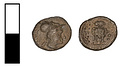
| Myrina (Lemnos) ... Cleaning north well of LRWC I - ΙΘ-ΚΒ. Cleaning north well of LRWC I. Head of Athena r., wearing Corinthian helmet. MYPI (usually upward at l.)
Owl standing, facing; usually at r., a branch. C 130, 85-13-28 ... 386-276/261 B.C. |
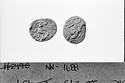
Perperene ... RPC I, 2350 Coin no. 2. Well. [θEAN PωMHN] Bust of Roma, turreted, r. [πEPπE-PHNIωN] Bunch of grapes. 750, 4755, 5411 ... 1st century after Christ |
| Demetrios Poliorketes, Kings of Macedonia ... Mint = Amphipolis or Pella. Coin no. 54. Great Drain, sand. Macedonian shield; in center, BA-ςI Macedonian helmet; uncertain symbol at l. 2892, 4476 85-24-35 ... Ca. 294-288 B.C. |
Demetrios Poliorketes, Kings of Macedonia ... Demetrius Poliorcetes 306-283 B.C. (?)
Prow. Coin no. 63. Great Drain, sand. Head of Demetrios r., wearing Corinthian helmet with horn. Β Α above
Prow r. 2893, 4476 ... 300-295 B.C. |
Coin no. 8. Refuse pit in House Ν, Room 3. 2879 ... 330-300 B.C. or later? |
Coin no. 10. Refuse pit in House Ν, Room 3. 2880 ... 330-300 B.C. or later? |
Coin no. 12. Refuse pit in House N, Room 3. 2880 ... 330-300 B.C. or later |
Aigina ... BMC 206--222.
[Kleiner 1976, p. 19, no. 155.(A--B 19--20)] Weight: chipped
Coin no. 4. Great Drain, sand fill. A between Two dolphins upwards. Incuse square divided into five compartments. 2888 ... 4th--first half 3rd century B.C. |
Megara ... BMC 30-34.
[Kleiner 1976, p. 19, no. 150.(A-B 19-20:1)] Coin no. 1. Great Drain, sand. MEγA above Prow l. Tripod between two dolphins upward; border of dots. 2889, 4476 ... Second quarter 3rd century B.C. |
Megara ... Coin no. 3.
76-79/* Great Drain; sand. Prow l. ΜΕΓ between
Two dolphins swimming r. in circle. Border of dots. 2889, 4476 ... Last half or third of 4th--early 3rd century B.C. |
| A well on the lower slope of the Hill of the Nymphs, (diam. 1.20m -water level -7m), to 7.90m. The scanty use filling at the bottom contained water jars and pitchers as well as the inventoried objects; ... Second quarter of 6th. c. B.C. |
| Cistern in the valley between the Areopagus and the Hill of the Nymphs. Simple, flask-shaped chamber withdraw-shaft; no tunnels. Mouth cut away in Byzantine times. Lower filling, 3rd c. B.C. Coins:
25 ... 25-30 April 1947 |
Rodney Young ... Grave. RSY Grave 50. Outside archaic cemetery on the lower slopes of the Hill of the Nymphs, cremation burial. Roughly square pit (0.80x1.00m). This pit contained a heavy deposit of cinders and ash; its ... Beginning of the last quarter of the 6th century |
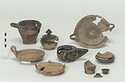
Nb page 5044: Great shapeless pit with a well (62/Ξ) at its bottom which we were unable to dig because it was too dangerous. Fill in the pit was of sand and white ash. The finds and pottery 4th. and perhaps ... Late 4th.-early 3rd. c. |
| Pyre(?) in House N, S.W. Room. (=House C, Room 10)
In room 10. Vessels from an earlier pyre were found dispersed in the makeup of the latest "floor" in the room, with tile fragments trodden into its surface ... First quarter of the 4th c. B.C. |
|
|