|
|
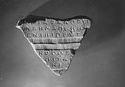
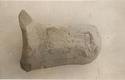
| Fragment from left side of inscribed block.
Left side, tooth chisel marks; front rasp finished.
Rounded edge between. Otherwise, breaks.
Pentelic marble. Found in a marble pile, in the western part of ... 17 March 1932 |
| Small inscribed fragment.
Triangular fragment; three broken edges. Back parallel with front but probably by natural cleavage.
Two lines erased center of fragment.
Bluish-white marble. Found in a marble ... 245-235 B.C. |
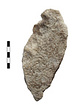
| Inscribed fragment.
Broad surface chip. Appears to be inscribed with a series of plain circles, six of them being preserved in a row 0.082m. long, and another 0.018m. away below the row. Surface weatherd; ... 17 March 1932 |
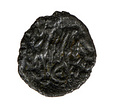
| A: five ears of wheat in wreath.
A lunate epsilon (E) near bottom.
B: plain. Entered as coin no. 5, for the day. With coins nos. 3-5. Leica ... 15 March 1932 |
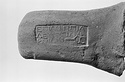
| Typical shape.
Clay fired yellow at surface; otherwise typical.
Impression sharp but not worn down middle; slightly incomplete on lower left(?). Ἐπὶ Ἀσκηπιά (sic)
δευς Νεικία
Κνίδιο caduceus r.
... 15 March 1932 |
| Probably typical; broken at curve.
Typical clay; fired yellow at surface; traces of light slip.
Diamond-shaped impression; sharp. Ἀπολλων | ίου (ΙΟΥ retr)
bee
Κνιδι(
(in diamond) Leica ... 15 March 1932 |
| Shape like Knidian.
Rather coarse pinkish-buff clay; cream slip.
Impression incomplete below; damaged. Ἐπὶ Φιλομβρ
οτίδα Κνί(διον) [Χ]
αρμοκρά
τ[ευς double axe l. in outline]
(Σ lunate) Leica ... 17 March 1932 |
| Slightly concave side of fragment glazed with rather thin and dull black glaze, through which has been scratched in the dry clay the letters:
Other side unglazed.
Attic clay. Leica ... 17 March 1932 |
|
|